
This Tier II ESSA-aligned efficacy study examined the impact of Albert on state ELA performance across 146 high schools in California and Florida during the 2024–2025 school year. Using propensity score matching, 73 schools with sustained Albert ELA use were compared against 73 demographically similar non-using schools, matched on race/ethnicity, student-teacher ratio, free/reduced lunch percentage, prior-year state ELA performance, and school enrollment size.
The two states use different assessments (CAASPP Grade 11 ELA in California and FAST Grade 9 ELA in Florida), so each school's proficiency was standardized within its own state before results were pooled. For that reason, the effect is reported in standard-deviation units rather than as a single percentage-point change.
Schools that used Albert for ELA outperformed their matched non-using peers on 2024–2025 state ELA assessments in both states. The pooled effect is positive and statistically significant across two independent models.
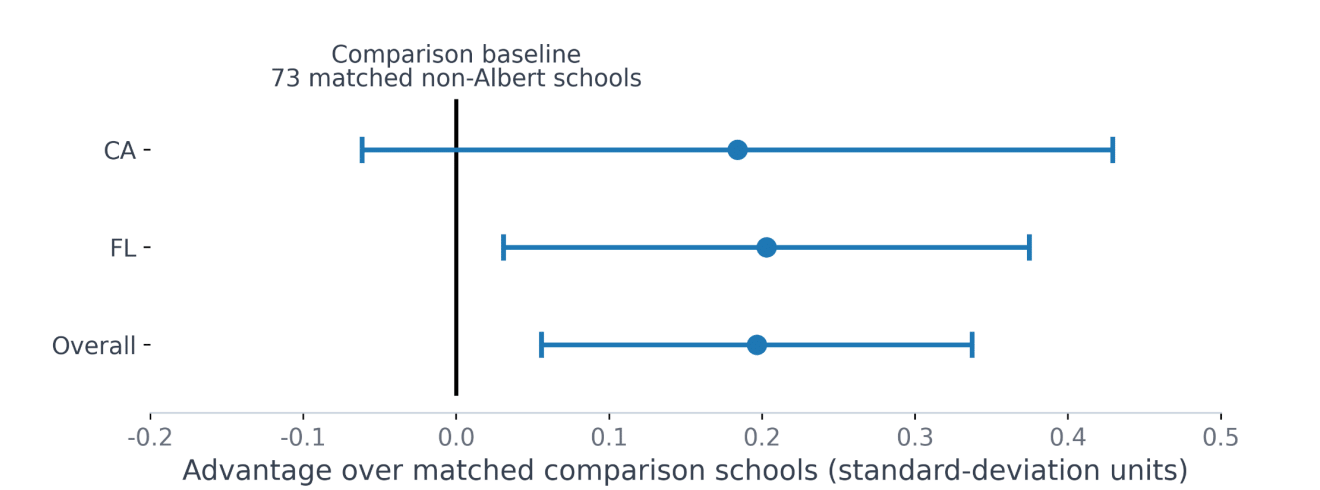
Relative to the comparison schools, which sit at the 50th percentile by definition, the pooled result places the average Albert school near the 58th percentile, a gain of 7.8 percentile points.
The effect was positive in both states examined, and the two states agree closely, with no measurable variation between them. That consistency across two large, independent state assessment systems supports the study's conclusion: schools that make Albert a sustained part of ELA instruction see measurably stronger state assessment outcomes.
For more details on this study and how Albert can benefit your students, click here to learn more.

