
The Sun is about 93,000,000 miles from Earth. A red blood cell is about 0.000008 meters wide. Writing, reading, and calculating with numbers like these is slow and error-prone. Scientific notation compresses them into a short, standard form so you can compare and compute with them quickly.
This article covers Topic 7.3: Scientific Notation in Unit 7, Exponents and Exponential Functions. The topic asks you to convert between standard form and scientific notation, compare values, and multiply and divide numbers written in scientific notation.
By the end, you should be able to:
- Recognize when a number is correctly written in scientific notation.
- Convert very large and very small numbers in both directions.
- Compare and order numbers in scientific notation.
- Multiply and divide in scientific notation and adjust the result to proper form.
What Scientific Notation Looks Like
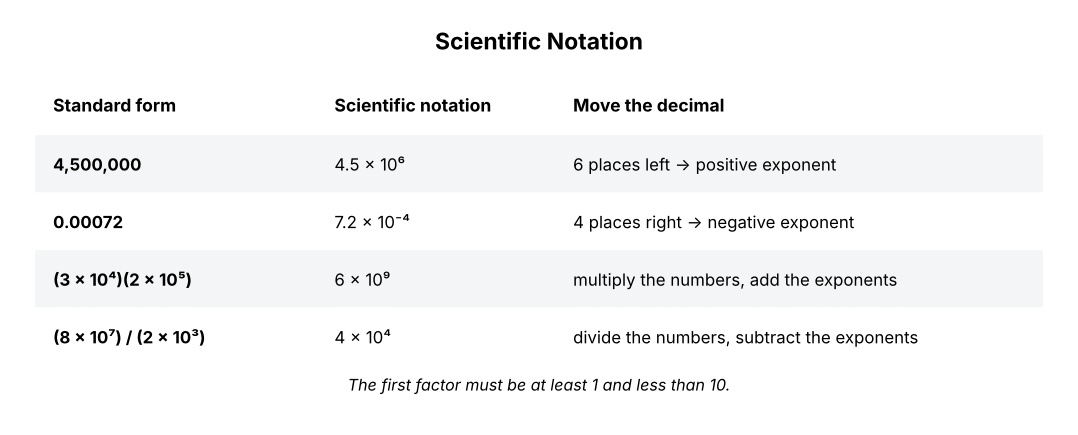
A number in scientific notation has the form \(a\times 10^{n}\), where \(1\le a\lt 10\) and \(n\) is an integer. The first factor, \(a\), is sometimes called the coefficient. The exponent \(n\) tells you how many places the decimal point moved.
| Expression | Proper Scientific Notation? | Reason |
|---|---|---|
| \(9.3\times 10^{7}\) | Yes | The coefficient is between 1 and 10. |
| \(8\times 10^{-6}\) | Yes | Whole numbers from 1 to 9 are allowed. |
| \(12.5\times 10^{3}\) | No | The coefficient is 10 or greater. Rewrite as \(1.25\times 10^{4}\). |
| \(0.7\times 10^{2}\) | No | The coefficient is less than 1. Rewrite as \(7\times 10^{1}\). |
Why does this matter? Multiple-choice items often include a value like \(12.5\times 10^{3}\) that equals the right number but is not in proper form. If the question asks for scientific notation, that choice is wrong even though its value is correct.
Converting Between Forms
Large numbers to scientific notation: Move the decimal point left until one nonzero digit remains to its left. Count the moves; that count is a positive exponent.
- 93,000,000 becomes \(9.3\times 10^{7}\) because the decimal moves 7 places left.
- 4,560 becomes \(4.56\times 10^{3}\).
Small numbers to scientific notation: Move the decimal point right until one nonzero digit is to its left. The count is a negative exponent.
- 0.000008 becomes \(8\times 10^{-6}\) because the decimal moves 6 places right.
- 0.0302 becomes \(3.02\times 10^{-2}\).
Scientific notation to standard form: A positive exponent moves the decimal right, making the number large. A negative exponent moves it left, making the number small. For example, \(6.1\times 10^{-4}=0.00061\).
Comparing Numbers
To compare numbers in scientific notation, look at the exponents first. The larger exponent always means the larger number, as long as both coefficients are positive and in proper form. Only when exponents match do you compare coefficients.
- \(2.1\times 10^{5}\) is greater than \(9.8\times 10^{4}\), because \(10^{5}\) beats \(10^{4}\) no matter what the coefficients are.
- \(3.4\times 10^{-3}\) is greater than \(7.2\times 10^{-4}\), because \(-3\) is greater than \(-4\).
- \(5.6\times 10^{8}\) is greater than \(5.2\times 10^{8}\), because the exponents match and 5.6 is greater.
Multiplying and Dividing
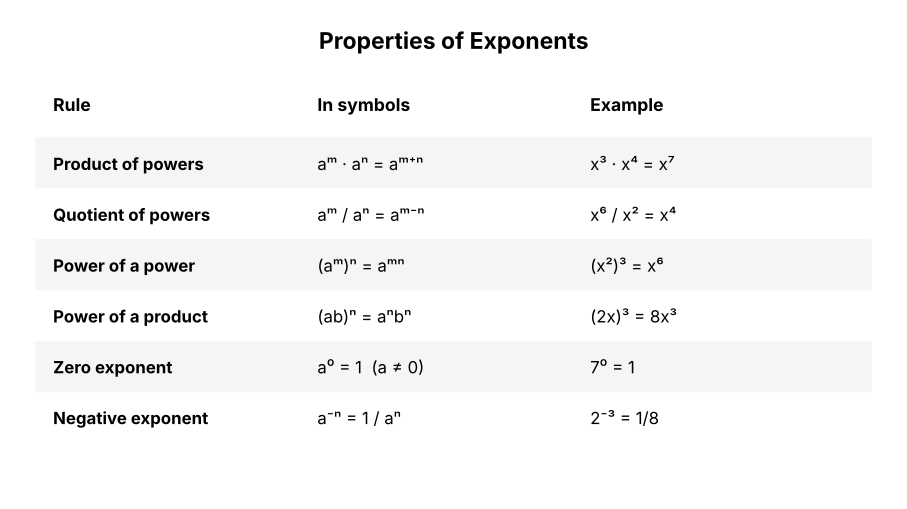
Multiply or divide the coefficients, then use the exponent rules on the powers of ten. Finally, adjust if the coefficient is not between 1 and 10.
Worked example 1: Multiply \((4\times 10^{6})(3\times 10^{-2})\).
- Multiply coefficients: \(4\cdot 3=12\).
- Add exponents: \(10^{6+(-2)}=10^{4}\).
- Result: \(12\times 10^{4}\).
- Adjust: \(12=1.2\times 10^{1}\), so the answer is \(1.2\times 10^{5}\).
Worked example 2: Divide \(\frac{6.3\times 10^{2}}{9\times 10^{-5}}\).
- Divide coefficients: \(6.3\div 9=0.7\).
- Subtract exponents: \(10^{2-(-5)}=10^{7}\).
- Adjust: \(0.7=7\times 10^{-1}\), so the answer is \(7\times 10^{6}\).
Why does this matter? The adjustment step is where most points are lost. When the coefficient grows past 10, the exponent goes up by one. When it shrinks below 1, the exponent goes down by one. Think of it as balancing: whatever you do to the coefficient, you undo with the exponent.
Test-Taking Strategies
Mnemonic Devices and Memory Shortcuts
Use “Big number, positive power. Small number, negative power.” For the adjustment step, remember “coefficient up, exponent down” and the reverse: making the coefficient smaller raises the exponent by the same number of places.
Cross-Topic Connections
- Adding and subtracting exponents comes from Topic 7.1: Properties of Exponents.
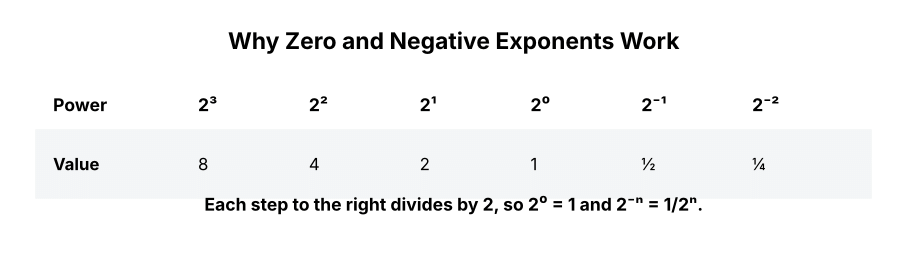
- Negative powers of ten rely on Topic 7.2: Zero and Negative Exponents.
- Rates with huge or tiny values use Topic 2.6: Ratios, Rates, and Proportions.
- Commuting and grouping factors uses Topic 1.3: Properties of Real Numbers.
Common Question Formats
- Convert a value from standard form to scientific notation or back.
- Order three or four values written in scientific notation.
- Multiply or divide two values and express the result in scientific notation.
- Answer “how many times larger” questions, such as comparing planet distances.
Frequent Student Mistakes
- Using a negative exponent for a large number or a positive one for a small number.
- Leaving a coefficient like 12 or 0.7 unadjusted.
- Multiplying the exponents instead of adding them when multiplying powers of ten.
Test-Day Shortcuts
For “how many times larger” questions, divide the two values. If \(6\times 10^{9}\) is compared with \(2\times 10^{6}\), the answer is \(3\times 10^{3}\), or 3,000 times larger. Calculators accept scientific notation with the EE key, so check whether calculator use is allowed.
Time Management Tips
Scientific notation items on Algebra 1 unit tests and end-of-course exams usually take about a minute each. Write the coefficient step and exponent step on separate lines, then do the adjustment last. That three-line habit is fast and prevents the most common errors.