
Have you ever wanted to praise something so much that ordinary words felt too small? Poets have a form for exactly that feeling: the ode. Odes celebrate everything from Greek athletes and nightingales to autumn, the west wind, and even an old clay urn. They are formal, serious, and full of deep feeling, and they rank among the most admired poems in English.
This article covers Topic 2.8: The Ode in Unit 2, Structure and Form. The topic asks you to identify the features of the ode, compare its main types, and analyze how an ode develops its praise into a larger reflection.
By the end, you should be able to:
- Define the ode and describe its typical tone and subject.
- Distinguish Pindaric, Horatian, and irregular odes.
- Recognize apostrophe as a common feature of odes.
- Analyze how an ode moves from praise to reflection.
What Is an Ode?
An ode is a lyric poem that praises or celebrates a person, object, event, or idea. Odes are usually:
- Serious and elevated in tone.
- Addressed directly to their subject, using apostrophe.
- Reflective, moving from description to a larger insight about life, art, or time.
- Carefully structured, often in stanzas of complex design.

The word comes from the Greek aeidein, meaning “to sing.” Ancient Greek odes were performed with music and dance.
Three Types of Odes
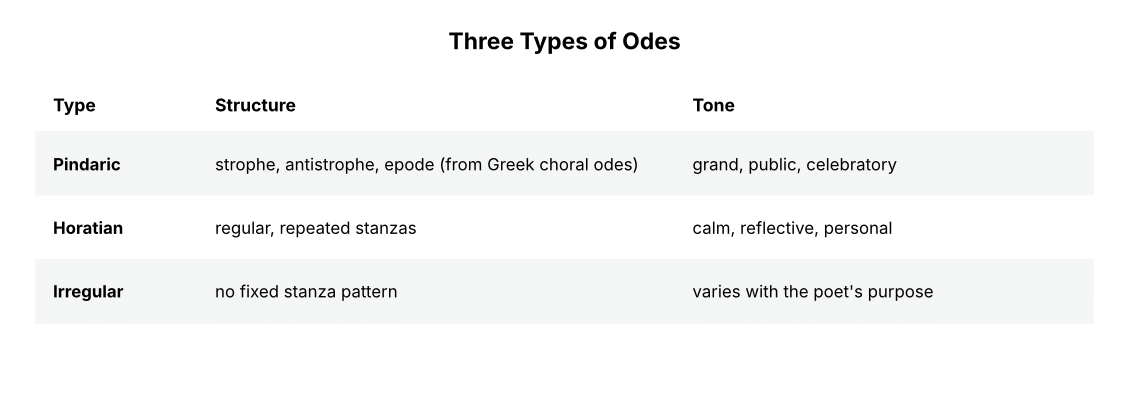
| Type | Origin | Features |
|---|---|---|
| Pindaric | Greek poet Pindar (about 518 to 438 BCE) | Grand and public; written in groups of three stanzas called strophe, antistrophe, and epode; often celebrated athletes |
| Horatian | Roman poet Horace (65 to 8 BCE) | Calmer and more personal; uses regular, repeated stanzas |
| Irregular | English poets, especially from the 1600s on | Freer stanza lengths and rhyme schemes, set by the poet |
Wordsworth’s “Ode: Intimations of Immortality” (1807) is a famous irregular ode, with stanzas of varying length.
The Romantic Odes
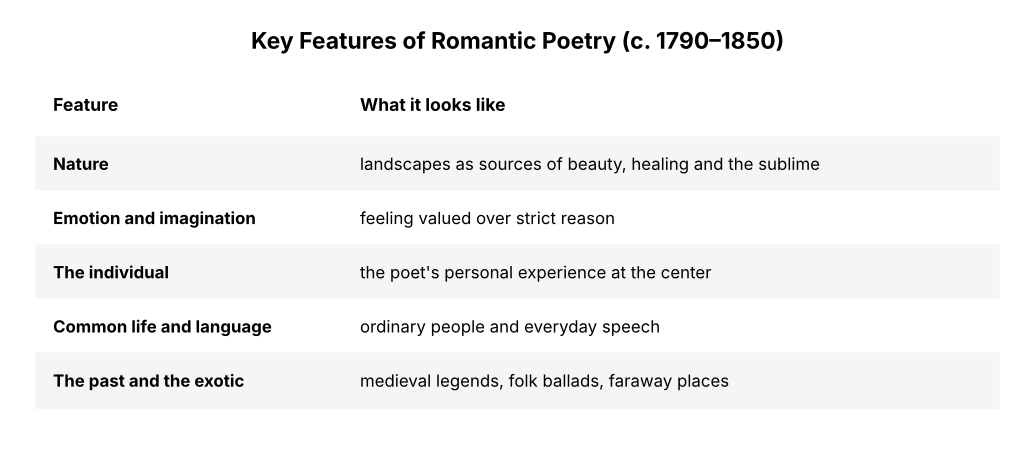
The English Romantic poets of the early 1800s produced some of the most celebrated odes. In 1819 alone, John Keats wrote “Ode to a Nightingale,” “Ode on a Grecian Urn,” and “To Autumn.” Percy Bysshe Shelley wrote “Ode to the West Wind” the same year. It begins with a direct address:
O wild West Wind, thou breath of Autumn’s being,
The “O” signals apostrophe: the speaker speaks directly to the wind as if it could listen. Calling the wind the “breath” of autumn also personifies it, giving it life and power.
Why does this matter? Apostrophe creates intimacy and urgency. Speaking to a subject, rather than about it, makes the praise feel personal and intense, and it lets the speaker plead, question, or wonder aloud.
Worked Example: “Ode on a Grecian Urn”
- Subject: an ancient Greek vase painted with scenes of lovers, musicians, and a village procession.
- Praise: the speaker admires how the painted figures stay forever young and their moments last forever.
- Reflection: the speaker realizes the figures can never complete their actions; the lover can never kiss his beloved. Art is permanent but frozen, while life is brief but real.
- Conclusion: the poem ends with the famous lines “Beauty is truth, truth beauty,” suggesting that art offers a lasting kind of truth.
The ode begins by praising an object but ends by exploring a big question: what lasts, and what is worth more, art or life?
From Praise to Reflection
Most great odes follow a pattern:
- Address the subject directly.
- Describe and praise its qualities.
- Reflect on what the subject reveals about human life, often including a tension or problem.
- Resolve or reach a new understanding.
Why does this matter? Questions about odes often ask how the speaker’s attitude changes or what the subject comes to represent. Tracing the movement from praise to reflection helps you find the theme.
Modern Odes
The ode is still alive. In the twentieth century, the Chilean poet Pablo Neruda wrote a collection of odes to ordinary things, such as onions, socks, and tomatoes. These poems use the elevated, celebratory spirit of the ode to show that everyday objects deserve attention and gratitude. Students today often write odes to favorite foods, places, or people as a way to practice close observation.
Test-Taking Strategies
Mnemonic Devices and Memory Shortcuts
“An ode is an ‘O!’” The exclamation of praise often appears in the first line. For types, remember “Pindar is public, Horace is homey, irregular is individual.”
Cross-Topic Connections
- Odes often belong to the period covered in Topic 4.1: Poetry Through the Ages.
- The speaker’s address is discussed in Topic 1.2: Speaker and Voice.
- Odes rely on vivid detail, as in Topic 3.1: Imagery.
- Stanza design is explained in Topic 2.1: Lines and Stanzas.
Common Question Formats
- Identify a poem as an ode and explain why.
- Explain the effect of apostrophe in the opening lines.
- Describe how the speaker’s view of the subject develops.
- Explain what the subject comes to symbolize.
Frequent Student Mistakes
- Assuming any poem of praise is an ode, even a short, casual one.
- Confusing an ode, which praises, with an elegy, which mourns.
- Stopping at the praise and missing the reflection.
Test-Day Shortcuts
Read the final stanza closely. In an ode, the last stanza usually states the speaker’s deepest insight about the subject.
Time Management Tips
Odes are long, so on English unit tests and standardized reading tests such as the SAT and ACT, skim the whole poem in two minutes, then reread the stanza each question cites.