
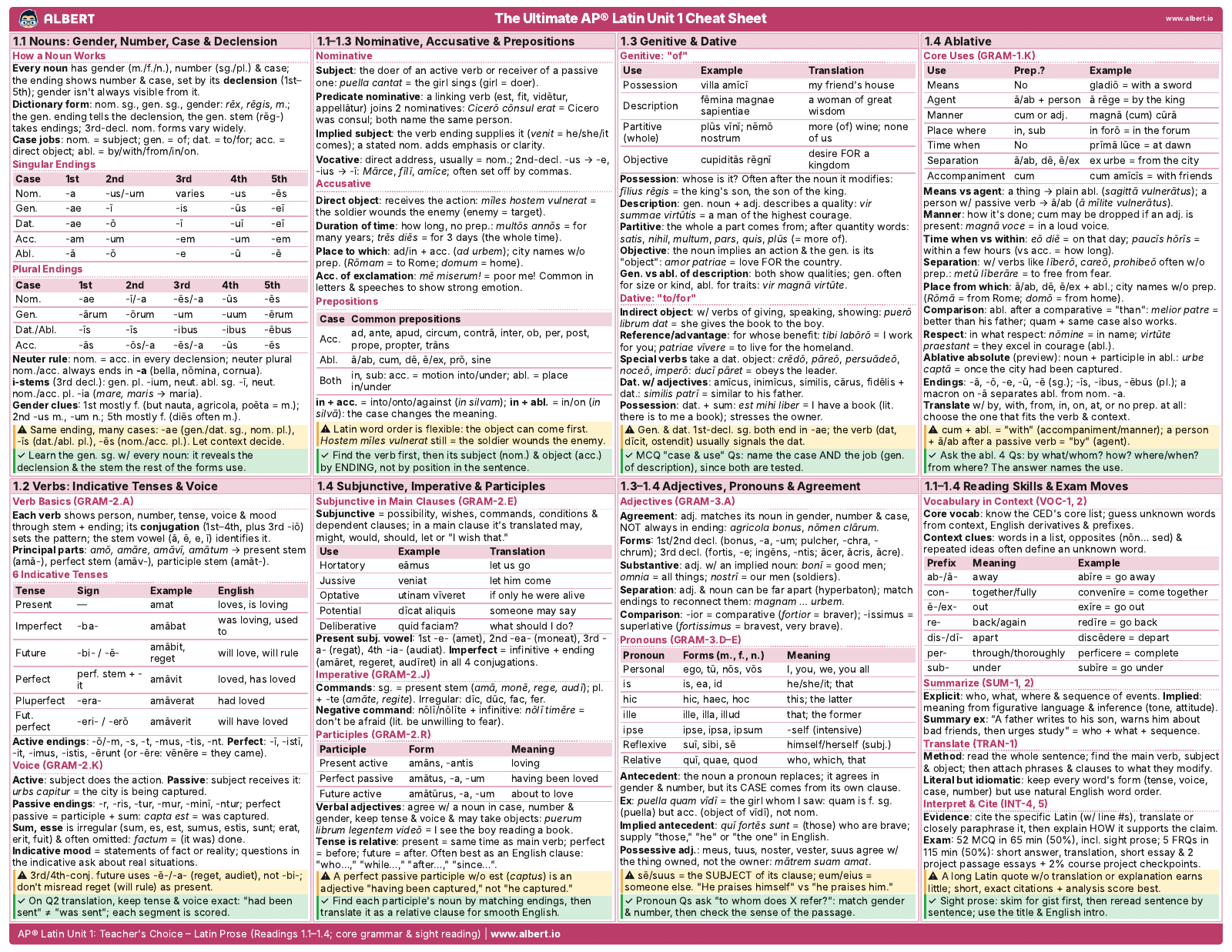
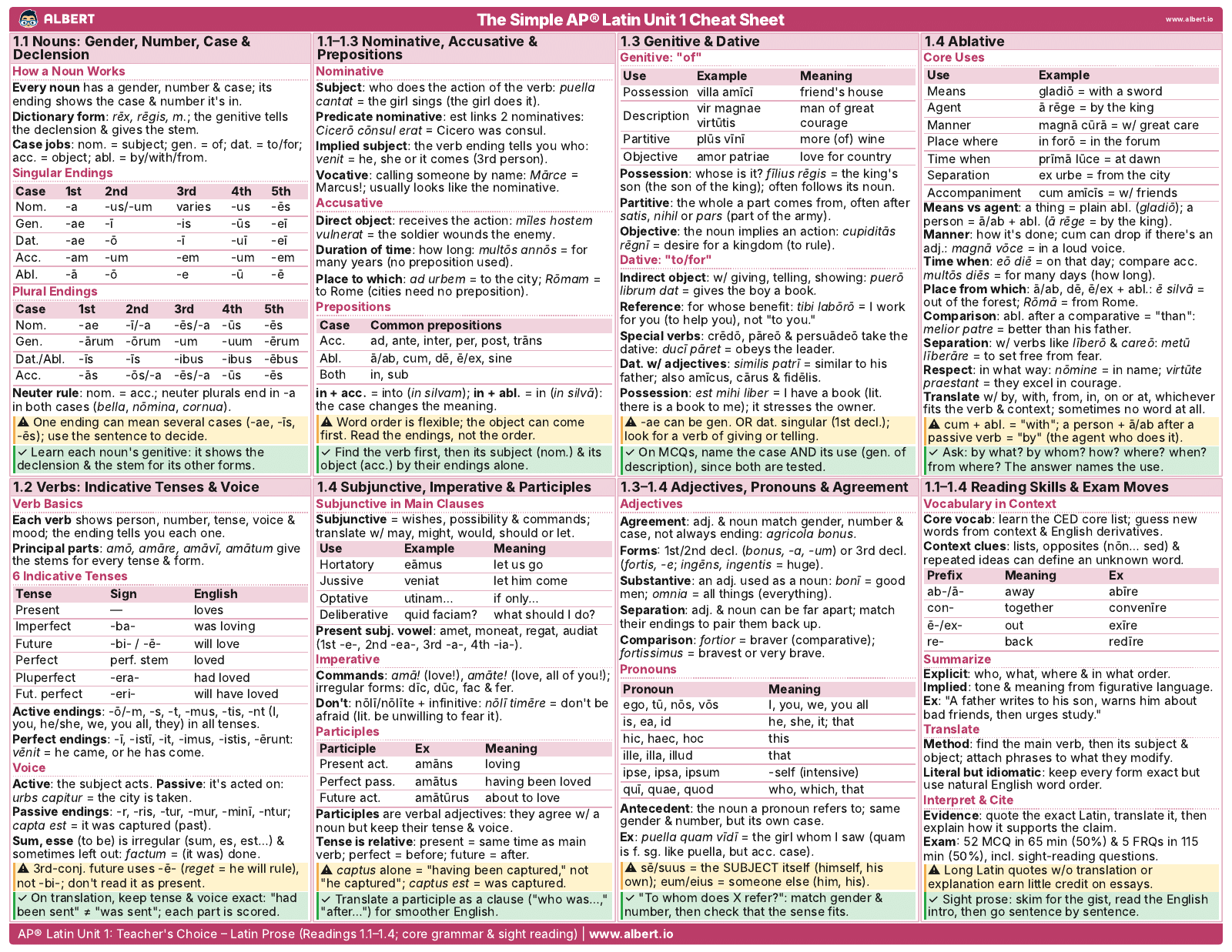
This AP® Latin Unit 1 cheat sheet covers the grammar you need for teacher-chosen Latin prose: all five noun cases, prepositions, the six indicative tenses, voice, the subjunctive in main clauses, imperatives, participles, adjectives, and pronouns. It also covers summarizing, translating, and citing Latin evidence. Unit 1 has no fixed exam weight, but every section of the exam depends on these skills.
Practice AP® Latin Unit 1 questions on Albert
What’s on the AP® Latin Unit 1 Cheat Sheet?
In the AP® Latin Course and Exam Description (effective fall 2025), Unit 1 is Teacher’s Choice: Latin Prose. Your teacher picks about 1,200 words of prose across Readings 1.1–1.4, so there is no set text to memorize. Instead, the unit’s required content is the grammar and reading skills listed for each reading. That is exactly what this sheet organizes.
Both versions have eight cards: noun declensions, the nominative and accusative with prepositions, the genitive and dative, the ablative, indicative verbs and voice, the subjunctive with imperatives and participles, adjectives and pronouns, and reading skills for the exam. Simple gives the core endings and one clear example per use, which suits students coming back to Latin after a summer off. Ultimate adds full ending tables, i-stems, special dative verbs, comparison, the ablative absolute as a preview, every main-clause subjunctive use, and a prefix table for figuring out unfamiliar words.
AP® Latin Unit 1 at a Glance
Unit 1 runs about 16 class periods. The CED doesn’t assign units a percentage of the exam. Instead, Unit 1 builds the foundation for the sight-reading questions, which make up about half of the multiple-choice questions (a mix of prose and poetry), and for every grammar and translation task that follows.
| Reading | Grammar focus (CED) | Skills |
|---|---|---|
| 1.1 | Gender, number, case; nominative subject; accusative direct object; prepositional phrases | Vocabulary, summary, translation |
| 1.2 | Predicate nominative; verb person, number, tense, voice, mood; six indicative tenses; active vs passive | Vocabulary, summary, translation |
| 1.3 | Genitive uses; dative to/for; accusative of duration; pronouns and antecedents | Adds implied-meaning summaries |
| 1.4 | Ablative uses; subjunctive in main clauses; imperative; participles; adjectives | Adds citing Latin evidence for an interpretation |
Key Concepts in Unit 1: Teacher’s Choice: Latin Prose
Nouns, Cases, and Declensions (Readings 1.1–1.3)
Every Latin noun has gender, number, and case, and its ending tells you the case and number. The ending set depends on the declension, which you identify from the genitive singular in the dictionary entry: rēx, rēgis, m. is third declension, and rēg- is the stem. The trouble is that endings repeat. The ending -ae can be genitive singular, dative singular, or nominative plural, so the rest of the sentence has to settle it.
Worked example: Rēgīna ancillae dōnum dat. The verb dat (gives) calls for a dative recipient, so ancillae is dative: “The queen gives a gift to the maidservant.” If the verb were videt, ancillae would more likely be genitive with dōnum: “sees the maidservant’s gift.”
Exam tip: multiple-choice questions often ask for a word’s case and its use. “Genitive” alone isn’t enough when the options separate possession, description, partitive, and objective.
The Ablative and Prepositions (Reading 1.4)
The ablative has more jobs than any other case. The CED lists the essentials: means, agent, manner, place where, time when, and separation. A thing in the plain ablative is usually means (gladiō, with a sword). A person with ā/ab after a passive verb is the agent (ā rēge, by the king). Cum marks accompaniment or manner. Prepositions split by case: ad, per, post, trāns take the accusative, while ā/ab, cum, dē, ē/ex, sine take the ablative. In and sub take either, and the case changes the meaning.
Worked example: Mīlitēs in castra currunt means “the soldiers run into the camp” (accusative, motion toward). Mīlitēs in castrīs manent means “the soldiers stay in the camp” (ablative, location).
Exam tip: ask the ablative four questions: by what or whom? how? where or when? from where? Whichever one the word answers names its use.
Verbs: Tense, Voice, and Mood (Readings 1.2 and 1.4)
Each verb ending shows person, number, tense, voice, and mood. Know the six indicative tenses by their signs: -ba- for imperfect, -bi- or -ē- for future, the perfect stem for perfect, -era- for pluperfect, and -eri- for future perfect. Passive verbs use -r, -ris, -tur, -mur, -minī, -ntur, and the perfect passive is a participle plus sum. Forms of sum are often left out, so factum alone can mean “it was done.”
The subjunctive in a main clause expresses something other than plain fact: eāmus (let us go), utinam vīveret (if only he were alive), quid faciam? (what should I do?). Imperatives give commands (audī!), and nōlī plus an infinitive makes a negative command.
Worked example: Urbs ab hostibus capta erat. Capta erat is pluperfect passive, so the translation is “The city had been captured by the enemy,” not “the city was captured.”
Exam tip: watch third-conjugation futures. Reget is “he will rule,” not “he rules.”
Participles, Adjectives, and Pronouns (Readings 1.3–1.4)
Adjectives and participles agree with their nouns in gender, number, and case, but not always in ending: agricola bonus pairs a first-declension masculine noun with a second-declension adjective. Participles are verbal adjectives with tense and voice. The present shows the same time as the main verb, the perfect shows time before it, and the future shows time after it. Pronouns agree with their antecedent in gender and number, but they take their case from their own clause.
Worked example: Puerōs in viā lūdentēs vīdimus. Lūdentēs is accusative plural like puerōs, so: “We saw the boys (who were) playing in the street.”
Exam tip: reflexive sē and suus point back to the subject of their own clause. Eum and eius point to someone else. Pronoun-reference questions often hinge on this.
Summarizing, Translating, and Citing Evidence
Unit 1 also sets up the skills the exam scores. A summary gives the explicit meaning (who, what, where, and in what order) and, from Reading 1.3 on, the implied meaning from tone and figurative language. A translation must be literal enough to show every form but written in idiomatic English. By Reading 1.4, you also practice citing specific Latin to support an interpretation and explaining how it does so.
Worked example: to support the claim “the writer is angry,” quote quid hōc indignius? (“what is more shameful than this?”) and explain that the rhetorical question and the comparative with an ablative of comparison (hōc) show outrage, not just disapproval.
Exam tip: keep citations short and exact. A long Latin quote with no translation or explanation earns little credit.
How Unit 1 Shows Up on the Exam
The AP® Latin exam has 52 multiple-choice questions in 65 minutes (50% of the score) and five free-response questions in 115 minutes (50%). Unit 1 skills appear most directly in the sight-reading multiple-choice questions: 20 discrete questions on sight prose or poetry, plus short sets on sight prose and poetry. You’ll read a passage you’ve never seen and answer questions about vocabulary in context, case and use, verb forms, pronoun reference, and meaning.
On the free-response section, Question 1 (Short Answer) asks you to explain forms and syntax. Question 2 (Translation) scores 15 segments for exact tense, voice, case, and number. Questions 3–5 are short essays that require cited Latin evidence with explanation. Every one of those tasks uses Unit 1 grammar.
For AP® Latin Unit 1 practice, take a short prose passage, parse every noun and verb, then translate it, checking each form against the AP® Latin Unit 1 cheat sheet.
Common Mistakes in Unit 1
- Translating by word order. Students make the first noun the subject. Fix: find the verb, then identify the subject and object by their endings.
- Ignoring ambiguous endings. Treating every -ae as plural. Fix: list every case the ending could be, then let the verb and context choose.
- Flattening tense and voice. Writing “was sent” for missus erat. Fix: pluperfect passive is “had been sent,” and graders check this.
- Misreading participles as main verbs. Captus alone is not “he captured.” Fix: without est, it’s an adjective: “having been captured.”
- Quoting without explaining. Fix: cite a short phrase, translate it, then explain how it supports the point.
Frequently Asked Questions
Can I use this cheat sheet on the exam?
No. The AP® Latin exam doesn’t allow notes or grammar charts. Use this sheet while you study, then practice until you can recall the endings and uses without it.
Should I start with the Simple or Ultimate version?
Start with Simple if you’re reviewing after a break or still mixing up endings. Move to Ultimate when the basics are solid and you want the extra uses and tables that help on sight passages and the short-answer question.
Why doesn’t Unit 1 have a set text?
The CED leaves Unit 1’s prose to your teacher, often modern novellas or adapted readings that build up to authentic prose. The required content is the grammar and the skills, which is why this sheet focuses on them rather than on one passage.
Do I need macrons?
The exam prints Latin with macrons, and they help you tell cases apart, as with ablative -ā versus nominative -a. You don’t need to write them in your translations, but read them carefully.
How should I use this as a Latin grammar study guide?
Take one card at a time. Cover the tables, write the endings or uses from memory, then parse five sentences from your class reading using only that card’s grammar.