
Polynomials are the building blocks of much of the algebra you will meet from here on: factoring, quadratics, and later rational expressions all start with them. Adding and subtracting polynomials is the first skill in that chain, and it is mostly an extension of combining like terms. The new challenge is handling subtraction, where one sign error can change every term.
This article covers Topic 9.1: Adding and Subtracting Polynomials in Unit 9, Polynomials and Factoring. The topic asks you to classify polynomials, write them in standard form, and add and subtract them accurately.
By the end, you should be able to:
- Identify the degree and leading coefficient of a polynomial.
- Classify polynomials by number of terms and by degree.
- Add polynomials by combining like terms.
- Subtract polynomials by distributing the negative sign to every term.
Polynomial Vocabulary
A monomial is a number, a variable, or a product of numbers and variables with whole-number exponents, such as \(7\), \(x\), or \(-4a^{2}b\). A polynomial is a monomial or a sum of monomials.
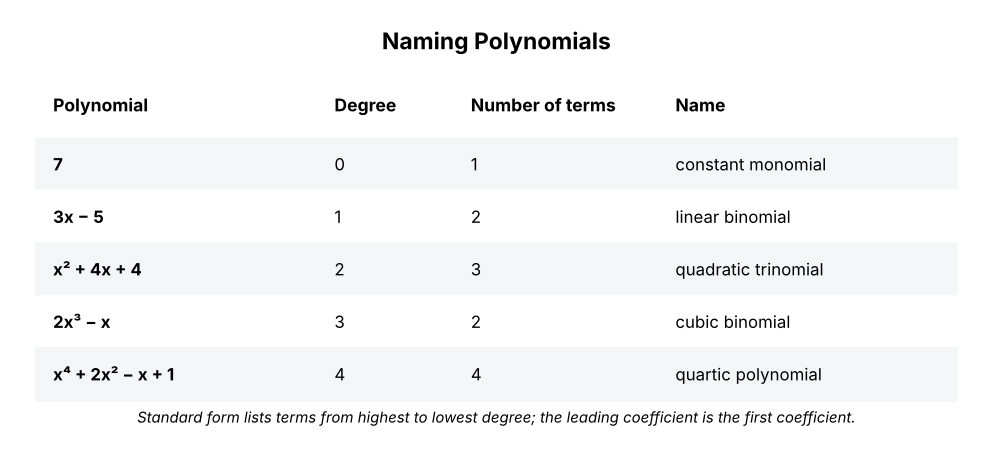
The degree of a monomial is the sum of its variables’ exponents. The degree of a polynomial is the highest degree among its terms. A polynomial is in standard form when its terms are written from highest degree to lowest. The first term’s coefficient is the leading coefficient.
| Polynomial | By Terms | By Degree | Leading Coefficient |
|---|---|---|---|
| \(-6\) | Monomial | Constant (0) | \(-6\) |
| \(3x-8\) | Binomial | Linear (1) | \(3\) |
| \(x^{2}+5x+6\) | Trinomial | Quadratic (2) | \(1\) |
| \(2x^{3}-x\) | Binomial | Cubic (3) | \(2\) |
| \(4x^{4}+x^{3}-2x+9\) | Polynomial with 4 terms | Quartic (4) | \(4\) |
Why does this matter? Expressions with variables in a denominator, negative exponents, or variables under a radical are not polynomials. So \(\frac{3}{x}\) and \(x^{-2}+1\) do not qualify. Tests often ask you to pick the one expression that is or is not a polynomial.
Adding Polynomials
To add polynomials, combine like terms. You can work horizontally by grouping, or vertically by lining up like terms in columns.
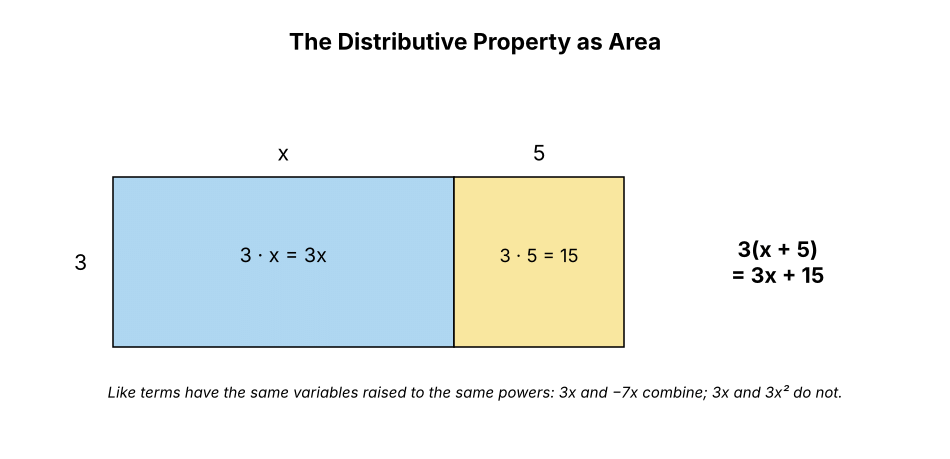
Worked example 1: Add \((3x^{2}-5x+2)+(x^{2}+7x-9)\).
- Remove the parentheses. Adding does not change any signs: \(3x^{2}-5x+2+x^{2}+7x-9\).
- Group like terms: \((3x^{2}+x^{2})+(-5x+7x)+(2-9)\).
- Combine: \(4x^{2}+2x-7\).
The vertical method helps when polynomials have missing terms. Write a placeholder of zero for any missing power so the columns stay aligned. For example, write \(2x^{3}+0x^{2}+4x-1\) when there is no \(x^{2}\) term. Without the placeholder, it is easy to slide the \(4x\) into the \(x^{2}\) column and combine terms that are not alike.
Subtracting Polynomials
Subtracting a polynomial means adding its opposite. Distribute the negative sign to every term in the second polynomial, then add.
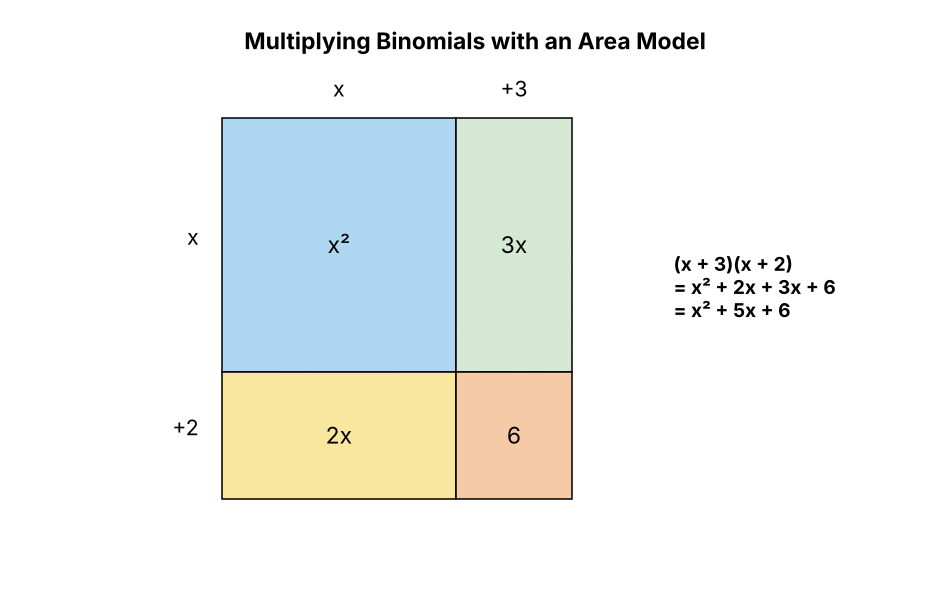
Worked example 2: Subtract \((5x^{2}+3x-4)-(2x^{2}-6x+1)\).
- Distribute the negative: \(5x^{2}+3x-4-2x^{2}+6x-1\).
- Group like terms: \((5x^{2}-2x^{2})+(3x+6x)+(-4-1)\).
- Combine: \(3x^{2}+9x-5\).
Worked example 3: Find the perimeter of a triangle with sides \(2x+3\), \(x^{2}-1\), and \(4x\).
- Add all three sides: \((2x+3)+(x^{2}-1)+4x\).
- Combine and write in standard form: \(x^{2}+6x+2\).
Why does this matter? In Example 2, the \(-6x\) becomes \(+6x\) and the \(+1\) becomes \(-1\). Students who change only the first sign get \(3x^{2}-3x-3\), which is wrong in two terms. Rewriting the subtraction as a full line with every sign flipped prevents this.
Polynomials in Context
Subtracting polynomials appears naturally in business problems. Profit equals revenue minus cost, so if both are polynomials, profit is their difference.
Worked example 4: A company’s revenue from selling \(x\) items is \(R(x)=-0.5x^{2}+40x\) dollars, and its cost is \(C(x)=10x+200\) dollars. Write the profit function.
- Set up the difference: \(P(x)=(-0.5x^{2}+40x)-(10x+200)\).
- Distribute the negative: \(-0.5x^{2}+40x-10x-200\).
- Combine: \(P(x)=-0.5x^{2}+30x-200\).
Why does this matter? The fixed cost of 200 dollars becomes \(-200\) in the profit function, which makes sense: before selling anything, the company is 200 dollars in the hole. Checking that each term’s sign has a real-world meaning is a powerful way to catch subtraction errors.
Test-Taking Strategies
Mnemonic Devices and Memory Shortcuts
For subtraction, use “Keep, Change, Change All”: keep the first polynomial, change subtraction to addition, and change the sign of every term in the second polynomial. For classification, remember “mono, bi, tri” for one, two, and three terms.
Cross-Topic Connections
- Combining terms here follows Topic 1.4: Combining Like Terms and the Distributive Property.
- Exponent rules that define degree come from Topic 7.1: Properties of Exponents.
- Negative exponents disqualify an expression, as shown in Topic 7.2: Zero and Negative Exponents.
- Quadratic trinomials in standard form lead into Topic 10.2: Forms of Quadratic Functions.
Common Question Formats
- Classify a polynomial by degree and number of terms.
- Add or subtract two polynomials and choose the simplified result.
- Write a perimeter or total cost as a polynomial.
- Identify which expression is not a polynomial.
Frequent Student Mistakes
- Changing only the first sign when subtracting.
- Adding exponents when combining like terms, as in \(x^{2}+x^{2}=x^{4}\). The correct result is \(2x^{2}\).
- Combining unlike terms such as \(3x^{2}\) and \(3x\).
Test-Day Shortcuts
Check your answer by substituting \(x=1\) into the original problem and your result. Both should give the same number. For Example 2, the original gives \(4-(-3)=7\) and the result gives \(3+9-5=7\).
Time Management Tips
Polynomial addition and subtraction items on Algebra 1 unit tests and end-of-course exams usually take about a minute. Spend the extra seconds rewriting subtraction with all signs flipped. Use the vertical method only when terms are missing, because it takes longer to set up.