
Seats in a theater increase by 4 per row. A savings jar grows by 15 dollars every week. A staircase rises the same height with each step. Patterns that change by the same amount each time are arithmetic sequences, and they are linear functions in disguise. Recognizing that link makes this topic one of the easiest to score on.
This article covers Topic 4.4: Arithmetic Sequences in Unit 4, Functions. The topic asks you to identify arithmetic sequences, find the common difference, write explicit and recursive formulas, and connect sequences to linear functions.
By the end, you should be able to:
- Decide whether a sequence is arithmetic and find its common difference.
- Write an explicit formula and use it to find any term.
- Write a recursive formula that describes each term from the one before it.
- Explain why an arithmetic sequence is a linear function with a domain of positive integers.
Recognizing Arithmetic Sequences
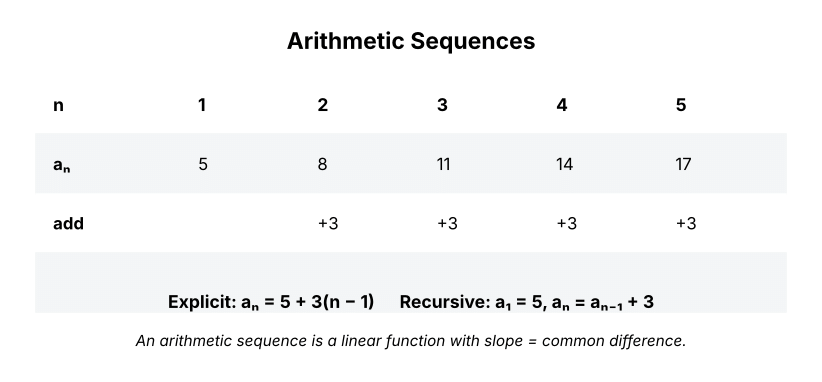
A sequence is an ordered list of numbers called terms. In an arithmetic sequence, you add the same number, the common difference \(d\), to get from one term to the next. Find \(d\) by subtracting any term from the term after it.
| Sequence | Arithmetic? | Common Difference |
|---|---|---|
| \(3, 7, 11, 15, \ldots\) | Yes | \(d=4\) |
| \(20, 14, 8, 2, \ldots\) | Yes | \(d=-6\) |
| \(2, 6, 18, 54, \ldots\) | No | Each term is multiplied by 3, so the differences are not constant. |
| \(1, 4, 9, 16, \ldots\) | No | The differences are 3, 5, 7, so they keep changing. |
Why does this matter? Always check at least two differences. A sequence like \(1, 4, 9, 16\) starts with a difference of 3, but the next difference is 5. Checking only one pair is how students mistake other patterns for arithmetic ones.
The Explicit Formula
The explicit formula lets you jump straight to any term without listing the ones before it:
\(a_{n}=a_{1}+(n-1)d\)
Here \(a_{n}\) is the \(n\)th term, \(a_{1}\) is the first term, and \(d\) is the common difference. The \((n-1)\) counts how many jumps you make from the first term.
Worked example 1: Find the 30th term of \(3, 7, 11, 15, \ldots\).
- Identify \(a_{1}=3\) and \(d=4\).
- Write the formula: \(a_{n}=3+(n-1)(4)\).
- Simplify: \(a_{n}=4n-1\).
- Substitute \(n=30\): \(a_{30}=4(30)-1=119\).
Worked example 2: Which term of \(20, 14, 8, \ldots\) equals \(-46\)?
- Write the formula: \(a_{n}=20+(n-1)(-6)=-6n+26\).
- Set it equal to \(-46\): \(-6n+26=-46\).
- Solve: \(-6n=-72\), so \(n=12\). It is the 12th term.
Why does this matter? If your solution for \(n\) is not a positive whole number, the value is not a term in the sequence. That check answers “Is 50 a term of this sequence?” questions instantly.
The Recursive Formula
A recursive formula describes each term using the previous term. It needs two parts: a starting term and a rule.
- Starting term: \(a_{1}=3\).
- Rule: \(a_{n}=a_{n-1}+4\), meaning each term is 4 more than the one before it.
Recursive formulas are great for describing step-by-step growth, but they are slow for far-away terms. To find the 30th term recursively, you would need all 29 terms before it. That is why tests often ask you to convert a recursive formula into an explicit one.
Arithmetic Sequences as Linear Functions
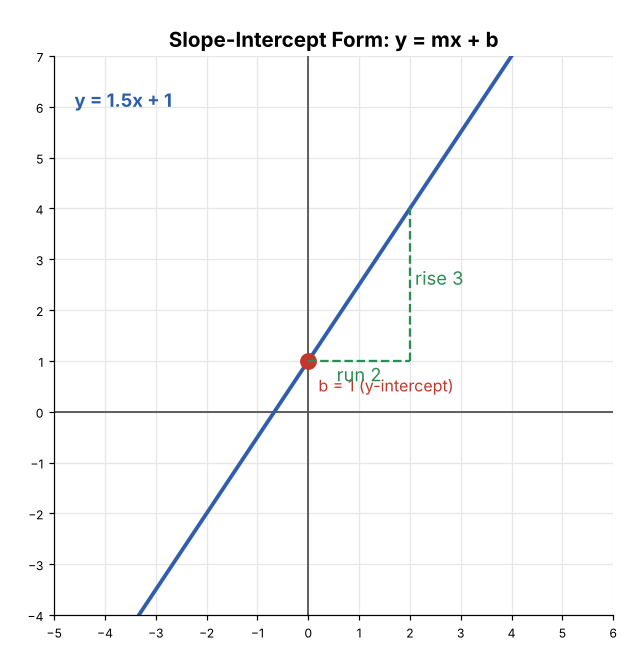
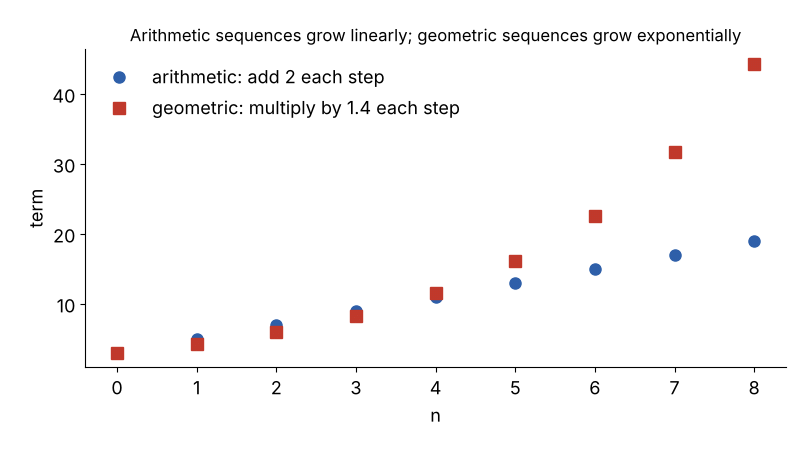
The simplified explicit formula \(a_{n}=4n-1\) looks just like \(y=4x-1\). The common difference is the slope, and the term number plays the role of \(x\). The only difference is the domain: sequences use only positive integers, so their graphs are separate dots that lie along a line rather than a solid line.
This connection lets you use everything you know about lines. A constant difference of \(-6\) means a line falling 6 units for every step to the right. The value \(a_{1}-d\) acts like the \(y\)-intercept, which is the “zeroth” term.
Test-Taking Strategies
Mnemonic Devices and Memory Shortcuts
Remember “Start, then jump \(n-1\) times.” You begin at \(a_{1}\) and make one fewer jump than the term number. For recursive formulas, think “now equals before plus \(d\).”
Cross-Topic Connections
- Sequences are functions with whole-number inputs, building on Topic 4.2: Function Notation.
- Restricted inputs connect to Topic 4.3: Domain and Range.
- The common difference is the slope from Topic 5.1: How to Find Slope.
- The simplified formula matches Topic 5.2: Slope-Intercept Form.
Common Question Formats
- Find the next terms or the common difference of a sequence.
- Use an explicit formula to find a far-away term, such as the 50th.
- Convert a recursive formula into an explicit formula, or the reverse.
- Model a situation like seats per row or weekly savings with a sequence.
Frequent Student Mistakes
- Using \(nd\) instead of \((n-1)d\), which overshoots every term by one difference.
- Subtracting in the wrong order and getting the wrong sign for \(d\). Always subtract the earlier term from the later term.
- Writing a recursive formula without a starting term.
Test-Day Shortcuts
Simplify the explicit formula to the form \(dn+c\) right away. The constant \(c\) equals \(a_{1}-d\), so for \(3, 7, 11\) it is \(3-4=-1\), giving \(4n-1\) in one step.
Time Management Tips
Sequence questions on Algebra 1 unit tests and end-of-course exams usually take one to two minutes. Write the formula before substituting, since most errors come from skipping that line. If a question asks for a nearby term, just count forward instead of using the formula.