
The derivative of cos(x) — d/dx[cos(x)] = −sin(x) — is one of the foundational results in single-variable calculus. Understanding this derivative and its proof gives you a window into how all trigonometric derivatives are derived, using limit definitions and trigonometric identities. For AP® Calculus AB and BC students, knowing this result cold (along with all six basic trig derivatives) is essential for differentiation questions on the exam.
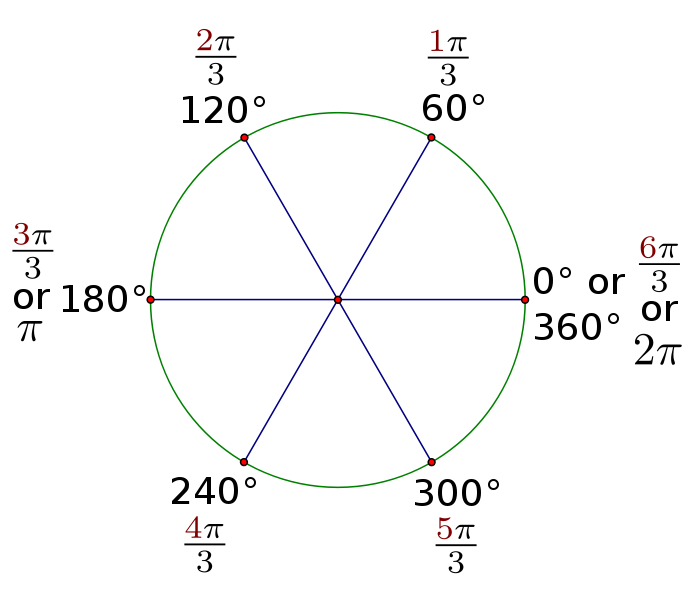
In calculus, angles are measured in radians, not degrees. One radian is the angle subtended when the arc length equals the radius of the circle. The relationship between radians and degrees:
x (radians) = θ (degrees) × (2π / 360)

The goal: prove that d/dx[cos(x)] = −sin(x) using the definition of the derivative. We’ll then confirm the same result using the derivative of sin(x) and a trigonometric identity.
Deriving the Derivative from a Fundamental Definition
The derivative of any function f(x) is defined as a limit (the “first principles” or “limit definition” approach):
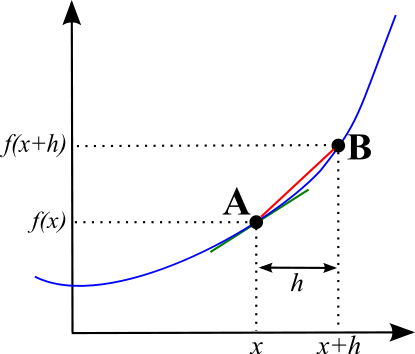

f'(x) = d/dx f(x) = limh→0 [f(x + h) − f(x)] / h
Applying this to f(x) = cos(x):
d/dx cos(x) = limh→0 [cos(x + h) − cos(x)] / h
Using the cosine addition formula: cos(x + h) = cos(x)cos(h) − sin(x)sin(h):
d/dx cos(x) = limh→0 [cos(x)cos(h) − sin(x)sin(h) − cos(x)] / h
Rearranging:
d/dx cos(x) = cos(x) × limh→0 [(cos(h) − 1) / h] − sin(x) × limh→0 [sin(h) / h]
This separates the problem into evaluating two key limits. For the second limit, the unit circle argument shows:
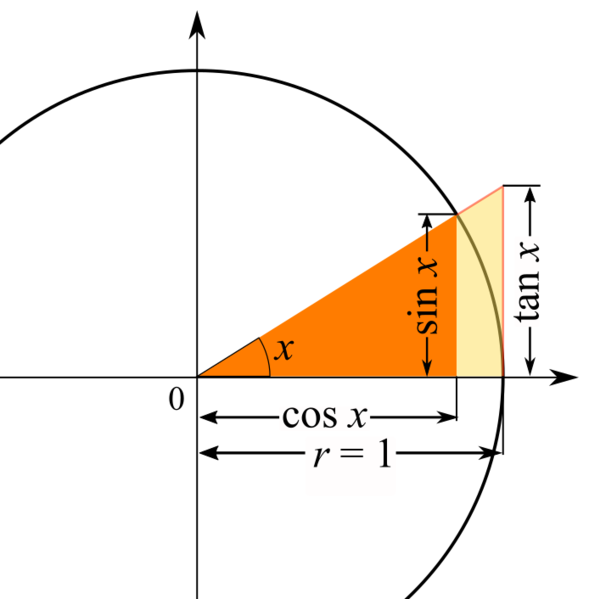

From the unit circle, when x is in radians: sin(x) < x < tan(x) for 0 < x < π/2.
Dividing by sin(x): 1 < x/sin(x) < 1/cos(x), so cos(x) < sin(x)/x < 1.
As x → 0, cos(x) → 1, so by the Squeeze Theorem:
limh→0 [sin(h) / h] = 1
For the first limit, using the double-angle formula cos(h) = 1 − 2sin²(h/2):
(cos(h) − 1) / h = −2sin²(h/2) / h = −[sin(h/2)/(h/2)] × sin(h/2)
As h → 0: [sin(h/2)/(h/2)] → 1 and sin(h/2) → 0, so:
limh→0 [(cos(h) − 1) / h] = 0
Combining both limits:
d/dx cos(x) = cos(x) × 0 − sin(x) × 1 = −sin(x)
Proof Based on the Derivative of Sin(x)
An alternative derivation uses the known result d/dx[sin(x)] = cos(x) and the cofunction identity:
cos(x) = sin(π/2 − x)
Differentiating both sides using the chain rule:
d/dx[cos(x)] = d/dx[sin(π/2 − x)] = cos(π/2 − x) × (−1) = −cos(π/2 − x)
Applying the cofunction identity cos(π/2 − x) = sin(x):
d/dx[cos(x)] = −sin(x)
This confirms the result from the first method. Both approaches yield the same answer — a consistency check that’s always valuable when you can verify a result two different ways.
Wrapping Up the Derivative of Cos(x)
Mnemonic for the six basic trigonometric derivatives:
- d/dx[sin(x)] = cos(x) — “sine becomes cosine”
- d/dx[cos(x)] = −sin(x) — “cosine becomes negative sine”
- d/dx[tan(x)] = sec²(x) — “tangent becomes secant squared”
- d/dx[csc(x)] = −csc(x)cot(x) — “cosecant becomes negative co-co”
- d/dx[sec(x)] = sec(x)tan(x) — “secant stays, gains tangent”
- d/dx[cot(x)] = −csc²(x) — “cotangent becomes negative cosecant squared”
Pattern: the three “co-” functions (cosine, cosecant, cotangent) all gain a negative sign when differentiated. The three “non-co” functions (sine, secant, tangent) do not. This halves the memory burden.
Cross-topic connections on the AP® Calculus exam:
- Chain rule: d/dx[cos(u)] = −sin(u) × u’, where u is a function of x. For example: d/dx[cos(x²)] = −sin(x²) × 2x. This is the most common extension of the basic trig derivative.
- Product rule: d/dx[x³ cos(x)] = 3x² cos(x) + x³(−sin(x)) = 3x² cos(x) − x³ sin(x). The negative sign from d/dx[cos(x)] appears here — students often miss it.
- Integration: Since d/dx[cos(x)] = −sin(x), the antiderivative of sin(x) is −cos(x) + C. AP® Calculus frequently pairs differentiation with integration — knowing the derivative tells you the antiderivative.
- Implicit differentiation: When cos(y) appears in an equation, its derivative with respect to x is −sin(y) × (dy/dx). The chain rule is always at work.
- Taylor series (BC only): The Taylor series for cos(x) = 1 − x²/2! + x´/4! − x⁶/6! + … The alternating signs in the series correspond to the alternating derivatives: d/dx[cos(x)] = −sin(x), d²/dx²[cos(x)] = −cos(x), d³/dx³[cos(x)] = sin(x), d⁴/dx⁴[cos(x)] = cos(x) — repeating cycle of 4.
Common question formats on the AP® Calculus exam:
- “Find d/dx[cos(3x² − 5)]” → Apply chain rule: −sin(3x² − 5) × (6x) = −6x sin(3x² − 5)
- “At what x-values does the function f(x) = cos(x) have horizontal tangents?” → Set f'(x) = 0: −sin(x) = 0 → x = nπ for integer n
- “Find the second derivative of f(x) = sin(x)” → f'(x) = cos(x), f”(x) = −sin(x). (Second derivative of sin equals negative sin — this is the hallmark of simple harmonic motion)
Frequent student mistakes:
- Forgetting the negative sign. The most common error: writing d/dx[cos(x)] = sin(x) instead of −sin(x). The co-functions always add a negative sign.
- Not applying the chain rule. d/dx[cos(u)] ≠ −sin(u). It equals −sin(u) × u’. If u is anything other than plain x, the chain rule is mandatory.
- Confusing d/dx[cos(x)] with d/dx[−sin(x)]. The derivative of −sin(x) is −cos(x) — negative cosine. The derivative of cos(x) is −sin(x) — negative sine. Students mix these up when computing second derivatives.
- Using degree measure instead of radians. All calculus derivative formulas assume radians. If you differentiate cos(180°) instead of cos(π), your numerical answers will be wrong by a factor of π/180.
Test-day shortcuts:
- The co-rule: Co-functions (cos, csc, cot) all acquire a negative sign when differentiated. Non-co functions (sin, sec, tan) do not. When in doubt: “co gets negative.”
- Cyclic derivatives of cos(x): cos → −sin → −cos → sin → cos → … The pattern repeats every 4 derivatives. The n-th derivative of cos(x) = cos(x + nπ/2). This lets you find any higher-order derivative quickly.
- Verification by antiderivative: If you get d/dx[cos(x)] = −sin(x), verify: the antiderivative of −sin(x) should be cos(x) + C. Since ∫(−sin(x))dx = cos(x) + C, you’re correct.
Time management: On AP® Calculus, trig derivative questions in multiple choice should take 30-45 seconds each. The key is having all six derivatives memorized so you can apply them instantly without derivation. For FRQ problems involving trig functions, write out the derivative formula explicitly before simplifying — this earns process points even if arithmetic errors occur later.