
Two phone plans charge different monthly fees and different rates per gigabyte. When do they cost the same? Questions like this produce equations with a variable on both sides, such as \(20+5g=35+2g\). Solving them takes one extra move beyond what you used for two-step equations: collecting the variable on a single side.
This article covers Topic 2.4: Equations with Variables on Both Sides in Unit 2, Linear Equations. The topic asks you to solve linear equations where the variable appears on both sides and to recognize equations with no solution or infinitely many solutions.
By the end, you should be able to:
- Move variable terms to one side using inverse operations.
- Solve equations that also require distributing and combining like terms.
- Identify when an equation has no solution or infinitely many solutions.
- Check a solution by substituting it into the original equation.
The Core Strategy
The goal is to rewrite the equation so that all variable terms sit on one side and all constants sit on the other. Each move must be done to both sides to keep the equation balanced.
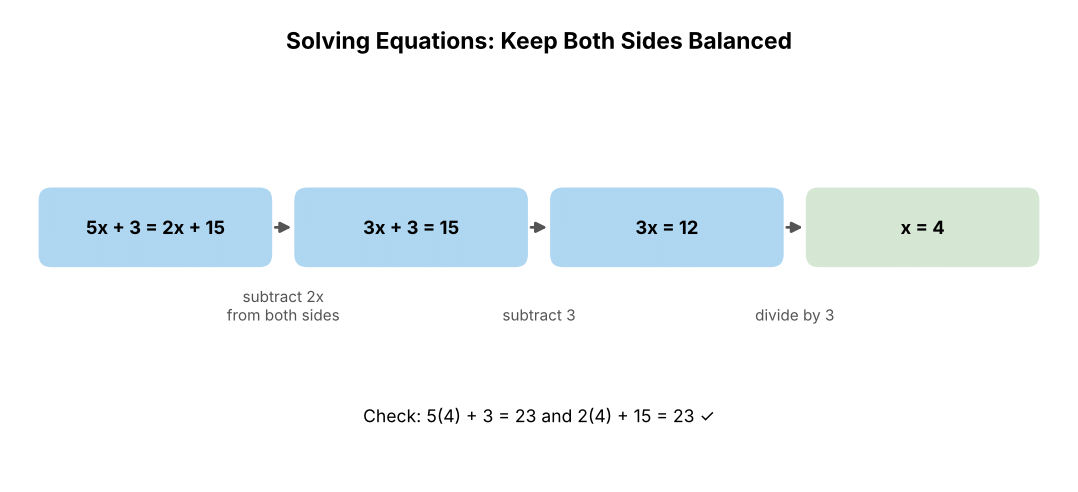
- Simplify each side. Distribute and combine like terms separately on the left and on the right.
- Collect the variable terms. Add or subtract a variable term on both sides so the variable appears on only one side.
- Collect the constants. Add or subtract constants so they sit on the other side.
- Isolate the variable. Divide or multiply by the coefficient.
- Check. Substitute your answer into the original equation.
Worked example: Solve \(20+5g=35+2g\).
- Subtract \(2g\) from both sides: \(20+3g=35\).
- Subtract 20 from both sides: \(3g=15\).
- Divide by 3: \(g=5\).
- Check: \(20+5(5)=45\) and \(35+2(5)=45\). Both plans cost 45 dollars at 5 gigabytes.
Why does this matter? Moving the smaller variable term usually leaves a positive coefficient, which reduces sign errors. In the example, subtracting \(2g\) left \(3g\). Subtracting \(5g\) instead would work too, but it creates \(-3g\) and an extra negative to manage.
Equations That Need Simplifying First
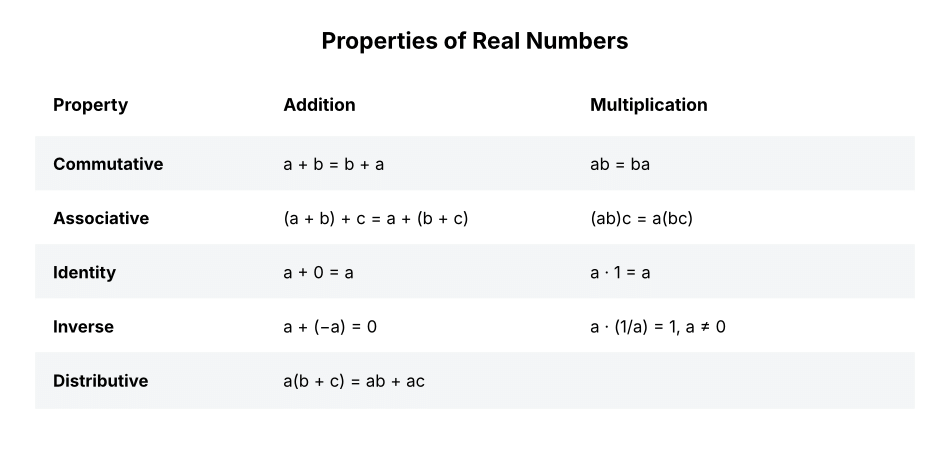
Many problems combine this topic with the distributive property. Simplify each side completely before you start moving terms across the equals sign.
Worked example: Solve \(4(x-3)+2=2x+6\).
- Distribute on the left: \(4x-12+2=2x+6\).
- Combine like terms on the left: \(4x-10=2x+6\).
- Subtract \(2x\) from both sides: \(2x-10=6\).
- Add 10 to both sides: \(2x=16\).
- Divide by 2: \(x=8\).
Fractions can be cleared before you begin. In \(\frac{x}{3}+2=\frac{x}{2}\), multiply every term by 6, the least common denominator, to get \(2x+12=3x\). Then subtract \(2x\) to find \(x=12\).
Decimals work the same way. In \(0.4x+1.2=0.1x+3\), multiply every term by 10 to get \(4x+12=x+30\), then solve to find \(x=6\). Clearing fractions and decimals is optional, but it removes the most error-prone arithmetic from the problem.
No Solution and Infinitely Many Solutions
Sometimes the variable terms cancel completely. What remains tells you how many solutions the equation has.
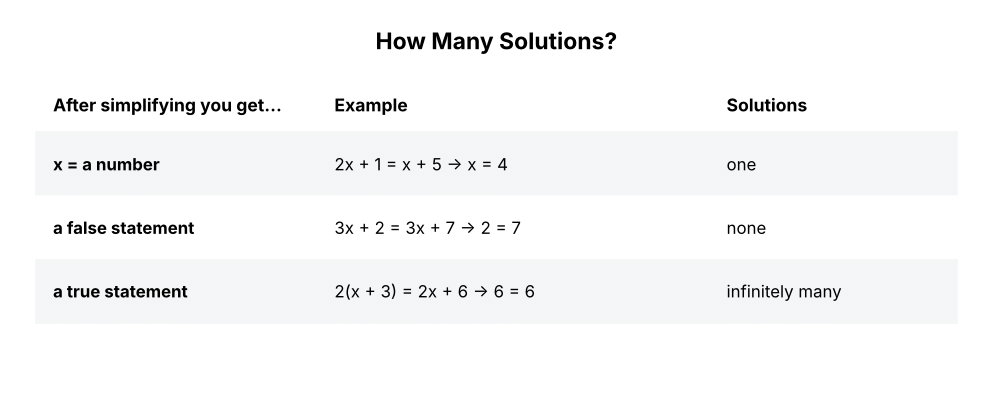
| Result After Simplifying | Meaning | Example |
|---|---|---|
| A single value, like \(x=4\) | One solution. Exactly one number makes the equation true. | \(3x+1=x+9\) |
| A false statement, like \(5=-2\) | No solution. No number can make the sides equal. | \(2x+5=2x-2\) |
| A true statement, like \(6=6\) | Infinitely many solutions. Every real number works. This is called an identity. | \(3(x+2)=3x+6\) |
Why does this matter? You can predict the outcome before solving. If both sides have the same variable coefficient but different constants, there is no solution. If both sides simplify to exactly the same expression, there are infinitely many. Test writers love asking you to choose a constant that makes an equation have no solution, and this shortcut answers that instantly.
Test-Taking Strategies
Mnemonic Devices and Memory Shortcuts
Use “Simplify, Shift, Solve.” Simplify each side, shift variables to one side and constants to the other, then solve. For the special cases, remember “False means none, true means all.”
Cross-Topic Connections
- Simplifying each side relies on Topic 1.4: Combining Like Terms and the Distributive Property.
- The final isolation steps are the same as in Topic 2.2: Solving Two-Step Equations.
- Equating two cost expressions is the algebra behind Topic 6.3: Solving Systems of Equations by Substitution.
- No solution and infinitely many solutions return as parallel and identical lines in Topic 6.2: Solving Systems of Equations by Graphing.
Common Question Formats
- Solve an equation with variables on both sides and select the value.
- Determine whether an equation has one, zero, or infinitely many solutions.
- Find the value of a constant that makes an equation have no solution.
- Model a “when are they equal” word problem, such as two savings plans or two rental companies.
Frequent Student Mistakes
- Moving a term without changing its operation. Subtracting \(2x\) from one side means subtracting it from the other side too.
- Reporting \(x=0\) when the variables cancel. If the variables disappear, look at the remaining statement instead.
- Forgetting to multiply every term when clearing fractions, including terms without denominators.
Test-Day Shortcuts
On multiple-choice problems, substitute each answer choice into the original equation and keep the one that balances. For special-case questions, compare coefficients and constants after simplifying instead of solving all the way through.
Time Management Tips
These equations usually take two to three minutes on Algebra 1 unit tests and end-of-course exams. Spend a few seconds checking your answer, because substitution catches nearly every sign error. If an equation involves fractions, clear them first, since working with whole numbers is faster and safer.