
Factoring is multiplication run in reverse. Instead of expanding \(4x(x+3)\) into \(4x^{2}+12x\), you start with \(4x^{2}+12x\) and recover the product. The simplest and most important factoring move is pulling out the greatest common factor. It is always the first step in any factoring problem, so mastering it pays off across all of Unit 9 and Unit 10.
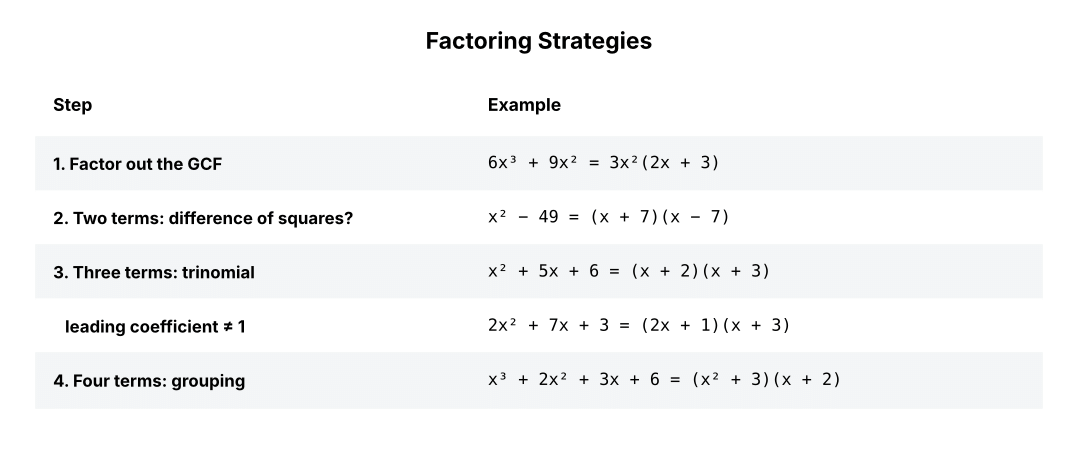
This article covers Topic 9.3: Factoring Out the Greatest Common Factor in Unit 9, Polynomials and Factoring. The topic asks you to find the GCF of monomials, factor it out of a polynomial, and factor by grouping when a common binomial appears.
By the end, you should be able to:
- Find the greatest common factor of two or more monomials.
- Factor the GCF out of any polynomial.
- Factor out a negative GCF when the leading coefficient is negative.
- Factor four-term polynomials by grouping.
Finding the Greatest Common Factor
The greatest common factor (GCF) of monomials is the largest expression that divides each of them evenly. Find it in two parts.
- Numbers: Find the greatest common factor of the coefficients.
- Variables: For each variable that appears in every term, take the smallest exponent.
| Terms | Number GCF | Variable GCF | Overall GCF |
|---|---|---|---|
| \(12x^{3}\), \(18x^{2}\) | 6 | \(x^{2}\) | \(6x^{2}\) |
| \(10a^{2}b\), \(15ab^{3}\) | 5 | \(ab\) | \(5ab\) |
| \(8y^{4}\), \(20y^{2}\), \(4y\) | 4 | \(y\) | \(4y\) |
| \(7m^{2}\), \(9n\) | 1 | None in common | 1 |
Why does this matter? You take the smallest exponent because that is the highest power that fits inside every term. In \(12x^{3}\) and \(18x^{2}\), you cannot pull out \(x^{3}\) because \(18x^{2}\) only has two factors of \(x\).
Factoring the GCF Out of a Polynomial
Write the GCF outside parentheses. Inside, write what remains after dividing each term by the GCF.
Worked example 1: Factor \(12x^{3}-18x^{2}+6x\).
- GCF of 12, 18, and 6 is 6. Smallest power of \(x\) is \(x^{1}\). So the GCF is \(6x\).
- Divide each term: \(\frac{12x^{3}}{6x}=2x^{2}\), \(\frac{-18x^{2}}{6x}=-3x\), and \(\frac{6x}{6x}=1\).
- Result: \(6x(2x^{2}-3x+1)\).
Notice the 1 in the last position. When the GCF equals an entire term, a 1 stays behind. Leaving it out gives \(6x(2x^{2}-3x)\), which multiplies back to the wrong polynomial.
Worked example 2: Factor \(-4y^{2}+20y\) with a negative GCF.
- The leading coefficient is negative, so factor out \(-4y\).
- Divide: \(\frac{-4y^{2}}{-4y}=y\) and \(\frac{20y}{-4y}=-5\).
- Result: \(-4y(y-5)\).
The GCF can also be a binomial already sitting in each term. In \(3x(x-4)+7(x-4)\), both terms share \((x-4)\), so the factored form is \((x-4)(3x+7)\). Treat the repeated binomial exactly like a single variable, and the problem becomes a simple GCF step.
Factoring is useful well beyond tidying expressions. A factored form makes it easy to find values that make a polynomial zero, to simplify fractions, and to see the dimensions of a rectangle from its area. Each of those uses depends on factoring completely, which always starts with the GCF.
Why does this matter? Factoring out a negative keeps the leading term inside the parentheses positive, which makes later factoring of trinomials much easier. Every sign inside flips, so check each one by multiplying back.
Factoring by Grouping
Sometimes the common factor is a binomial. A four-term polynomial can often be factored by grouping its terms into pairs.
Worked example 3: Factor \(x^{3}+3x^{2}+2x+6\).
- Group the terms in pairs: \((x^{3}+3x^{2})+(2x+6)\).
- Factor the GCF from each pair: \(x^{2}(x+3)+2(x+3)\).
- Factor out the common binomial \((x+3)\): \((x+3)(x^{2}+2)\).
Worked example 4: Factor \(2ab-6a+5b-15\).
- Group: \((2ab-6a)+(5b-15)\).
- Factor each pair: \(2a(b-3)+5(b-3)\).
- Factor out \((b-3)\): \((b-3)(2a+5)\).
Why does this matter? Grouping only works when both pairs share the same binomial. If you get \((x+3)\) from one pair and \((x-3)\) from the other, try factoring a negative from the second pair or rearranging the terms. Grouping also drives the “ac method” for factoring trinomials in the next topic.
Test-Taking Strategies
Mnemonic Devices and Memory Shortcuts
“GCF goes first, always.” Before any other factoring technique, check for a GCF. For variable exponents, remember “smallest power wins,” since the GCF can only use what every term has.
Cross-Topic Connections
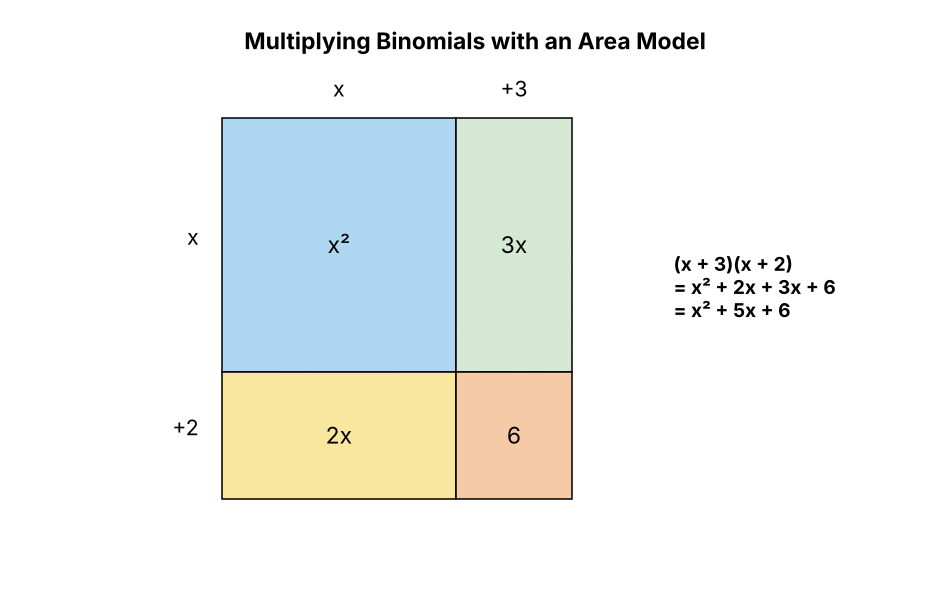
- Factoring reverses Topic 9.2: Multiplying Polynomials.
- Pulling out a factor is the distributive property backwards, from Topic 1.4: Combining Like Terms and the Distributive Property.
- Dividing powers uses the quotient rule from Topic 7.1: Properties of Exponents.
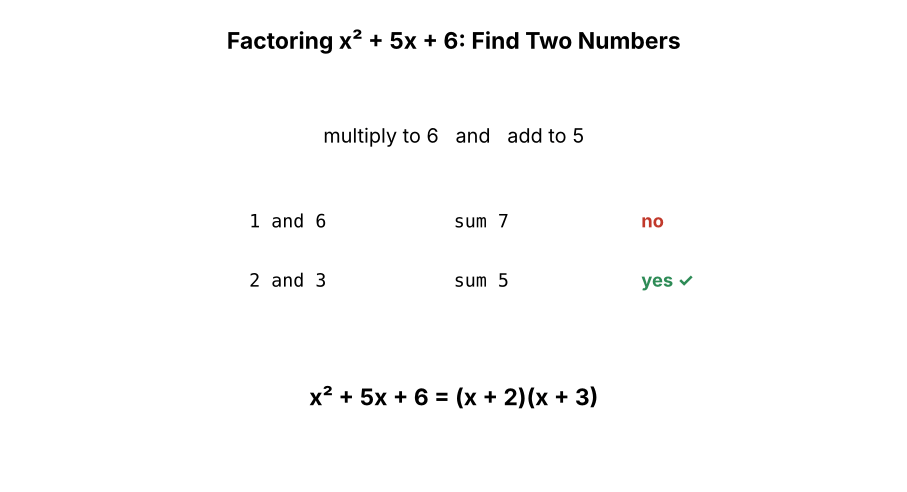
- Factoring is the first step in Topic 10.3: Solving Quadratic Equations by Factoring.
Common Question Formats
- Find the GCF of two or three monomials.
- Factor a polynomial completely by removing the GCF.
- Factor a four-term polynomial by grouping.
- Choose which factored form is equivalent to a given polynomial.
Frequent Student Mistakes
- Leaving out the 1 when the GCF equals a whole term.
- Choosing a common factor that is not the greatest, such as \(2x\) instead of \(6x\). The result is not factored completely.
- Forgetting to flip signs inside the parentheses after factoring out a negative.
Test-Day Shortcuts
Check every factoring answer by multiplying back in your head. It takes seconds and catches missing terms and sign errors. If the terms inside the parentheses still share a factor, you have not removed the greatest one.
Time Management Tips
GCF items on Algebra 1 unit tests and end-of-course exams usually take under a minute. Grouping problems take one to two minutes. If grouping stalls, rearrange the middle two terms and try again before moving on.