


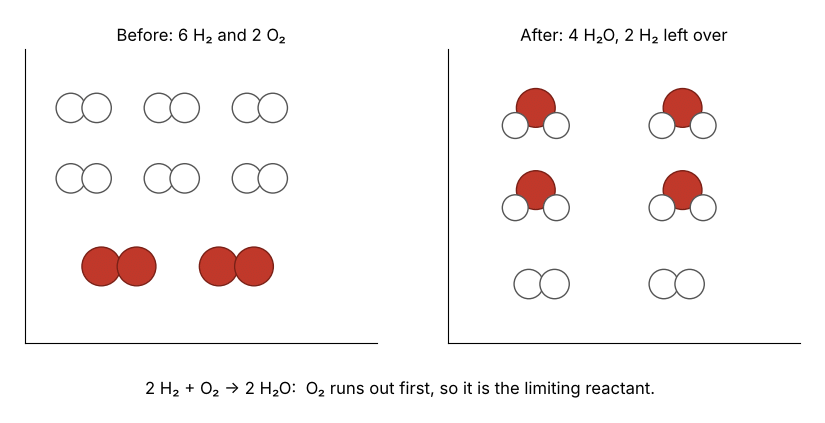
As the cookie analogy in the image illustrates, a limiting reactant works just like running out of flour mid-batch — it doesn’t matter how much sugar you have left, because the missing ingredient stops everything. In chemistry, the limiting reactant is the substance that gets completely consumed first, determining the maximum amount of product a reaction can produce. The excess reactant is whatever remains after the limiting reactant is used up.
On the AP® Chemistry exam, limiting reactant problems appear in stoichiometry FRQs, percent yield calculations, and lab-based questions. You need to identify the limiting reactant quickly and accurately, then calculate how much product forms and how much excess reactant remains. This article gives you the systematic method to handle all of these.
What We Review
How to Find Limiting Reactant
The method is always the same: calculate the theoretical yield of product from each reactant separately. Whichever reactant produces less product is the limiting reactant. Here’s the step-by-step process applied to a worked example.
Example: \(10 \text{ g}\) of \(H_2\) reacts with \(15 \text{ g}\) of \(N_2\). Which is the limiting reactant in the reaction \(N_2 + 3H_2 \rightarrow 2NH_3\)?
Step 1: Write and Balance the Chemical Equation
\(N_2(g) + 3H_2(g) \rightarrow 2NH_3(g)\)
The balanced equation tells you: 1 mol \(N_2\) reacts with 3 mol \(H_2\) to produce 2 mol \(NH_3\).
Step 2: Convert All Reactants to Moles
\(\text{Moles of } H_2 = \frac{10 \text{ g}}{2.02 \text{ g/mol}} \approx 4.95 \text{ mol}\)
\(\text{Moles of } N_2 = \frac{15 \text{ g}}{28.02 \text{ g/mol}} \approx 0.54 \text{ mol}\)
Step 3: Calculate the Theoretical Yield of Product from Each Reactant
Use the mole ratio to find how much \(NH_3\) each reactant could produce if it were the only constraint:
\(\text{From } H_2: \quad 4.95 \text{ mol } H_2 \times \frac{2 \text{ mol } NH_3}{3 \text{ mol } H_2} = 3.30 \text{ mol } NH_3\)
\(\text{From } N_2: \quad 0.54 \text{ mol } N_2 \times \frac{2 \text{ mol } NH_3}{1 \text{ mol } N_2} = 1.08 \text{ mol } NH_3\)
Step 4: Identify the Limiting Reactant
\(N_2\) produces fewer moles of \(NH_3\) (1.08 vs. 3.30), so \(N_2\) is the limiting reactant. The theoretical yield is \(1.08 \text{ mol } NH_3\), and \(H_2\) is in excess.Additional Example Problem:
Problem: \(5 \text{ g}\) of \(Zn\) reacts with \(2.5 \text{ g}\) of \(H_2SO_4\) via \(Zn + H_2SO_4 \rightarrow ZnSO_4 + H_2\). Find the limiting reactant.
Convert to moles:
\(\text{Moles of } Zn = \frac{5 \text{ g}}{65.38 \text{ g/mol}} \approx 0.076 \text{ mol}\)
\(\text{Moles of } H_2SO_4 = \frac{2.5 \text{ g}}{98.07 \text{ g/mol}} \approx 0.025 \text{ mol}\)
Apply the 1:1 mole ratio: \(Zn\) could produce 0.076 mol product; \(H_2SO_4\) could produce only 0.025 mol. Since \(H_2SO_4\) produces less, \(H_2SO_4\) is the limiting reactant and \(Zn\) is in excess.
How to Find Excess Reactant
Once you’ve identified the limiting reactant, finding how much excess reactant remains is a three-step extension of the same calculation.
Step 1: Find the Limiting Reactant
From the ammonia example above, \(N_2\) is the limiting reactant (0.54 mol).
Step 2: Calculate the Amount of Excess Reactant Used
Use the mole ratio to find how much \(H_2\) the limiting reactant consumes:
\(0.54 \text{ mol } N_2 \times \frac{3 \text{ mol } H_2}{1 \text{ mol } N_2} = 1.62 \text{ mol } H_2 \text{ consumed}\)
Step 3: Determine the Amount of Excess Reactant Remaining
Subtract what was consumed from what you started with:
\(4.95 \text{ mol } H_2 – 1.62 \text{ mol } H_2 = 3.33 \text{ mol } H_2 \text{ remaining}\)
To convert to grams: \(3.33 \text{ mol} \times 2.02 \text{ g/mol} = 6.73 \text{ g } H_2\) unreacted.
Example Problem: Finding the Excess Reactant in the Zinc and Sulfuric Acid Reaction
From the zinc example: \(H_2SO_4\) is the limiting reactant (0.025 mol). Since the ratio is 1:1, exactly 0.025 mol of \(Zn\) is consumed.
Excess \(Zn\) remaining: \(0.076 – 0.025 = 0.051 \text{ mol Zn}\), or \(0.051 \times 65.38 = 3.33 \text{ g Zn}\).
Importance of the Limiting Reactant and Excess Reactants
Maximizing Efficiency in Chemical Reactions

As shown in the image, pharmaceutical manufacturing depends on precise limiting reactant calculations. If a drug synthesis uses too little of one reagent, the yield drops and production costs soar. If too much excess reactant remains, it must be separated from the product — adding purification steps and cost. Industrial chemists deliberately design reactions so that the more expensive reagent is the limiting reactant, ensuring none of it goes to waste.
Environmental Impact
Excess reactants that aren’t consumed can become pollutants. In combustion reactions, excess fuel produces carbon monoxide and soot instead of \(CO_2\) and water. In industrial synthesis, unreacted chemicals may require hazardous waste disposal. Understanding and controlling the ratio of reactants is how chemists minimize environmental harm.
Educational and Research Applications
In the lab, miscalculating the limiting reactant leads to low yields, wasted reagents, and unreliable data. Whether you’re running a titration or synthesizing a compound for research, accurate stoichiometry is the difference between a successful experiment and a failed one.
Real-World Applications
The concept extends beyond the lab: rocket fuel requires precise oxidizer-to-fuel ratios (too much fuel wastes mass, too little leaves energy on the table), airbag inflators must produce exactly the right volume of \(N_2\) gas, and even cooking relies on ingredient ratios — your cookie analogy from the introduction applies everywhere.
Test-Taking Strategies
Limiting reactant problems are among the most frequently tested stoichiometry skills on the AP® Chemistry exam. Here’s how to handle them efficiently.
Mnemonic: “Two paths, pick the smaller.” Every limiting reactant problem comes down to calculating the theoretical yield from each reactant and choosing the smaller result. If you remember this single principle, you’ll never second-guess the method.
Cross-topic connections to watch for:
- Limiting reactants + percent yield: The most common FRQ combo. Find the limiting reactant → calculate theoretical yield → compare to actual yield → calculate percent yield. Practice this full chain until it’s automatic.
- Limiting reactants + solution stoichiometry: When reactants are given as volumes and molarities (e.g., titrations), convert to moles first (\(M \times V = \text{mol}\)), then proceed with the standard limiting reactant method.
- Limiting reactants + gas stoichiometry: If one reactant is a gas given in liters, use \(PV = nRT\) (or 22.4 L/mol at STP) to convert to moles before comparing.
- Excess reactant calculations: FRQs sometimes ask “how much of the excess reactant remains?” This requires the extra subtraction step — don’t forget it.
Common question formats:
- FRQ giving masses of two reactants and asking: identify the limiting reactant, calculate theoretical yield, explain a percent yield below 100%
- MCQ asking which reactant is limiting given mole or mass quantities — tests whether you convert to moles and apply ratios correctly
- MCQ or FRQ asking how many grams of excess reactant remain after the reaction
Frequent student mistakes on exam day:
- Assuming the reactant with fewer grams is limiting. Grams don’t determine the limiting reactant — moles relative to the stoichiometric ratio do. A small mass of a light molecule can provide many moles.
- Only checking one reactant. You must calculate the theoretical yield from both reactants to compare. If you only check one, you can’t identify which is limiting.
- Forgetting the excess reactant step. If the question asks for the amount remaining, you need to calculate how much was consumed and subtract from the initial amount.
- Mixing up “limiting” and “excess.” The limiting reactant is the one that produces less product. The excess reactant produces more product theoretically but isn’t fully consumed.
Time management tip: For MCQs, you can often shortcut the full calculation. Convert both reactants to moles, divide each by its coefficient in the balanced equation, and compare. The reactant with the smaller ratio (moles ÷ coefficient) is the limiting reactant. This avoids calculating the full theoretical yield for both paths and saves 30–60 seconds per question.