
Many students open a poem, read it once, feel confused, and decide that poetry is a puzzle with a secret answer only teachers know. That is not how experienced readers approach a poem. They read it several times, slowly and out loud, and they ask simple questions before they ask hard ones. Reading poetry is a skill, and like any skill, it follows a repeatable process.
This article covers Topic 1.1: How to Read a Poem in Unit 1, Reading Poetry. The topic asks you to use a step-by-step approach to read a poem closely, understand its literal meaning, and begin to interpret its deeper meaning.
By the end, you should be able to:
- Explain how reading poetry differs from reading prose.
- Use a multi-read strategy to understand a poem.
- Paraphrase a poem’s literal meaning.
- Ask questions that lead from literal meaning to interpretation.
How Poetry Differs from Prose
Prose runs across the page in sentences and paragraphs. Poetry is arranged in lines and stanzas, and the poet decides exactly where each line breaks. Poems usually pack a great deal of meaning into very few words, so every choice matters: the sound of a word, its position, and even the white space around it.
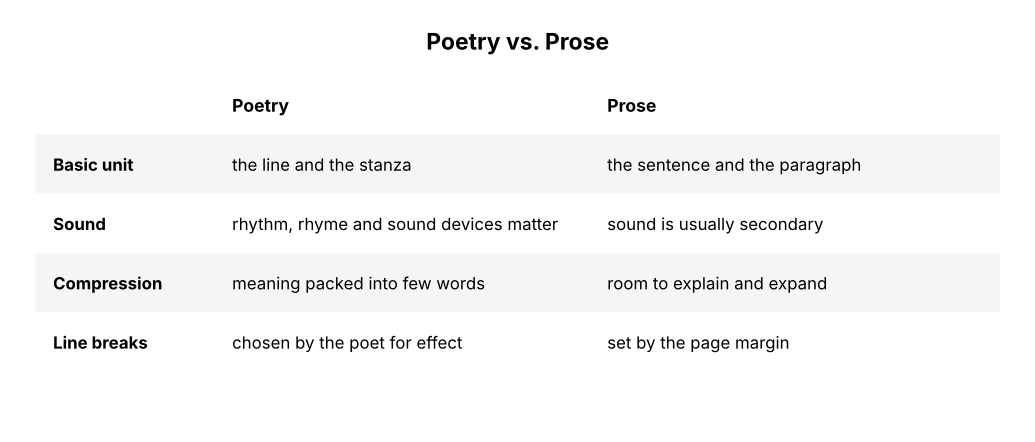
| Feature | Prose | Poetry |
|---|---|---|
| Basic unit | Sentence and paragraph | Line and stanza |
| Length | Often long and detailed | Usually compressed |
| Sound | Important but secondary | Often central: rhythm, rhyme, repetition |
| Language | Often literal | Often figurative |
A Four-Read Strategy
Read 1: Just read. Read the whole poem without stopping. Notice your first reaction. What feeling does it leave? What images stick with you?
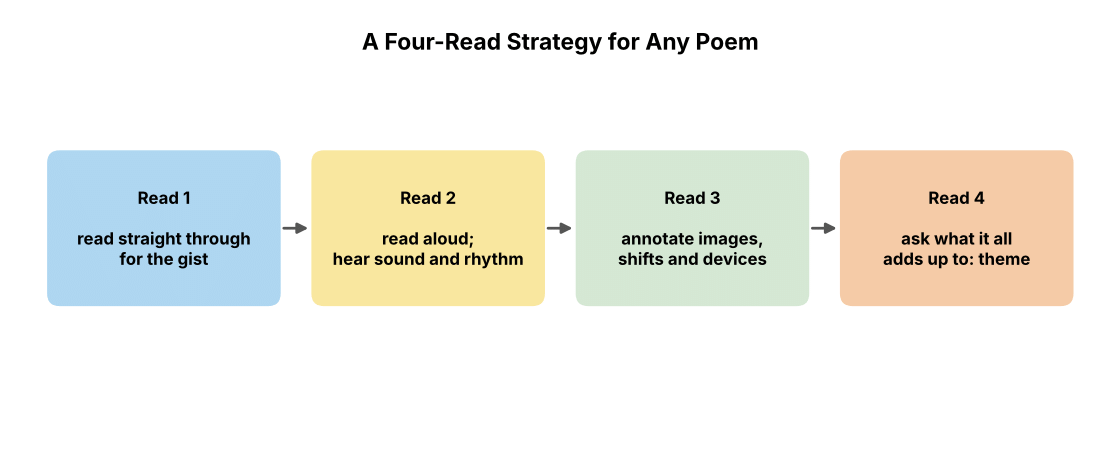
Read 2: Read aloud. Poems are written to be heard. Reading aloud reveals rhythm, rhyme, and emphasis. Follow the punctuation, not the line breaks: if a line has no punctuation at the end, keep reading into the next line without a full stop.
Read 3: Read for the literal meaning. Look up unfamiliar words. Figure out who is speaking, to whom, where, and when. Then paraphrase: restate what happens in plain language, one stanza at a time.
Read 4: Read for interpretation. Look for patterns, contrasts, shifts, and striking word choices. Ask what the poem suggests beyond its literal events.
Why does this matter? Most confusion about poetry comes from trying to interpret before understanding. A student who skips the literal level may build an interpretation on a misreading. Paraphrasing first gives you solid ground.
Worked Example
Consider these lines from William Blake’s “The Tyger” (1794):
Tyger Tyger, burning bright,
In the forests of the night;
- Literal meaning: The speaker addresses a tiger that seems to glow in a dark forest.
- Word choice: “Burning” suggests fire, energy, and danger, not just brightness.
- Sound: Strong beats and the repeated “Tyger” create a chant-like rhythm.
- Question: Why describe a tiger as burning? Later stanzas ask who could have created such a fearsome creature, which opens questions about creation and the existence of both beauty and danger.
Questions to Ask Any Poem
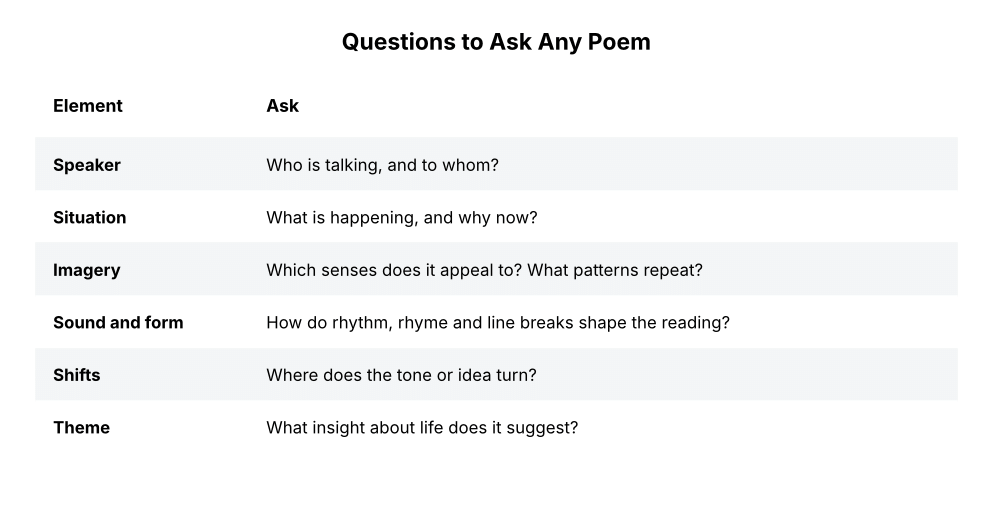
- Who is speaking? The speaker is not always the poet.
- What is the situation? What is happening, and where?
- What is the tone? How does the speaker feel about the subject?
- What images and comparisons appear? What senses do they appeal to?
- Where is the shift? Many poems change direction partway through, often signaled by words like but, yet, or now.
- What is the title doing? Titles often provide context or a key to the poem.
- What is the theme? What larger idea about life does the poem explore?
Annotating a Poem
As you read, mark the poem. Circle unfamiliar words, underline striking images, draw arrows between connected ideas, and note shifts in the margin. Write a one-sentence paraphrase beside each stanza. Annotations turn a passive reading into an active conversation with the text.
Why does this matter? On tests, you rarely have time to reread an entire poem for each question. Good annotations let you find evidence quickly and answer with confidence.
Test-Taking Strategies
Mnemonic Devices and Memory Shortcuts
“Read, Hear, Say, See”: read it through, hear it aloud, say it in your own words, see what it means. Another favorite is TPCASTT: Title, Paraphrase, Connotation, Attitude, Shifts, Title again, Theme.
Cross-Topic Connections
- A complete analysis process is modeled in Topic 1.5: Poetry Analysis Step by Step.
- Line breaks and stanza patterns are explained in Topic 2.1: Lines and Stanzas.
- Sensory language is the focus of Topic 3.1: Imagery.
- Slow, careful reading is practiced in Reading Skills Topic 1.1: Close Reading for Key Ideas and Details.
Common Question Formats
- Paraphrase a stanza or line in your own words.
- Identify who the speaker is addressing.
- Explain the meaning of a word or phrase in context.
- Identify where the poem shifts and explain the change.
Frequent Student Mistakes
- Stopping at the end of every line instead of following punctuation.
- Assuming the speaker is the poet.
- Jumping to symbolism before understanding the literal situation.
Test-Day Shortcuts
Read the title and the last stanza first. They often reveal the subject and the poem’s final position, which helps you understand everything in between.
Time Management Tips
On English unit tests and standardized reading tests such as the SAT and ACT, spend two to three minutes reading a short poem before answering. That investment makes each question faster.