
“I eat lunch” and “I am eating lunch” both describe a meal, but they paint different pictures. The first sounds like a habit. The second puts you in the middle of the action, fork in hand. That difference comes from the progressive tenses, which English uses to show actions that are ongoing, in progress, or unfinished at a particular moment.
This article covers Topic 2.6: Progressive Verb Tenses in Unit 2, Parts of Speech: Verbs. The topic asks you to form and use the past, present, and future progressive tenses and to tell them apart from the simple tenses.
By the end, you should be able to:
- Form the present, past, and future progressive tenses.
- Explain when a progressive tense fits better than a simple tense.
- Recognize the perfect progressive tenses.
- Avoid progressive forms with stative verbs and avoid unnecessary tense shifts.
How Progressive Tenses Are Built
Every progressive tense combines a form of the helping verb be with the present participle, the -ing form of the main verb. The form of be carries the time; the participle carries the meaning.
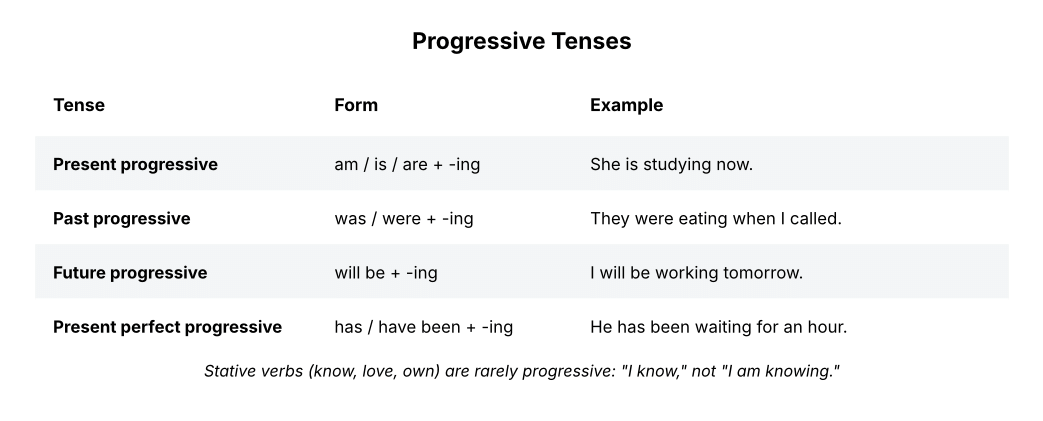
| Tense | Formula | Example | Use |
|---|---|---|---|
| Present progressive | am/is/are + -ing | She is studying right now. | Action happening at this moment or around now |
| Past progressive | was/were + -ing | They were walking home when it rained. | Action in progress at a past moment |
| Future progressive | will be + -ing | I will be working at noon tomorrow. | Action that will be in progress at a future moment |
Spelling rules for the participle matter. Drop a silent final e (make, making). Double a final consonant after a single stressed short vowel (run, running; begin, beginning). Change ie to y (lie, lying).
Simple Versus Progressive
The simple tenses describe facts, habits, and completed actions. The progressive tenses describe actions as ongoing.
- Simple present: Marcus plays the trumpet. (He is a trumpet player; it is a habit.)
- Present progressive: Marcus is playing the trumpet. (He is playing it at this moment.)
- Simple past: I read the chapter last night. (Completed.)
- Past progressive: I was reading the chapter when the power went out. (Interrupted while ongoing.)
The past progressive often pairs with the simple past to show one action interrupting another. The longer, ongoing action takes the progressive; the short, interrupting action takes the simple past.
Why does this matter? Choosing the progressive changes how a reader experiences time. Writers of stories use the past progressive to set a scene (“Rain was falling, and the streetlights were flickering”) before a sudden event happens in the simple past (“Then the door slammed”).
Other Uses of the Present Progressive
The present progressive also describes:
- Temporary situations: “My cousin is staying with us this month.”
- Changing situations: “The climate is getting warmer.”
- Planned future events: “We are leaving for Chicago on Friday.”
The Perfect Progressive Tenses
Combining the perfect and progressive tenses shows an ongoing action that continues up to a certain point.
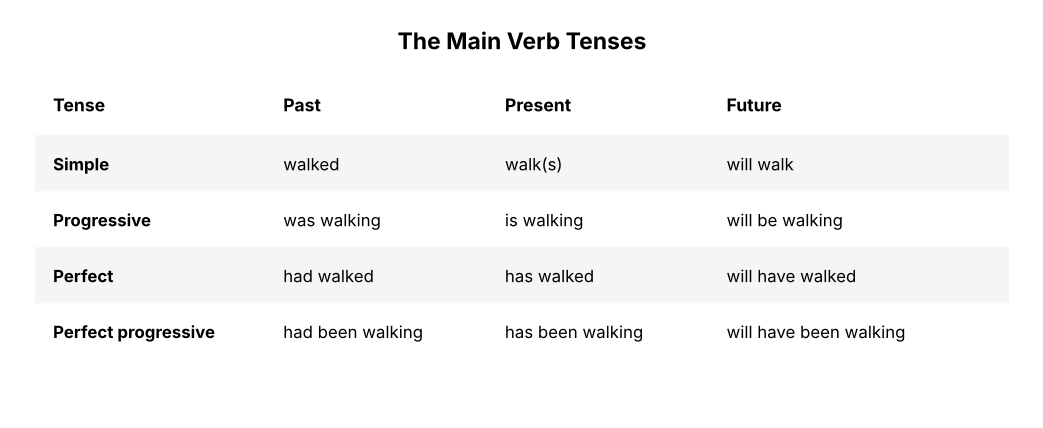
- Present perfect progressive (has/have been + -ing): “She has been practicing for three hours.”
- Past perfect progressive (had been + -ing): “They had been waiting for an hour before the bus came.”
- Future perfect progressive (will have been + -ing): “By June, I will have been studying Spanish for two years.”
Look for duration words such as for, since, and all day. They often signal a perfect progressive tense.
Stative Verbs
Some verbs describe states rather than actions, and they usually do not take progressive forms. These stative verbs include know, believe, belong, own, need, prefer, seem, and understand.
- Incorrect: I am knowing the answer.
- Correct: I know the answer.
A few verbs can be stative or active depending on meaning. “I have a dog” is stative, but “I am having lunch” is an action. “She thinks it will rain” states an opinion, but “She is thinking about the problem” describes a mental activity in progress.
Keeping Tenses Consistent
Do not shift between progressive and simple tenses, or between past and present, without a reason.
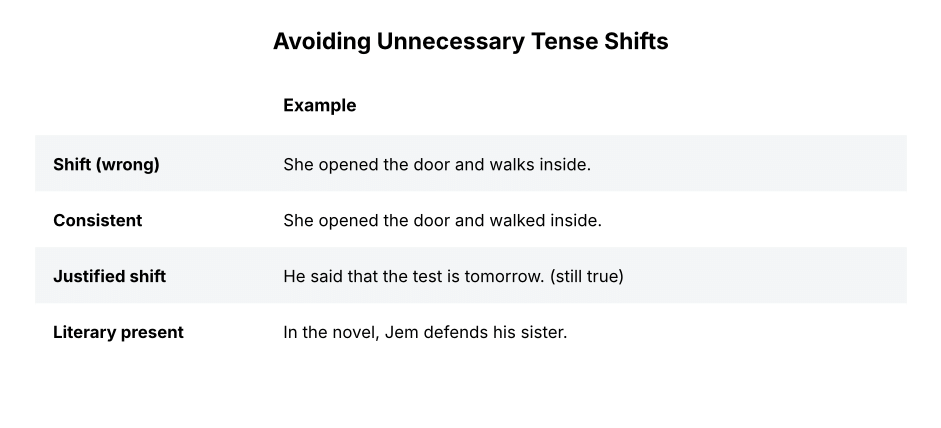
- Incorrect: We were hiking up the trail, and suddenly a deer jumps out.
- Correct: We were hiking up the trail, and suddenly a deer jumped out.
Why does this matter? Unnecessary tense shifts confuse readers about when events happen. Editing questions on standardized tests frequently test whether a verb matches the time frame set by the rest of the passage.
Test-Taking Strategies
Mnemonic Devices and Memory Shortcuts
“Be plus -ing equals in progress.” The form of be tells you when, and the -ing verb tells you what. For the perfect progressive, think “been plus -ing equals for a while.”
Cross-Topic Connections
- The base tenses are reviewed in Topic 2.4: Simple Verb Tenses.
- Combined forms build on Topic 2.5: Perfect Verb Tenses.
- The helping verb be is explained in Topic 2.3: Auxiliary Verbs.
- Action and state verbs are compared in Topic 2.1: Action Verbs.
Common Question Formats
- Identify the tense of an underlined verb.
- Choose the verb form that fits a time clue in the sentence.
- Correct an unnecessary tense shift in a paragraph.
- Rewrite a sentence to show an interrupted past action.
Frequent Student Mistakes
- Leaving out the helping verb: “She studying” instead of “She is studying.”
- Using progressive forms with stative verbs like know and belong.
- Misspelling participles such as “runing” or “makeing.”
Test-Day Shortcuts
Scan for time clues first: right now points to present progressive, when plus a past event often points to past progressive, and for or since points to a perfect tense.
Time Management Tips
Verb tense items on English unit tests and standardized tests such as the SAT and ACT take about 30 seconds. Read the sentence before and after the verb to confirm the time frame.