
Photosynthesis is the process that makes nearly all life on Earth possible: plants, algae, and cyanobacteria convert light energy into chemical energy stored in glucose. For AP® Biology, understanding where each stage of photosynthesis occurs within the chloroplast is just as important as understanding the reactions themselves. Location determines function — and AP exam questions frequently ask you to connect a specific product or reaction to its precise site within the chloroplast.
The complete equation for photosynthesis:
6CO2 + 6H2O + light energy → C6H12O6 + 6O2
This single equation encompasses two interconnected reaction systems that occur in different compartments of the chloroplast, each requiring specific molecular machinery. Before exploring those systems, let’s understand where they occur.
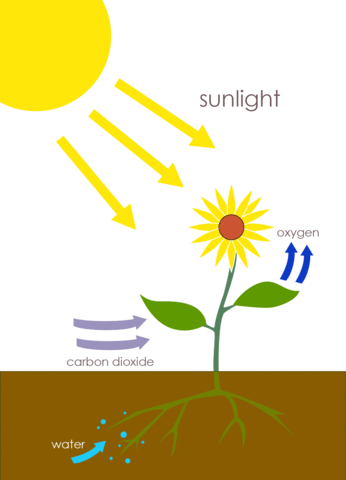

The chloroplast is the organelle responsible for photosynthesis in plant cells. Like mitochondria, chloroplasts contain their own DNA and ribosomes, reflecting their evolutionary origin as free-living cyanobacteria that entered into an endosymbiotic relationship with early eukaryotic cells.
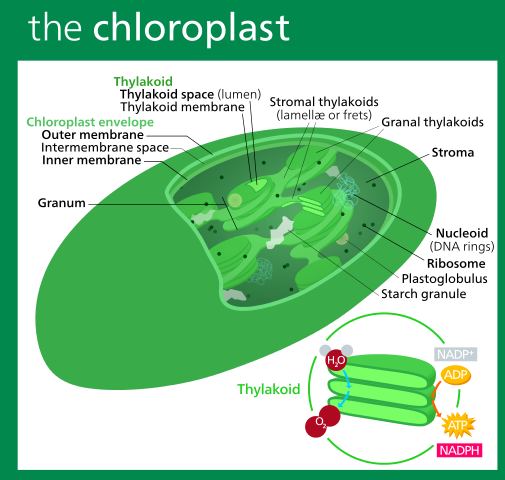

The chloroplast has two main internal compartments:
- Thylakoids: Flattened membrane sacs arranged in stacks (grana). The thylakoid membrane contains photosystems, electron transport chains, and ATP synthase. The thylakoid interior (lumen) is where protons accumulate during the light reactions.
- Stroma: The fluid-filled space surrounding the thylakoids. Contains enzymes for the Calvin Cycle, chloroplast DNA, and ribosomes.
These locations matter: the light-dependent reactions occur in the thylakoid membrane; the Calvin Cycle occurs in the stroma.
Light-dependent Reaction
The light-dependent reactions (light reactions) occur in the thylakoid membrane. Their primary functions are:
- Capture light energy via chlorophyll pigments
- Use that energy to synthesize ATP and NADPH
- Split water to release O2 (a by-product)
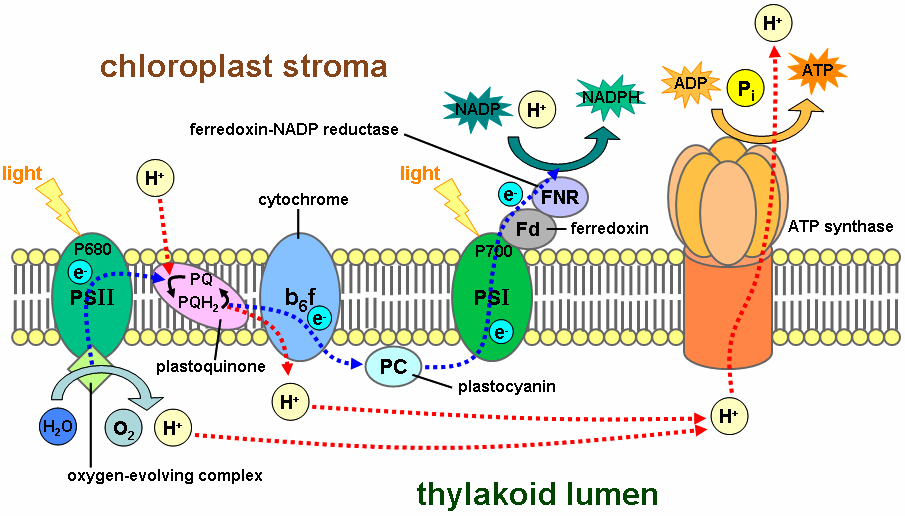

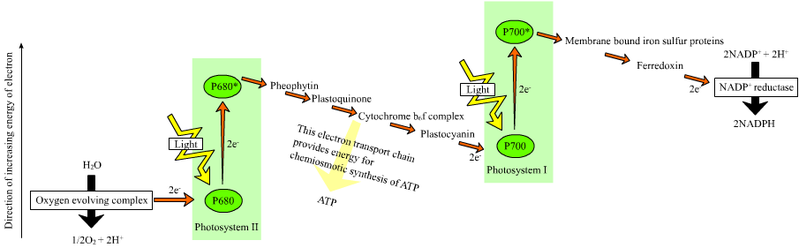
The two key protein complexes are Photosystem II (PSII) (absorbs light maximally at 680 nm) and Photosystem I (PSI) (absorbs maximally at 700 nm). They work in series:
- PSII absorbs light → excites electrons to a higher energy state
- Excited electrons leave PSII and enter the electron transport chain (a series of protein complexes embedded in the thylakoid membrane)
- As electrons move through the chain, they release energy that pumps H+ ions from the stroma into the thylakoid lumen — creating a proton gradient (chemiosmosis)
- PSII replaces its lost electrons by splitting water (photolysis): 2H2O → O2 + 4H+ + 4e–. The O2 is released as a by-product — the oxygen in the air you breathe comes from this reaction.
- Electrons reach PSI, absorb another photon, and are energized again
- Energized electrons from PSI reduce NADP+ to NADPH via ferredoxin and NADP+ reductase
- H+ ions flow back through ATP synthase from lumen to stroma, driving ATP synthesis via chemiosmosis
Products of the light reactions: ATP, NADPH, O2. These products power the next stage.

Light-independent Reaction
The Calvin Cycle (also called the light-independent reactions or dark reactions) occurs in the stroma. Despite being “light-independent,” it is tightly coupled to the light reactions because it depends entirely on ATP and NADPH produced there. It cannot proceed without them, so it is indirectly light-dependent.
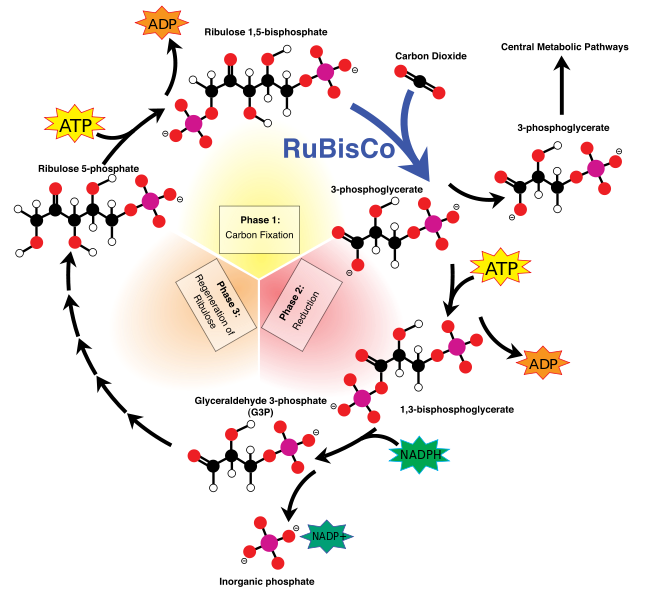

The Calvin Cycle has three stages:
- Carbon fixation: The enzyme RuBisCO catalyzes the combination of CO2 with ribulose-1,5-bisphosphate (RuBP), a 5-carbon molecule. The product is two molecules of 3-phosphoglycerate (3-PGA), a 3-carbon compound. This is why the Calvin Cycle is also called C3 photosynthesis in most plants.
- Reduction: ATP and NADPH from the light reactions are used to convert 3-PGA into glyceraldehyde-3-phosphate (G3P). G3P is the three-carbon sugar that is the direct product of photosynthesis and the building block for glucose and other organic molecules.
- Regeneration of RuBP: Most G3P molecules are used to regenerate RuBP using ATP, allowing the cycle to continue. One G3P exits to build glucose and other organic compounds.
Energy cost: For every 3 molecules of CO2 fixed (producing 1 net G3P), the Calvin Cycle uses 9 ATP and 6 NADPH.
Background Stories of ADP →ATP and NADPH and NADP+
The two most important energy carriers produced by the light reactions — ATP and NADPH — are generated through distinct but linked mechanisms:
Chemiosmosis and ATP synthesis: As electrons move through the thylakoid membrane’s electron transport chain, they pump H+ ions from the stroma into the thylakoid lumen. This creates a proton gradient (high H+ concentration in lumen, low in stroma). ATP synthase spans the thylakoid membrane; when H+ ions flow back into the stroma through ATP synthase (chemiosmosis), the energy drives the phosphorylation of ADP to ATP. This is photophosphorylation.
Two types of photophosphorylation occur:
- Noncyclic photophosphorylation: Electrons flow from water through PSII, through the electron transport chain, through PSI, and to NADP+ to produce NADPH. This is the main pathway — it produces both ATP and NADPH and releases O2.
- Cyclic photophosphorylation: Electrons from PSI cycle back through the electron transport chain to PSI rather than going to NADP+. This produces only ATP (no NADPH, no O2). It occurs when NADPH accumulates faster than ATP, allowing the cell to balance its energy currency.
NADPH synthesis: At the end of the noncyclic electron transport chain, ferredoxin transfers electrons to NADP+ reductase, which catalyzes: NADP+ + H+ + 2e– → NADPH. This NADPH carries reducing power to the stroma for the Calvin Cycle.
Conclusion
Location summary mnemonic — “Light reactions in the membrane, Calvin in the stroma” or “Thylakoid = Light; Stroma = Sugar”:
- Thylakoid membrane: Light reactions, PSII, PSI, electron transport chain, chemiosmosis/ATP synthase, water splitting, O2 release
- Thylakoid lumen: H+ accumulation for chemiosmosis
- Stroma: Calvin Cycle (carbon fixation, G3P synthesis, RuBP regeneration), RuBisCO
Product tracking:
- Light reactions → ATP, NADPH, O2 (outputs); water, ADP, NADP+ (inputs)
- Calvin Cycle → G3P → glucose (outputs); CO2, ATP, NADPH (inputs)
Cross-topic connections on the AP® Biology exam:
- Cellular respiration (Big Idea 2): Photosynthesis and cellular respiration are complementary processes — photosynthesis produces glucose and O2; cellular respiration consumes them. ATP synthase in the thylakoid membrane is structurally and mechanistically similar to ATP synthase in the mitochondrial inner membrane (both use chemiosmosis). AP FRQs frequently ask you to compare these two processes.
- Endosymbiotic theory (Big Idea 1): Chloroplasts evolved from cyanobacteria that were engulfed by early eukaryotic cells. Evidence includes: chloroplasts have their own circular DNA, double membranes, and can replicate by binary fission. This connection between evolution and cell biology appears on AP exams.
- C3, C4, and CAM plants: The standard Calvin Cycle described here is C3 fixation (3-PGA is the first product). C4 plants use a spatial separation between carbon fixation and the Calvin Cycle to reduce photorespiration in hot, dry environments. CAM plants use temporal separation (fix CO2 at night, run Calvin Cycle during day). AP exam questions often ask you to predict which strategy is adaptive in specific environments.
- Climate change and photosynthesis: Rising CO2 can increase photosynthesis rates in C3 plants (more substrate for RuBisCO) but may negatively affect C4 plants’ competitive advantage. Ocean acidification affects photosynthesis in marine algae. These connections appear in AP® Environmental Science and AP® Biology cross-disciplinary questions.
Common question formats on the AP® Biology exam:
- “In which organelle compartment does ATP synthesis via chemiosmosis occur during photosynthesis?” → The thylakoid membrane (H+ flows from lumen through ATP synthase into stroma)
- “A researcher adds a compound that blocks electron transfer in PSI. What happens to NADPH production and Calvin Cycle output?” → NADPH production stops (PSI can’t reduce NADP+); Calvin Cycle halts (no NADPH to reduce 3-PGA to G3P)
- “What is the source of oxygen released during photosynthesis?” → Water (photolysis at PSII) — not CO2
- “Under what conditions might cyclic photophosphorylation be preferred over noncyclic?” → When ATP is limiting but NADPH is abundant; when CO2 fixation rate is high relative to electron supply
Frequent student mistakes:
- Saying the Calvin Cycle doesn’t need light. It doesn’t use light directly, but it requires ATP and NADPH from the light reactions. Without light, the Calvin Cycle stops within minutes once ATP and NADPH are depleted.
- Saying CO2 produces O2. O2 comes from water, not CO2. This was confirmed by isotope labeling experiments (heavy oxygen in water → heavy oxygen in O2). This is a common AP exam trap.
- Confusing thylakoid lumen and stroma. H+ accumulates in the lumen (inside thylakoids). ATP is synthesized in the stroma (outside thylakoids, inside the chloroplast but outside the thylakoid). ATP synthase spans the thylakoid membrane.
- Thinking RuBisCO operates in the thylakoid. RuBisCO (the most abundant enzyme on Earth) is in the stroma, where it catalyzes CO2 fixation in the first step of the Calvin Cycle.
Test-day shortcuts:
- If asked “where” for any photosynthesis reaction: Light reactions = thylakoid membrane; Calvin Cycle = stroma. These two facts answer most location questions.
- If asked about O2 production: Always trace to PSII (not PSI) and water (not CO2).
- For energy currency questions: Light reactions produce ATP and NADPH. Calvin Cycle consumes ATP and NADPH to make G3P. ATP and NADPH are the links between the two stages.
Time management: Photosynthesis questions on the AP® Biology exam can be complex. For diagram-based questions (“which part of the thylakoid membrane does X occur?”), draw out the thylakoid as a quick mental map: PSII → electron transport chain → PSI → NADPH, all embedded in the membrane, with H+ moving from stroma to lumen. Budget 30 seconds to sketch this, then answer quickly. For FRQ questions about experimental manipulation of photosynthesis, trace the consequence through the entire pathway: which stage is affected → what intermediate is missing → what downstream process fails.