
Albert is one K–12 practice and assessment platform for a whole district: free adaptive practice, plus question banks for every subject and test.
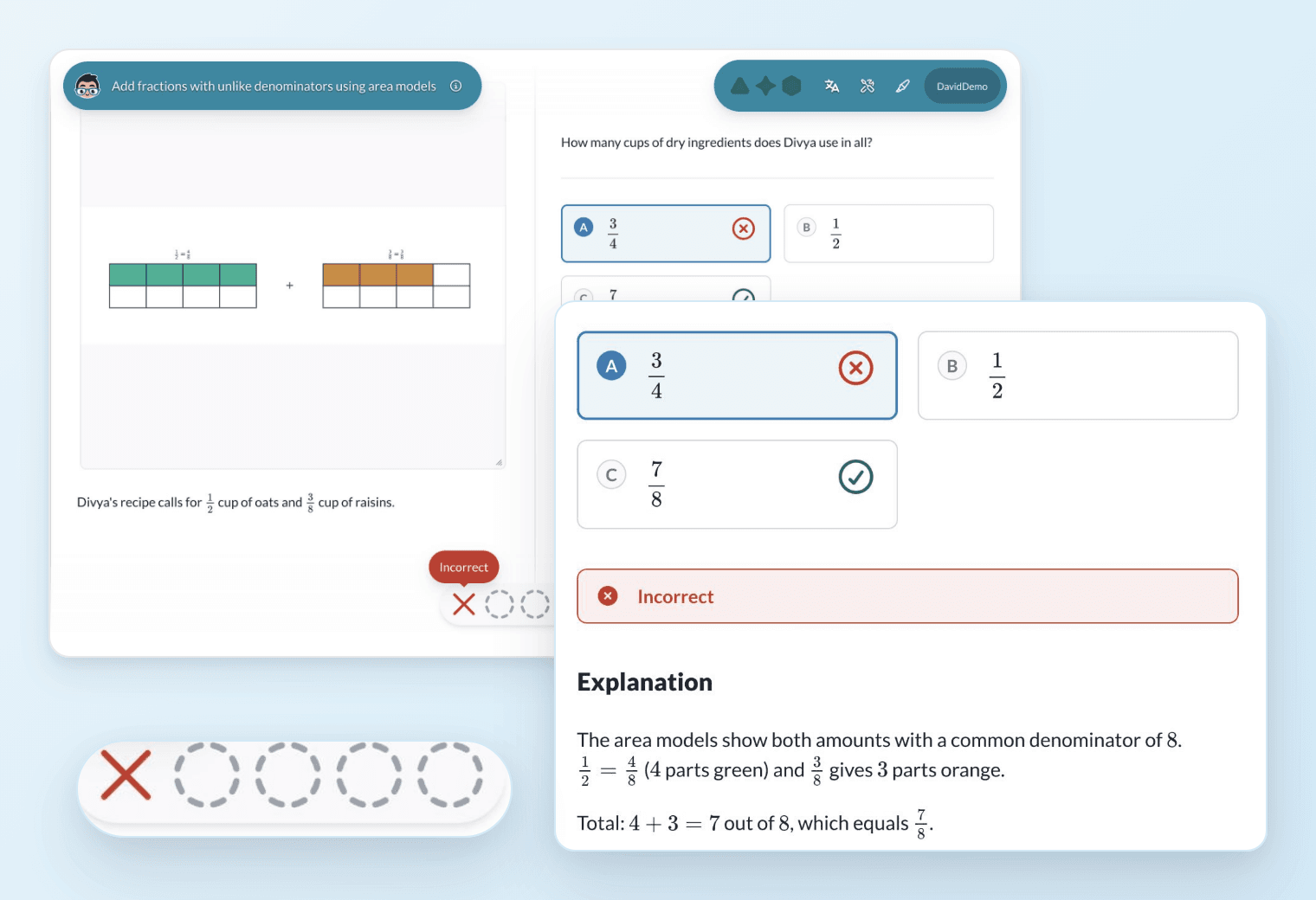
Albert is the better fit for K–12 schools that want free adaptive practice in every subject, or AP, SAT, ACT and state test prep. IXL is the better fit for pre-K, K–2 math, or one paid subject in a small school.
Five areas. Select one for the evidence.
Albert is the better fit in 4 of 5 areas; 1 depends on the school.
Price
For two or more subjects, Albert costs the same as IXL or less; for one subject in a small school, IXL can cost less ($13.25 per student against Albert’s top rate of $18).
List prices per student per year, before discounts.
| License | Albert | IXL |
|---|---|---|
| Every subject | Albert: $6–$18, lower with every 100 students | IXL: $24.00–$24.75 for the 4 core subjects |
| Two subjects | Albert: included in Albert's one $6–$18 license | IXL: $18.00–$18.75 |
| One subject | Albert: included in Albert's one $6–$18 license | IXL: $12.50–$13.25 |
| K–8 school | Albert: $2,799 flat, unlimited students (grades 3–8 question banks) | IXL: per student, by subject |
| Free plan | Albert: adaptive practice in every subject, K–12, no daily limit | IXL: 10 questions per subject per day |
Albert: albert.io/pricing-schools. IXL: rate card in San Francisco Unified's 2026–27 IXL agreement (prices fall slightly with enrollment, from under 1,000 to 10,000+ students). Checked November 23, 2026.
Test prep
For AP, SAT, ACT and state tests, Albert is the better fit than IXL: Albert writes exam-style questions and full-length timed sections; IXL maps each test’s topics to its everyday skills.
Practice carries over to test day when it matches the exam’s blueprint, item types, passages, rigor and timing.
| Criterion | Albert test prep | IXL skill plans |
|---|---|---|
| Blueprint | Albert: built from each exam's blueprint, specs and released items | IXL: test topics matched to existing IXL skills |
| Item types | Albert: modeled on the exam, from multiselect to graphing and free response | IXL's own formats, whichever test the plan names |
| Passages and data | Albert: built to the test's length, complexity and style | IXL: written for IXL skills |
| Rigor | Albert: matched to the exam, reviewed by veteran test graders | IXL: set by each skill's grade level |
| Timing | Albert: full-length, timed SAT and ACT sections with test-day tools | IXL: untimed; no full-length tests found |
| AP exams | Albert: 35 AP courses, including 1,150+ free-response questions with rubrics | IXL: no AP exam question banks found |
IXL's SAT Math plan describes itself this way: “This document includes IXL skill alignments to the SAT®.” “Not found” means not on ixl.com or in IXL's published materials. Checked November 23, 2026.
Adaptive practice
Albert’s adaptive practice is free for every K–12 teacher and student, with no daily limit; IXL allows 10 free questions per subject per day, and near mastery one miss can cost 8 SmartScore points.
IXL counts a skill as mastered at a SmartScore of 100 (IXL calls 80 proficient). From 90 up, a wrong answer costs more than a right one earns. Albert explains every miss and awards mastery for recent accuracy.
| Feature | Albert Adaptive | IXL |
|---|---|---|
| Free access | Albert: free forever for every teacher and student, no daily limit | IXL: 10 questions per subject per day without a license |
| Subjects and grades | Albert: math, ELA, science, social studies and Spanish, K–12 (in K–2, mostly phonics and grammar); 4,800+ skills | IXL: math, ELA, science, social studies and Spanish, pre-K–12; 17,000+ skills |
| How mastery works | Albert: a badge for meeting the skill's goal in recent attempts, such as 4 of the last 5 | IXL: SmartScore from 0 to 100; mastered at 100 |
| After a wrong answer | Albert: an expert explanation of the right answer and every wrong choice | IXL: a step-by-step explanation; from 90 up, a wrong answer also costs 3–8 points and a right one earns 1–2 |
| Teacher control | Albert: Skill Paths with due dates; diagnostics in about one class period (with a license) | IXL: skill plans and the LevelUp Diagnostic |
Sequence: 94 (start); 96 (✓); 98 (✓); 90 (✕), wrong; 92 (✓); 94 (✓); 96 (✓); 98 (✓).
On IXL, one slip at 98 can cost 8 points, which takes four or more correct answers to win back.
Sequence: ✓ (1), correct; ✓ (2), correct; ✕ (3), wrong; ✓ (4), correct; ✓ (5), correct; Badge (4 of 5), milestone.
In Albert, the student reads why after the miss. Four of the last five correct earns the next badge.
SmartScore rules from IXL's SmartScore guide: +1 to +2 for a right answer and −3 to −8 for a wrong one from 90 to 100, shown at the worst case. Try Albert Adaptive free. Checked November 23, 2026.
Content quality
Albert has 428,000+ expert-written questions, each with an explanation or rubric, and multiple-choice explanations cover every answer choice; IXL gives a step-by-step explanation of the correct solution.
| What students practice on | Albert | IXL |
|---|---|---|
| Explanations | Albert: a narrative explanation for every question, covering every choice on multiple-choice questions | IXL: step-by-step explanation of the correct solution |
| Reading | Albert: question banks for 99 novels and plays, from Macbeth to The Hate U Give | IXL: book-study skills on short passages |
| Writing | Albert: rubric-scored free response with teacher feedback | IXL: writing-strategy and revising skills; essays in NoRedInk, a separate brand IXL acquired in October 2026 |
| Social studies | Albert: 35,000+ questions built on primary sources: maps, cartoons, data | IXL: K–8 skills, plus high school U.S. history and civics |
| Science | Albert: NGSS-aligned, with simulations like Force Lab and phenomenon-based sets | IXL: science skill practice, including high school biology and physics |
| Courses | Albert: 359 question banks, including 61 core question banks with CTE and electives, 35 AP question banks and 119 state test question banks | IXL: skill practice in math, ELA, science, social studies and Spanish |
Albert counts from Albert's live content library, November 2026. IXL: NoRedInk acquisition. Checked November 23, 2026.
Support
An Albert license includes free, live 1-on-1 training for every teacher; IXL offers free webinars and sells live PD, such as a $695 virtual session.
| Service | Albert | IXL |
|---|---|---|
| Teacher training | Albert: free, live 1-on-1 training with a license | IXL: free webinars and a help center |
| Team sessions | Albert: free 15-minute tours in department or PLC meetings with a license | IXL: sold as PD sessions |
| Account support | Albert: live chat and email, plus a dedicated Account Manager with a license | IXL: email and phone support, plus an account manager with site licenses |
| Paid PD | Albert: $900 per virtual hour; $2,750 half-day on site | IXL: $695 per virtual session; $1,295 starter PD package per building |
Albert: professional development and albert.io/pricing-schools. IXL: site license benefits and San Francisco Unified's 2026–27 IXL agreement. Checked November 23, 2026.
“My favorite parts, though, are the literature and the poetry. The literature selections include a number of titles that our students read and will be a great supplement to our instruction. The poetry selections range from classical to contemporary, and I can't wait to explore more.”
Holly D.
ELAR, Middle School, Brownsville ISD
“I actually asked my students and they prefer Albert largely due to the explanations of the answers that they get when they are wrong.”
Joshua Craven
Math, High School, Perkiomen Valley High School
Yes, for most K–12 schools. Albert's adaptive practice is free for every teacher and student in math, ELA, science, social studies and Spanish, K–12 (in K–2, mostly phonics and grammar), and an Albert license adds question banks for 35 AP courses, the SAT, ACT and PSAT, and 119 state and English-proficiency question banks. IXL is the better fit for pre-K, which Albert does not cover, and for K–2 math.
Yes: Albert. Albert's adaptive practice is free forever for every teacher and student, with no daily limit, in math, ELA, science, social studies and Spanish, K–12 (in K–2, mostly phonics and grammar), with explanations and class reports. IXL's free access is 10 questions per subject per day.
It depends on how many subjects the school buys. For two subjects or more, Albert costs the same as IXL or less: Albert's school license is $6–$18 per student for every subject, while IXL, which doesn't publish site-license prices, lists $18.00–$18.75 per student for two subjects and $24.00–$24.75 for four on the rate card in San Francisco Unified's 2026–27 agreement. For one subject in a small school, IXL can cost less: $13.25 per student against Albert's top rate of $18. K–8 schools pay Albert a flat $2,799 (unlimited students; AP, SAT, ACT and CTE not included), less than one IXL subject at list price in any school above 211 students.
For skill review, yes; for test-day practice, Albert is the better fit. IXL's test plans map each test's topics to IXL's regular skills, in IXL's everyday formats, and we found no full-length SAT or ACT tests and no AP banks on IXL. Albert covers every current SAT, PSAT, ACT and PreACT section with 13,300+ questions and 60 full-length section exams, plus 35 AP question banks.
Yes, sharply near mastery. IXL's SmartScore guide says that from 90 up, right answers add 1–2 points and wrong answers subtract 3–8; mastery is 100, so one miss at 98 can drop a student to 90. Albert awards mastery badges on recent accuracy, such as 4 of the last 5 correct.
For most schools, Albert: Albert has free adaptive practice in math, ELA, science, social studies and Spanish with no daily limit, plus 26 middle school banks, question banks for 31 novels and 55 state test question banks for grades 6–8. IXL is a strong choice for grade 3–8 math and ELA skills, and Albert has no state test banks for grades 3–5.
Albert, and the gap is widest here: Albert has 35 AP question banks, full-length SAT and ACT exams, state end-of-course banks, question banks for 99 novels and plays, 20 CTE question banks, and free adaptive practice in every subject through grade 12. We found no AP banks or full-length tests on IXL.
For grades 3–12, Albert: Albert has chapter-by-chapter question banks for 99 novels and plays, rubric-scored writing, adaptive reading and grammar, and ELA prep for state tests, SAT, ACT and AP English. IXL's book study uses short passages, and IXL's essay-writing tool, NoRedInk, is a separate brand.
Albert: Albert has 35,000+ questions across 41 question banks, including 10 AP question banks and state tests like STAAR, Regents and LEAP, built on about 4,000 primary sources such as maps and political cartoons. IXL's social studies covers K–8 skills plus U.S. History and Civics.
Albert: Albert has 40,800+ NGSS-aligned questions, 22,800+ tagged to science and engineering practices, with simulations and phenomenon-based sets, from grade 3 through seven AP sciences and NGSS state tests like CAST. IXL offers science skill practice, including high school biology and physics.
Albert, which has 20 CTE question banks, ASVAB banks and 839 questions for the three WorkKeys tests behind the NCRC. We found no CTE courses on IXL; IXL's ASVAB and WorkKeys support is skill plans. IXL covers WorkKeys Business Writing, which Albert does not.
For grades 6–12, Albert: Albert has banks written for TELPAS, ELPAC and AZELLA, organized by each test's sections, with Spanish translations in most subjects. IXL's English-learner plans map test topics to IXL's regular ELA skills.
From grade 3, yes, with an Albert school license. Albert's diagnostics take about one class period in each adaptive subject, then Skill Paths assign each student skills with due dates. With Albert Pro, districts also share secure common assessments and compare item analysis across schools.
Yes. A school can keep IXL for pre-K or K–2 math and use Albert for adaptive practice, AP, SAT, ACT, state and English-proficiency prep, and literature question banks.
The IXL alternatives schools compare most are Albert, Khan Academy, DeltaMath, Freckle, DreamBox Math, Prodigy, Zearn and i-Ready. Each fits a different need.
| Tool | Best for | Grades and subjects | Price |
|---|---|---|---|
| Albert | Albert: one practice and assessment platform for a whole district, with question banks for every subject plus AP, SAT, ACT and state test prep | K–12: math, ELA, science, social studies, Spanish; AP, SAT, ACT, state test and CTE prep | Albert Adaptive: free, no daily limit. Albert high schools $6–$18 per student per year; Albert K–8 schools $2,799 per school per year |
| Khan Academy | Khan Academy: free video lessons with mastery practice, and SAT prep developed with College Board | Pre-K–12: math, reading, science, history, computing; SAT and AP | Khan Academy: free; Khan Academy Districts Enterprise Starter $10 per student, up to 1,000 students |
| DeltaMath | DeltaMath: teacher-built, autograded math assignments | Grades 4–12, through calculus: math only | DeltaMath: free teacher plan; paid plans $115–$180 per teacher |
| Freckle | Freckle: K–8 math and ELA practice driven by Renaissance Star or FastBridge scores | K–12: math, ELA, science, social studies | Freckle: a limited free teacher version; Freckle Premium by quote |
| DreamBox Math | DreamBox Math: adaptive, game-like math lessons with virtual manipulatives | K–8: math only | DreamBox Math: by quote |
| Prodigy | Prodigy: game-based math practice students choose to play | Math grades 1–8; English grades 1–6 | Prodigy: free for teachers and students; optional paid parent memberships |
| Zearn | Zearn: a K–8 math curriculum with digital lessons | K–8: math only | Zearn: free for 1 teacher and up to 35 students; school accounts by quote |
| i-Ready | i-Ready: a district-wide diagnostic that sets each student’s math and reading lessons | K–8: math, reading | i-Ready: by quote |
Albert is listed first; the other tools are in no ranked order. Prices and free tiers come from each tool’s linked page; Khan Academy’s price is sourced on the Albert vs Khan Academy comparison. Checked November 23, 2026.
Written by the Albert team and last reviewed on November 23, 2026. Details about IXL come from IXL’s public materials and public district purchasing records at that time; check with IXL for current pricing and features. Albert facts come from albert.io, Albert’s help center and Albert’s published content counts as of November 2026. If anything here about IXL is out of date, email schools@albert.io and we’ll fix it. IXL is a trademark of IXL Learning, Inc., which did not review this page.
IXL: SAT Math test prep plan (“This document includes IXL skill alignments to the SAT®.”), ACT WorkKeys Applied Math plan and English learner skill plans
IXL: classroom license calculator, site license benefits, classroom trial and SecureTest guide
Public IXL contracts and quotes: San Francisco USD 2026–27, San Francisco USD 2024–25, Moore (OK), Montrose County (CO), Navarre Middle School (IN), Bridges Charter (CA), Gulfport (MS) and Pennsbury (PA)
IXL Live 2026 listings: Classic Edition and Administrator Edition
Albert: pricing, professional development, adaptive practice, help center, research and ESSA evidence
Pricing · Adaptive practice · Question banks · For teachers · For school leaders · Research · ESSA evidence