

Maximize your score with these resources:
- Albert.io AP® US Government question banks
- Free AP® US Government cheat sheets
- Free AP® US Government score calculator
The 1968 presidential election is one of the most consequential in American history — a collision of Vietnam War fatigue, racial upheaval, and political fragmentation that reshaped both parties for a generation. For the AP® US Government exam, understanding 1968 means grasping how candidate ideology, third-party dynamics, and the Electoral College can interact to produce unexpected outcomes.
Introduction to the 1968 Election
The 1968 election matched Republican Richard Nixon against Democrat Hubert Humphrey, with third-party candidate George Wallace of the American Independent Party running a segregationist campaign. Nixon won with 301 electoral votes to Humphrey’s 191 and Wallace’s 46 — but the popular vote was razor-thin: Nixon 43.4%, Humphrey 42.7%, Wallace 13.5%. Wallace’s ability to carry five Deep South states made 1968 the last election in which a third-party candidate won any electoral votes. Understanding why requires examining the fractures running through 1960s America.
What Impacted the Vote
Several converging crises shaped the 1968 vote:
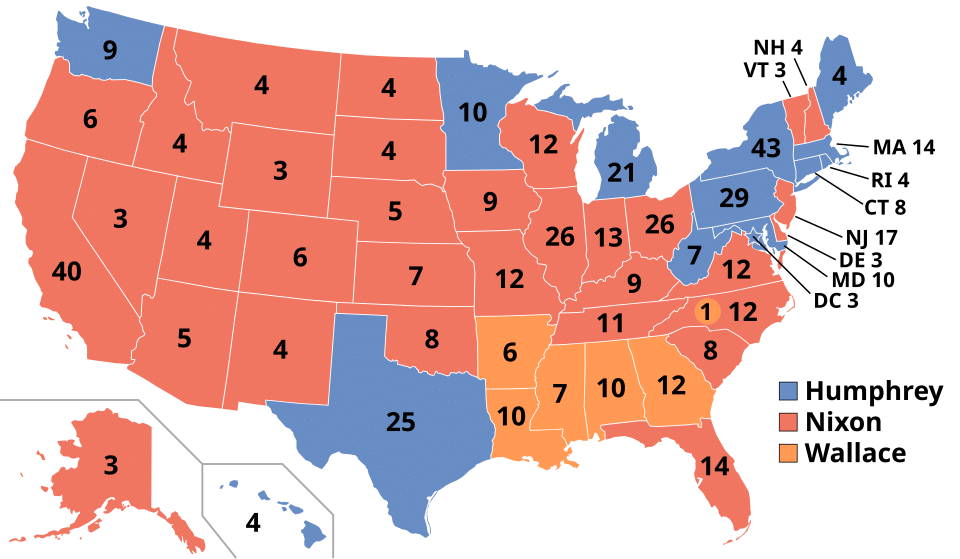
Vietnam War: By 1968 over 500,000 U.S. troops were in Vietnam with no clear end in sight. The January 1968 Tet Offensive — a coordinated North Vietnamese attack on over 100 cities — shattered the Johnson administration’s optimistic narrative and turned public opinion sharply against the war. Both candidates had to address the war, but on different terms: Humphrey was shackled to LBJ’s policy; Nixon promised a vague but appealing “secret plan” to end it.
Civil Rights and Social Disorder: The assassination of Martin Luther King Jr. in April 1968 triggered riots in more than 100 U.S. cities. Robert F. Kennedy was assassinated in June. Urban riots, anti-war protests, and the chaos at the Democratic National Convention in Chicago all fed a sense that the country was coming apart. Nixon’s appeal to the “silent majority” — law-abiding Americans exhausted by disorder — resonated strongly in this environment.
Democratic Party Fracture: Lyndon Johnson’s decision not to seek re-election, RFK’s assassination, and the violent Chicago convention left the Democrats visibly divided. George Wallace capitalized on white working-class and Southern white resentment, pulling voters who might otherwise have supported either party.
The Republican Candidate

Richard Nixon came to 1968 with an unusually deep political résumé. He had served in the House of Representatives (1947–1950), the Senate (1950–1953), and as Vice President under Dwight Eisenhower (1953–1961). He lost the 1960 presidential race to John F. Kennedy by a narrow margin, then lost the 1962 California governor’s race — a defeat that seemed to end his career. His political resurrection by 1968 was remarkable.
Nixon’s anti-communist credentials, established through his work on the House Un-American Activities Committee investigating Alger Hiss, gave him credibility with conservative voters. His Navy service during World War II and his reputation as a tough, disciplined campaigner rounded out an image of competence and toughness at a moment when the country wanted stability.
Nixon on the Issues
Nixon’s 1968 platform was built around several core themes. On Vietnam, he promised to “end the war and win the peace” without committing to specifics — a calculated ambiguity that allowed voters to project their preferences onto him. He pledged to pursue Vietnamization, gradually shifting combat responsibility to South Vietnamese forces, a policy he would implement after taking office.
On domestic policy, Nixon appealed to what he called the “silent majority” — middle-class Americans who opposed both the war escalation and the social disorder but who felt unheard by a media and political class focused on protesters. He ran hard on law and order, promising to restore stability to American cities and campuses. On racial policy, his “Southern Strategy” used coded appeals to white Southerners uncomfortable with rapid desegregation — an approach that would define Republican electoral strategy for decades.
The Republican Convention
The 1968 Republican primaries featured seven major candidates. Nixon systematically built delegate support by positioning himself as the electable moderate between the conservative Ronald Reagan and the liberal Nelson Rockefeller. He defeated Michigan Governor George Romney, who had self-destructed by saying he was “brainwashed” on Vietnam, along with Rockefeller and Reagan to secure the nomination.
For his running mate, Nixon chose Maryland Governor Spiro Agnew — a moderate who had taken a hard line against Black community leaders after the King assassination riots in Baltimore. The choice signaled to Southern and suburban voters that Nixon took law and order seriously, while remaining palatable to Northern moderates.
The Democratic Candidate

Hubert Humphrey had one of the most distinguished legislative careers in Senate history. As a senator from Minnesota, he had championed the 1964 Civil Rights Act, Medicare, and the Peace Corps. He served as Lyndon Johnson’s Vice President from 1965 to 1969, a position that defined his 1968 campaign — for better and worse.
Humphrey’s problem was loyalty. He supported Johnson’s Vietnam War policy despite growing public opposition, which cost him the anti-war wing of the party. He secured the Democratic nomination without entering a single primary, relying on party machinery after Johnson’s withdrawal and RFK’s assassination — a process that infuriated McCarthy supporters and reform Democrats and contributed to the chaos at the Chicago convention.
Humphrey on the Issues
Humphrey’s domestic agenda was the strongest of any 1968 candidate. He was the architect of much of the Great Society legislation: Medicare, Medicaid, federal education funding, and job training programs like Head Start. He advocated health insurance for the elderly and expanded job opportunities for the unemployed as part of the War on Poverty framework.
On Vietnam, Humphrey was trapped. He finally broke from Johnson in a late September speech, pledging to stop the bombing of North Vietnam as a step toward peace. The speech produced an immediate surge in his poll numbers — nearly erasing Nixon’s lead in the final weeks — suggesting that his early loyalty to Johnson had cost him the election. Had he broken earlier, many analysts believe he would have won.
The Democratic Convention
The 1968 Democratic National Convention in Chicago became a symbol of Democratic disarray. With Humphrey assured of the nomination through machine politics rather than primaries, tens of thousands of anti-war protesters descended on Chicago. Mayor Richard Daley’s police force responded with clubbings and tear gas broadcast live on television — what an official report later called a “police riot.” The spectacle damaged Humphrey before the general campaign even began.
Inside the convention, Democrats also fought over a peace plank in the party platform. Humphrey sided with the Johnson-backed majority plank, further alienating the party’s anti-war base. The chaos convinced many Democrats — particularly younger voters and the liberal wing — that the party’s nomination process needed reform, a conviction that led directly to the McGovern-Fraser Commission reforms of 1969–1972.
The Results of the 1968 Election
Nixon won 301 electoral votes to Humphrey’s 191, with Wallace taking 46 from five Deep South states (Alabama, Arkansas, Georgia, Louisiana, Mississippi). In the popular vote, Nixon’s margin was less than 500,000 votes out of 73 million cast — the third-closest popular vote of the twentieth century.
The geographic realignment was significant. Nixon carried most of the non-Southern states, while Wallace swept the Deep South, leaving Humphrey with only the Upper South and Northeast. This result confirmed what political scientists call the “dealignment” of the New Deal Coalition — the coalition of urban workers, farmers, and Southern Democrats that had elected Roosevelt four times was cracking up. Nixon’s ability to win without the South by consolidating the suburbs and the West foreshadowed the Republican coalition that would dominate presidential politics for the next generation.
The Election of 1968 and the AP® US Government Exam
The AP® US Government exam uses the 1968 election primarily to test understanding of electoral systems, party systems, and voting behavior. Key exam angles include:
Third-party dynamics: Wallace’s campaign illustrates how the Electoral College can amplify third-party candidates who have regional concentration rather than broad national support. His 46 electoral votes came from winning 5 states outright — a feat impossible for a candidate whose support is evenly spread nationally. The exam frequently asks about the structural barriers third parties face and 1968 is the premier recent exception.
Realignment and dealignment: 1968 is the key data point in the story of the collapse of the New Deal Coalition. Nixon’s “Southern Strategy” began shifting white Southern voters toward the Republican Party — a process that took another two decades to complete but that 1968 initiated.
The nomination process: Humphrey’s nomination without entering a primary directly triggered the McGovern-Fraser reforms that created the modern primary system. The exam may ask you to trace the causal chain from 1968 chaos → McGovern-Fraser reforms → binding primaries → implications for candidate selection.
Voting behavior: The 1968 electorate responded to valence issues (law and order, Vietnam) rather than just traditional party identification. Nixon’s “silent majority” framing is a textbook example of candidate strategy for mobilizing non-partisan voters.
Test-Taking Strategies
Know the three candidates, not just two. Wallace is tested as often as Humphrey. His significance: (1) last third-party candidate to win electoral votes, (2) his 5-state sweep shows how the Electoral College can be gamed regionally, (3) his campaign foreshadows the racial realignment of the South.
The causation chain the exam loves: Vietnam War unpopularity → LBJ withdrawal → RFK assassination → Chicago convention chaos → Humphrey nomination without primaries → McGovern-Fraser reforms → binding primaries → modern nomination system. Being able to trace this sequence earns full credit on FRQs about the evolution of the nomination process.
Contrast 1968 with other realignment elections. If an FRQ asks you to “analyze a realignment election,” 1968 pairs well with 1932 (FDR/New Deal Coalition forming) — you can argue 1968 was the beginning of that coalition’s collapse. Both elections illustrate how crisis conditions produce durable party shifts.
Nixon’s Southern Strategy framing. Be precise: Nixon did not carry the Deep South in 1968 (Wallace did). Nixon’s strategy targeted the “peripheral South” (Virginia, North Carolina, Tennessee, Florida) and the suburban Midwest. The full shift of the Deep South to Republicans took until 1980–1984. Confusing Nixon’s 1968 win with later Republican Southern dominance is a common exam mistake.
Popular vote vs. Electoral College disconnect. Nixon won 301 electoral votes on a 43.4% popular vote — a reminder that plurality winners in a multi-candidate race can win strong Electoral College victories. This makes 1968 useful evidence on FRQs about Electoral College reform arguments.
FRQ formula for election analysis: Candidate + Issue position + Voter group targeted + Electoral outcome. Example: “Nixon appealed to the silent majority on law and order, winning suburban and Midwestern voters, which offset his loss of the Deep South to Wallace and allowed him to construct a 301-electoral-vote majority.”