
Maximize your score with these resources:
- Albert.io AP® Human Geography question banks
- Free AP® Human Geography cheat sheets
- Free AP® Human Geography score calculator
Boundaries don’t only separate countries. Inside every state, lines divide provinces, counties, school districts, and voting districts. Those lines decide who represents you, which schools you attend, and sometimes which language your government uses. When they’re drawn to favor one group over another, they can change the outcome of an election before a single vote is cast. The AP® Human Geography exam tests how internal boundaries work, how they’re manipulated, and how they reflect cultural divisions within a state.
This article covers Topic 4.6: Internal Boundaries in Unit 4, Political Patterns and Processes. The topic asks you to explain how voting districts, redistricting, and gerrymandering affect election results, and how internal boundaries can reflect religious, ethnic, and linguistic divisions.
By the end, you should be able to:
- Explain reapportionment and redistricting and why they follow the census.
- Describe gerrymandering, including packing and cracking, with a worked example.
- Explain how courts and independent commissions have responded to gerrymandering.
- Use examples like Belgium, Cyprus, and Canada to show how internal boundaries reflect cultural divisions.
Drawing the Lines: Reapportionment and Redistricting
Two processes shape electoral boundaries in the United States, and the exam treats them as separate steps.
- Reapportionment divides the 435 seats in the House of Representatives among the states based on population. It happens after every census. States that gain population relative to others gain seats. After the 2020 census, Texas gained two seats, while states such as California, New York, and Illinois each lost one.
- Redistricting redraws the boundaries of districts within a state so each district has roughly the same population. In most states, the state legislature draws the maps, which gives the party in power a chance to shape them.
Redistricting affects more than Congress. State legislative districts, city council wards, and school board zones are redrawn too, so these decisions play out at the national, state, and local scales.
Gerrymandering: Packing and Cracking
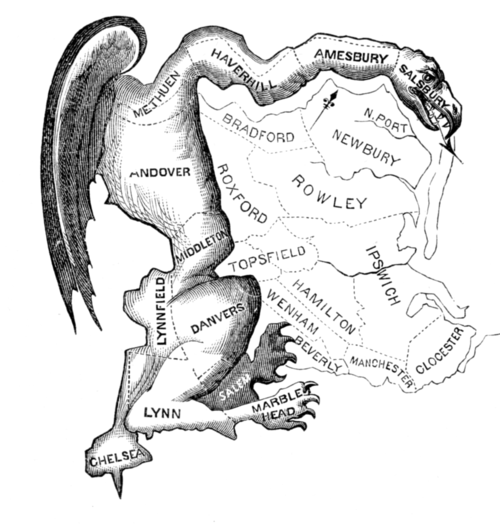

Gerrymandering is drawing district boundaries to give one party or group an advantage. The term dates to 1812, when Massachusetts Governor Elbridge Gerry signed a map with a district so oddly shaped that critics said it looked like a salamander. A newspaper cartoon named it the “Gerry-mander.”
Gerrymanderers use two main techniques:
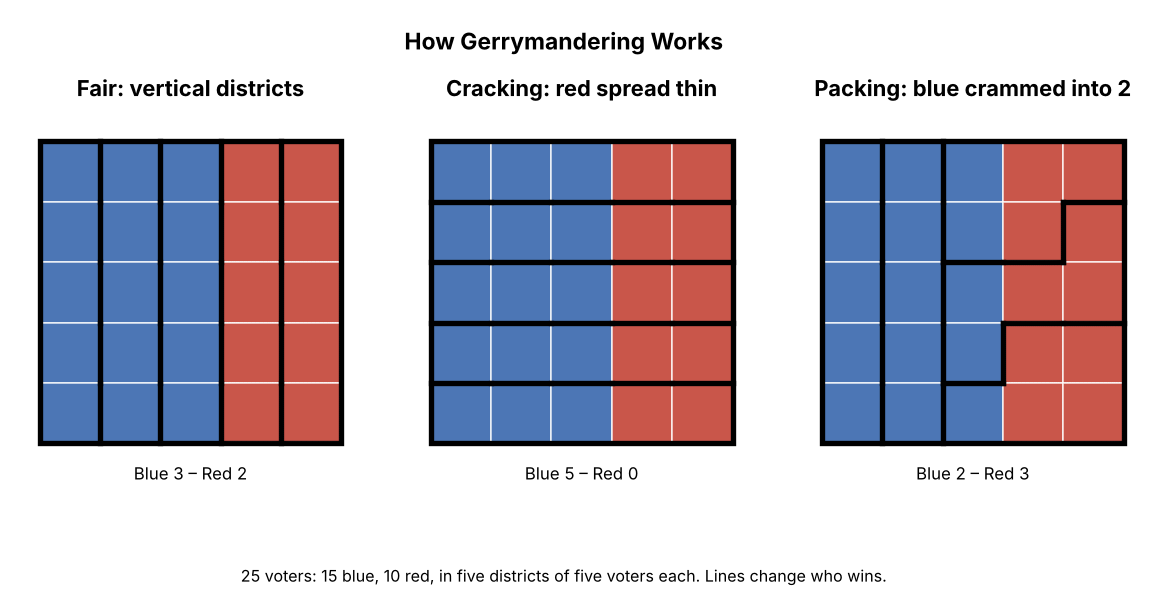
- Packing concentrates the opposing party’s voters into as few districts as possible. That party wins those districts by huge margins, “wasting” many of its votes.
- Cracking splits the opposing party’s voters across many districts so they’re a minority in each one and can’t win any.
A Worked Example
Imagine a state with 50 voters and five districts of 10 voters each. Thirty voters (60 percent) support the Blue Party and 20 (40 percent) support the Red Party. The same voters can produce very different results depending on how the lines are drawn.
| Map | How Voters Are Split | Result |
|---|---|---|
| Proportional | Three districts lean Blue, two lean Red. | Blue 3, Red 2, matching the vote share. |
| Favoring Blue | Red voters are cracked: each district has 6 Blue and 4 Red voters. | Blue 5, Red 0. |
| Favoring Red | Blue voters are packed into two districts of 10 Blue each. The remaining 10 Blue voters are cracked across the other three districts, which Red wins 7 to 3, 7 to 3, and 6 to 4. | Red 3, Blue 2, even though Red won only 40 percent of votes. |
Why does this matter? The example shows how district lines alone can flip control of a legislature. On the exam, if a stimulus shows a party winning a majority of seats with a minority of votes, gerrymandering is the likely explanation. Watch for oddly shaped districts on maps, since compact, regular shapes are one sign of fair districting.
Racial Gerrymandering and the Courts
District lines have also been used to dilute the votes of racial minorities. The Voting Rights Act of 1965 led to majority-minority districts, drawn so that a racial or ethnic minority makes up most of a district’s voters and can elect a candidate of its choice.
The Supreme Court has set limits on both sides:
- In Shaw v. Reno (1993), the Court ruled that a North Carolina district drawn primarily based on race, with a bizarre, snake-like shape, could be challenged under the Equal Protection Clause.
- In Rucho v. Common Cause (2019), the Court ruled that federal courts can’t decide claims of partisan gerrymandering, leaving the issue to states and Congress.
Reform: Independent Commissions
Several states have taken redistricting away from legislators. California, Arizona, and Michigan, among others, use independent redistricting commissions made up of citizens rather than elected officials. Supporters argue this produces fairer, more compact districts. Critics argue commissions can still be influenced by politics and are less accountable to voters.
Internal Boundaries and Cultural Divisions
Internal boundaries often follow cultural lines. Sometimes they’re drawn to give a group self-government and reduce conflict. Sometimes they mark a division that grew out of conflict.
| Country | Internal Division | What It Reflects |
|---|---|---|
| Belgium | Dutch-speaking Flanders in the north, French-speaking Wallonia in the south, and bilingual Brussels. | A linguistic divide. Belgium became a federal state in 1993 to give each region more self-rule. |
| Cyprus | A UN buffer zone, the Green Line, divides the Greek Cypriot south from the Turkish Cypriot north. | An ethnic and religious divide that hardened after fighting in 1974. |
| Canada | French-speaking Quebec; the territory of Nunavut, created in 1999 with an Inuit majority. | Linguistic and Indigenous identities recognized through provincial and territorial boundaries. |
| India | States redrawn largely along language lines after 1956. | Linguistic regions given their own state governments. |
These examples show two opposite effects. Boundaries that give cultural groups their own regions can ease tension by letting each group govern itself, which is one way states respond to devolutionary pressures. The same boundaries can also harden divisions and make it easier for a region to demand independence. For more on how boundaries are classified, see our review of defining political boundaries.
Test-Taking Strategies
Mnemonic Devices and Memory Shortcuts
- “Reapportion the seats, redistrict the streets.” Reapportionment divides House seats among states. Redistricting redraws lines within a state.
- “Pack them in, crack them apart.” Packing concentrates opponents in a few districts. Cracking spreads them thin.
- “Gerry’s salamander.” The 1812 cartoon gives gerrymandering its name and reminds you that odd shapes are a warning sign.
Cross-Topic Connections
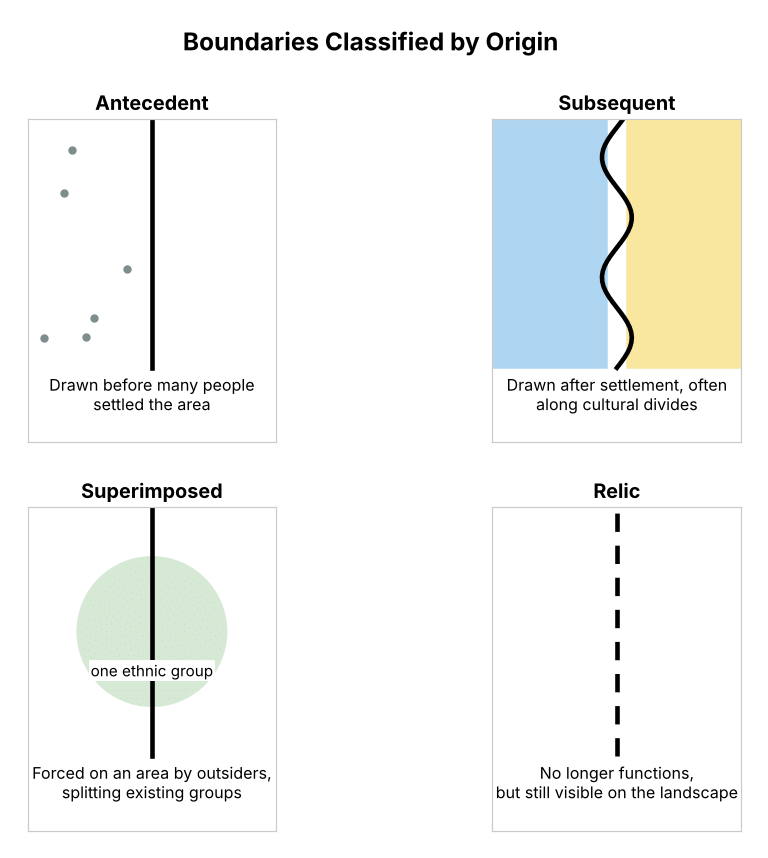
- Topic 4.4: Internal boundaries can be classified the same way international ones are, as antecedent, subsequent, or superimposed.
- Topic 4.7: Federal states rely on internal boundaries to divide power. See our review of forms of governance.
- Topic 4.8 and 4.10: Culturally defined regions can become the base for devolution or separatist movements. See our review of devolution.
- Topic 1.6: Redistricting operates at multiple scales, from Congress to city councils.
Common Question Formats
- Map-based MCQ. A map shows district lines and voter distributions, and you identify packing or cracking.
- Data-based MCQ. A table shows a party’s vote share and seat share. You explain why they don’t match.
- FRQ with a stimulus. A map of Belgium or Cyprus asks you to explain how an internal boundary reflects cultural divisions.
- No-stimulus FRQ. You define gerrymandering, describe one technique, and explain its effect on representation.
Frequent Student Mistakes
- Confusing reapportionment and redistricting. Reapportionment is about how many seats each state gets. Redistricting is about where the lines go inside a state.
- Thinking gerrymandering is illegal. Partisan gerrymandering isn’t reviewable by federal courts after Rucho. Racial gerrymandering can be challenged under the Constitution.
- Saying districts can have any population. Districts must have roughly equal populations. Gerrymandering works within that rule by choosing which voters go where.
- Treating internal boundaries only as a U.S. topic. The exam also uses international examples like Belgium and Cyprus.
Test-Day Shortcuts
- Compare votes to seats. A large gap between vote share and seat share signals gerrymandering.
- Check district shapes. Long, irregular, or snake-like shapes suggest manipulation. Compact districts suggest neutral drawing.
- Link census to redistricting. Any question that mentions a new census is setting up reapportionment or redistricting.
Time Management Tips
- Multiple choice: With 60 minutes for 60 questions, give map questions about districting a little extra time to count voters carefully.
- Free response: Budget about 25 minutes per FRQ. For gerrymandering parts, name the technique and describe its effect in one clear sentence each.
- Draw a quick sketch. On scratch paper, a five-box diagram of districts can help you reason through packing and cracking in seconds.
Check for Understanding
Think you’ve got it? Complete the quiz below to make sure. Download your results at the end.