
Maximize your score with these resources:
- Albert.io AP® Chemistry question banks
- Free AP® Chemistry cheat sheets
- Free AP® Chemistry score calculator
Kidney stones, the white crust inside a kettle, and the stalactites hanging in caves have something in common. They’re all made of ionic compounds that are “insoluble” in water. But insoluble doesn’t mean nothing dissolves. A tiny amount always does, and the dissolved ions sit in equilibrium with the solid. Topic 7.11 introduces the equilibrium constant that measures that tiny amount: the solubility product, \(K_{sp}\).
This article covers Topic 7.11: Introduction to Solubility Equilibria in Unit 7, Equilibrium. The topic asks you to write \(K_{sp}\) expressions, calculate molar solubility from \(K_{sp}\) and the reverse, and compare the solubilities of different salts.
By the end, you should be able to:
- Write the dissolution equation and \(K_{sp}\) expression for a salt.
- Calculate molar solubility from \(K_{sp}\).
- Calculate \(K_{sp}\) from a measured solubility.
- Compare solubilities correctly, even when salts have different formulas.
The Solubility Equilibrium
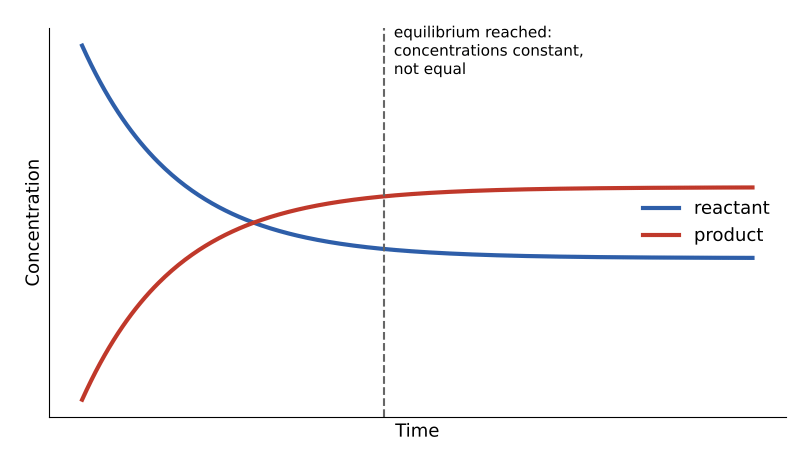
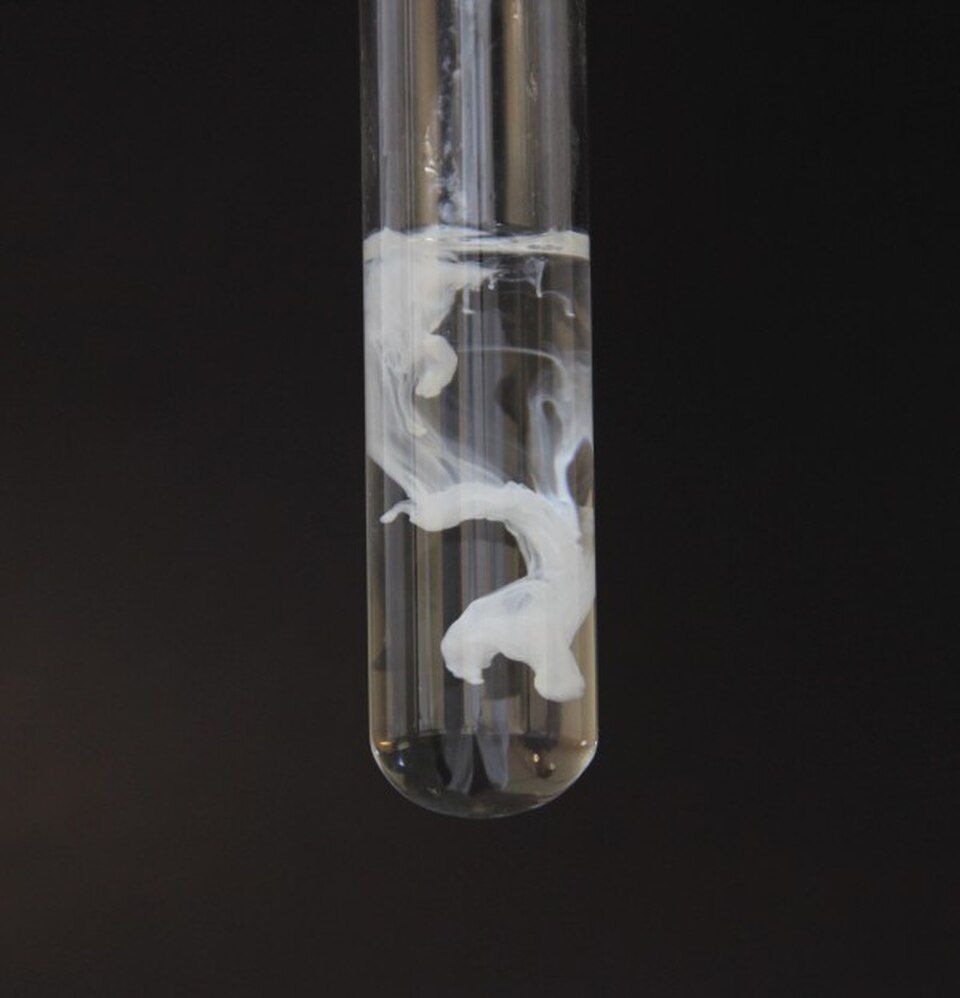
When a slightly soluble salt is placed in water, some of it dissolves until the solution is saturated. From then on, ions leave the solid and rejoin it at equal rates:
\(\text{AgCl}(s) \rightleftharpoons \text{Ag}^+(aq) + \text{Cl}^-(aq) \qquad K_{sp} = [\text{Ag}^+][\text{Cl}^-]\)
The solid doesn’t appear in the expression, because it’s a pure solid. \(K_{sp}\) is just the product of the ion concentrations, each raised to its coefficient.
| Salt | Dissolution | \(K_{sp}\) Expression |
|---|---|---|
| AgCl | \(\text{AgCl} \rightleftharpoons \text{Ag}^+ + \text{Cl}^-\) | \([\text{Ag}^+][\text{Cl}^-]\) |
| PbI₂ | \(\text{PbI}_2 \rightleftharpoons \text{Pb}^{2+} + 2\text{I}^-\) | \([\text{Pb}^{2+}][\text{I}^-]^2\) |
| Ca₃(PO₄)₂ | \(\text{Ca}_3(\text{PO}_4)_2 \rightleftharpoons 3\text{Ca}^{2+} + 2\text{PO}_4^{3-}\) | \([\text{Ca}^{2+}]^3[\text{PO}_4^{3-}]^2\) |
Molar Solubility
Molar solubility, \(s\), is the number of moles of the salt that dissolve per liter of saturated solution. Each ion’s concentration is \(s\) times its coefficient.
Worked Example: A 1:1 Salt
\(K_{sp}\) for AgCl is \(1.8 \times 10^{-10}\). Find its molar solubility.
- Let \(s\) = mol/L dissolved. Then \([\text{Ag}^+] = s\) and \([\text{Cl}^-] = s\).
- \(K_{sp} = s^2 = 1.8 \times 10^{-10}\)
- \(s = 1.3 \times 10^{-5}\ \text{M}\)
Worked Example: A 1:2 Salt
\(K_{sp}\) for CaF₂ is \(3.9 \times 10^{-11}\). Find its molar solubility.
- \(\text{CaF}_2 \rightleftharpoons \text{Ca}^{2+} + 2\text{F}^-\), so \([\text{Ca}^{2+}] = s\) and \([\text{F}^-] = 2s\).
- \(K_{sp} = (s)(2s)^2 = 4s^3 = 3.9 \times 10^{-11}\)
- \(s^3 = 9.75 \times 10^{-12}\), so \(s = 2.1 \times 10^{-4}\ \text{M}\)
Don’t forget to square the \(2s\). Writing \(2s^2\) instead of \(4s^2\) is one of the most common errors on this topic.
Going the Other Way: Ksp From Solubility
Worked Example
The molar solubility of PbI₂ is \(1.5 \times 10^{-3}\ \text{M}\). Find \(K_{sp}\).
- \([\text{Pb}^{2+}] = 1.5 \times 10^{-3}\) and \([\text{I}^-] = 2(1.5 \times 10^{-3}) = 3.0 \times 10^{-3}\)
- \(K_{sp} = (1.5 \times 10^{-3})(3.0 \times 10^{-3})^2 = 1.4 \times 10^{-8}\)
Comparing Solubilities
You can compare \(K_{sp}\) values directly only when the salts produce the same number of ions in the same ratio.
| Salt | Ion Ratio | \(K_{sp}\) | Molar Solubility |
|---|---|---|---|
| AgCl | 1:1 | \(1.8 \times 10^{-10}\) | \(1.3 \times 10^{-5}\ \text{M}\) |
| Ag₂CrO₄ | 2:1 | \(1.1 \times 10^{-12}\) | \(6.5 \times 10^{-5}\ \text{M}\) |
Ag₂CrO₄ has the smaller \(K_{sp}\), yet it’s about five times more soluble. The different exponents in the expressions make a direct comparison misleading. When formulas differ, calculate \(s\) for each salt.
Will a Precipitate Form?
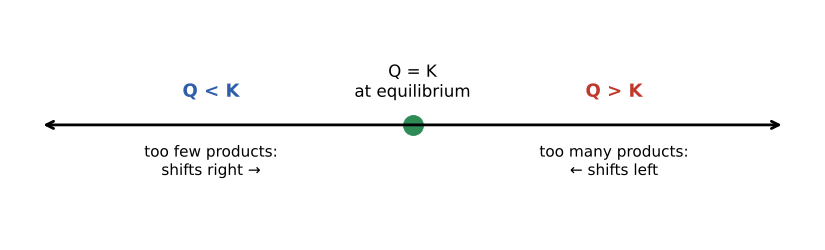
When two solutions are mixed, compare the ion product \(Q\) with \(K_{sp}\).
- \(Q \lt K_{sp}\): the solution is unsaturated, and no precipitate forms.
- \(Q = K_{sp}\): the solution is exactly saturated.
- \(Q \gt K_{sp}\): the solution is supersaturated, and solid precipitates until \(Q = K_{sp}\).
Worked Example
After mixing, a solution has \([\text{Ag}^+] = 1.0 \times 10^{-4}\ \text{M}\) and \([\text{Cl}^-] = 1.0 \times 10^{-4}\ \text{M}\). Does AgCl precipitate?
\(Q = (1.0 \times 10^{-4})(1.0 \times 10^{-4}) = 1.0 \times 10^{-8}\). That’s greater than \(1.8 \times 10^{-10}\), so AgCl precipitates. Remember to use concentrations after mixing, since each solution dilutes the other.
Why does this matter? \(K_{sp}\) problems are among the most predictable calculations in Unit 7. Set up the dissolution equation, write each ion in terms of \(s\), and apply the coefficients as both multipliers and exponents. Most lost points come from skipping one of those steps.
Test-Taking Strategies
Mnemonic Devices and Memory Shortcuts
- “Coefficient in front, and as a power.” For CaF₂, fluoride becomes \((2s)^2\).
- “Same ratio, compare K. Different ratio, compare s.” The rule for ranking solubility.
- “No solid in K.” The undissolved salt never appears in the expression.
Cross-Topic Connections
- Topic 7.4: \(K_{sp}\) follows the same expression rules as any \(K\).
- Topic 7.12: Adding a common ion lowers molar solubility. See our review of the common-ion effect.
- Topic 8.11: Salts with basic anions become more soluble in acid.
- Topic 3.10: Solubility depends on the balance between ionic attractions in the solid and hydration by water.
Common Question Formats
- Expression MCQ. You pick the correct \(K_{sp}\) expression for a salt.
- Solubility MCQ. You calculate molar solubility from \(K_{sp}\).
- Ranking MCQ. You rank salts by solubility, sometimes with different formulas.
- Lab FRQ. You calculate \(K_{sp}\) from a measured ion concentration in a saturated solution.
Frequent Student Mistakes
- Writing \(2s^2\) instead of \((2s)^2\). Square the whole term.
- Comparing \(K_{sp}\) across different formulas. Calculate \(s\) instead.
- Confusing \(s\) with an ion concentration. For CaF₂, \([\text{F}^-] = 2s\), not \(s\).
- Including the solid. Pure solids are left out.
Test-Day Shortcuts
- Memorize the patterns. 1:1 salts: \(K_{sp} = s^2\). 1:2 or 2:1 salts: \(K_{sp} = 4s^3\).
- Use cube roots carefully. Enter \(^{1/3}\) or use your calculator’s cube root key.
- Convert to g/L if asked. Multiply molar solubility by molar mass.
Time Management Tips
- Multiple choice: Section I has 60 questions in 90 minutes, about 1.5 minutes each. Recognizing \(s^2\) and \(4s^3\) patterns saves time.
- Free response: Section II has 7 questions in 105 minutes: 3 long and 4 short. Budget about 20 minutes per long question and 8 per short one.
- Show the \(s\) substitution. Writing \(K_{sp} = (s)(2s)^2\) earns credit before any arithmetic.
Check for Understanding
Think you’ve got it? Complete the quiz below to make sure. Download your results at the end.