
Maximize your score with these resources:
- Albert.io AP® Business with Personal Finance question banks
- Free AP® Business with Personal Finance score calculator
Very few people pay cash for a house, and many students cannot pay for college out of savings. Borrowing makes big goals possible years earlier than saving alone would. But every loan comes with interest and a promise to repay, and the cost of that promise depends heavily on your credit history. Two people can borrow the same amount for the same car and pay thousands of dollars apart. Topic 3.2 explains why people borrow, how lenders decide who is a good risk, and how to keep debt from taking over a budget.
This article covers Topic 3.2: Borrowing, Credit, and Debt in Unit 3, Part 1, Personal Saving and Borrowing. The topic asks you to describe why consumers borrow and where they can borrow from, explain how lenders judge creditworthiness, and recommend strategies to manage debt and credit.
By the end, you should be able to:
- Explain reasons for borrowing and the difference between secured and unsecured loans.
- Identify sources of consumer credit, including alternative financial services.
- Explain how lenders use income, debt, and credit reports to assess risk.
- Recommend strategies to manage debt and improve a credit score.
Why People Borrow and Where
Consumers borrow when they want goods or services that cost more than their current income and savings, such as a car, a house, or college tuition. They also borrow to handle emergencies, to keep their savings intact, or simply for convenience.
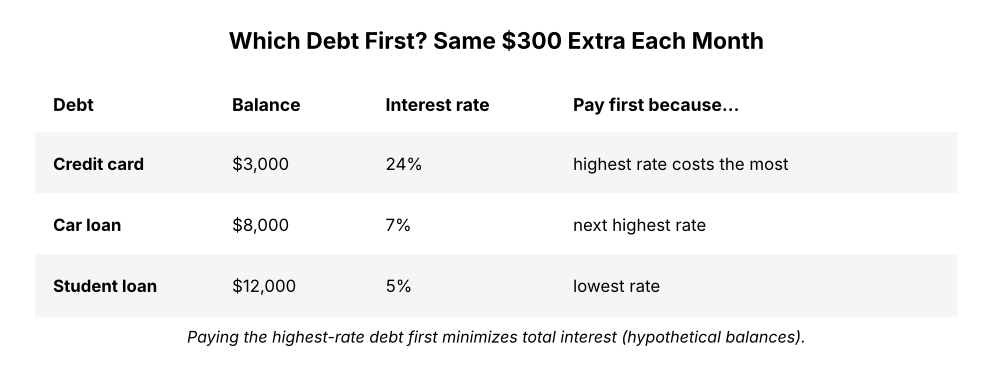
Borrowing creates a personal liability, or debt, that must be repaid with interest. The rate and repayment terms depend on the lender, the type of loan, the amount borrowed, and the borrower’s credit history.
| Loan type | Definition | Typical interest rate |
|---|---|---|
| Secured loan | Backed by collateral the lender can take if the loan is not repaid, such as a car or house | Lower |
| Unsecured loan | General consumer loan with no collateral | Higher |
Who lends:
- Commercial banks and credit unions lend to consumers, businesses, nonprofits, and governments using money deposited by savers.
- Credit card companies, retail stores, and mortgage lenders also lend to consumers.
- Alternative financial services, such as payday loans, check-cashing services, and instant tax refunds, lend to consumers, often at much higher cost.
Consumer protection laws require lenders to state credit terms clearly, regulate debt collection tactics, and prohibit discriminatory lending.
How Lenders Judge Creditworthiness
Lenders risk default, when a borrower does not repay. They prefer borrowers with low existing debt, high income and savings, and a record of on-time payments. Lenders that accept higher-risk borrowers, including alternative financial services, usually charge higher interest rates.
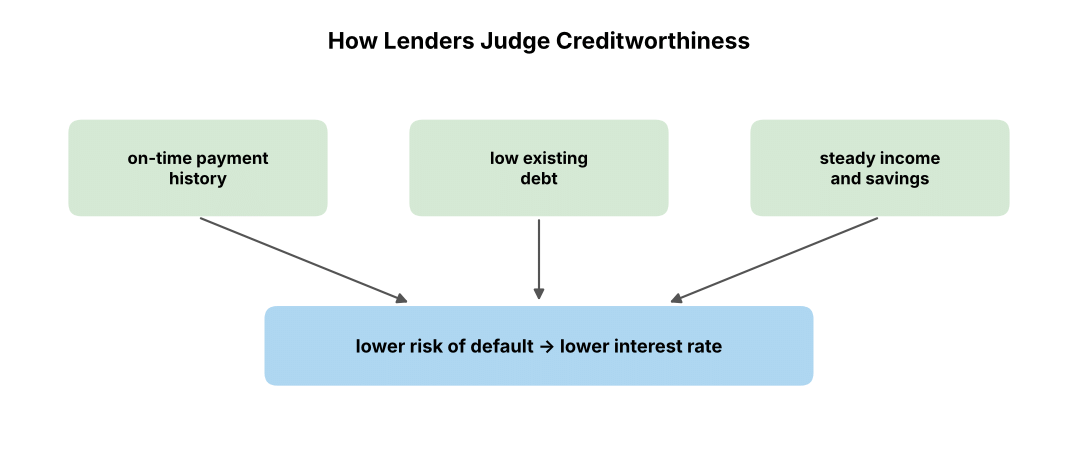
- Lenders collect information on income, savings, and existing debt.
- Credit bureaus (credit reporting agencies) build credit reports from a consumer’s interactions with financial institutions, such as opening accounts, taking loans, applying for cards, and making payments.
- A credit report includes a credit score summarizing past credit use. Reports can be shared with lenders, employers, landlords, insurance companies, and government agencies.
Managing Debt and Credit
High debt hurts because loan payments shrink the income left for saving and other expenses. Larger debts and higher rates mean higher monthly payments. Borrowers may struggle if they lose income or take on payments they cannot afford.
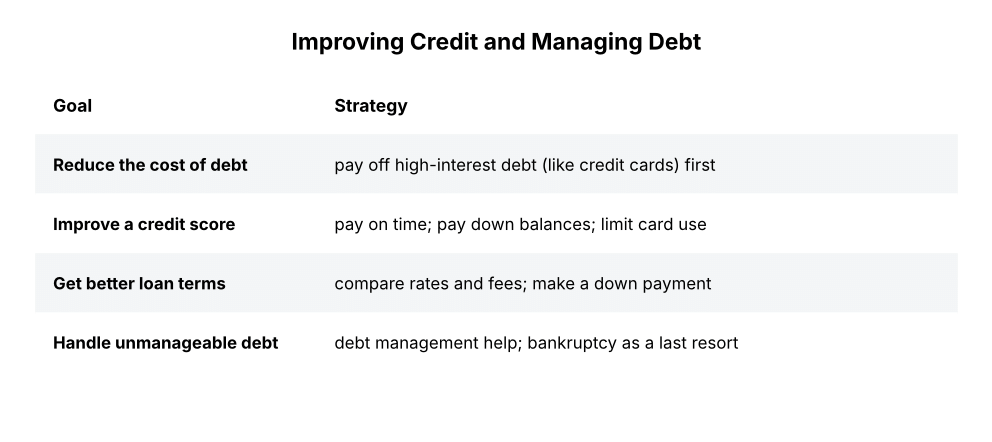
| Goal | Strategies |
|---|---|
| Reduce the cost of debt | Repay high-interest debt, such as credit cards, as quickly as possible |
| Improve a credit score | Pay bills on time, pay off existing debt, minimize credit card use |
| Get better loan terms | Compare lenders’ rates and fees; make a down payment on a home or car |
| Handle unmanageable debt | Seek debt management assistance; as a last resort, bankruptcy, a legal process that eliminates some debts and sets up repayment for others |
Worked Example: Which Debt First?
Marcus has an extra $200 a month to put toward debt. He owes:
- $1,500 on a credit card at 24% a year.
- $8,000 on a car loan at 6% a year.
- Monthly cost of the credit card: 24% a year is about 2% a month, so \(1{,}500\times 0.02=\$30\) in interest each month.
- Monthly cost of the car loan: 6% a year is 0.5% a month, so \(8{,}000\times 0.005=\$40\), but on a much larger balance.
- Recommendation: Every extra dollar on the card saves 24% a year, while a dollar on the car saves 6%. Marcus should keep making his regular payments on both and send the extra $200 to the credit card until it is gone. Paying on time also protects his credit score.
Why does this matter? Free-response Question 2 often describes a household’s debts and goals. Ranking debts by interest rate and naming a credit-score strategy is a reliable, well-supported recommendation.
Test-Taking Strategies
Mnemonic Devices and Memory Shortcuts
Remember “Collateral cuts the rate” for secured loans. For credit scores, “On time, Pay down, Swipe less.”
Cross-Topic Connections
- Topic 3.1: Saving for Future Purchases covers the assets on the other side of personal finance and the down payments that improve loan terms.
- Topic 2.1: Marketing to Customers explains the data collection that can lead to identity theft and credit damage.
- AP® Macroeconomics Topic 4.1: Financial Assets explains loans and interest rates from the economy’s point of view.
- AP® Macroeconomics Topic 4.4: Banking and the Money Supply shows how banks lend out savers’ deposits.
Common Question Formats
- A borrower profile asking which person a lender sees as lower risk.
- A list of debts asking which should be paid off first.
- A question asking who besides lenders may view a credit report.
Frequent Student Mistakes
- Thinking only lenders see credit reports. Employers, landlords, and insurers may too.
- Paying off the largest balance first instead of the highest interest rate.
- Calling a standard credit card loan secured. A typical credit card has no collateral.
Test-Day Shortcuts
When comparing debts, look only at the interest rates first. The highest rate is almost always the priority for extra payments.
Time Management Tips
The AP Business with Personal Finance Exam on May 4, 2027, is fully digital in Bluebook. Unit 3, Parts 1 and 2 together make up 25 to 35% of the multiple-choice section, the largest share of any unit. Give credit and debt questions extra review time.
Check for Understanding
Think you’ve got it? Complete the quiz below to make sure. Download your results at the end.