
Maximize your score with these resources:
- Albert.io AP® Business with Personal Finance question banks
- Free AP® Business with Personal Finance score calculator
Imagine running a food truck for a year without writing anything down. You would know roughly how busy you were, but you could not say whether you made money, which menu items paid off, or whether you could afford a second truck. A bank would not lend to you, and an investor would not even meet with you. Numbers are how a business sees itself. Topic 3.3 explains why businesses and households track their money, what financial statements are for, and who inside a business prepares and uses them.
This article covers Topic 3.3: Accounting and Financial Management in Unit 3, Part 2, Business Finance and Accounting. The topic asks you to explain why businesses and consumers track and evaluate financial data, and to describe the roles of accounting and finance departments.
By the end, you should be able to:
- Explain how transactions affect assets, liabilities, and owners’ equity or net worth.
- Describe the four purposes of business financial statements and the role of GAAP.
- Explain why consumers benefit from tracking transactions with a budget.
- Distinguish managerial accountants, financial accountants, and the finance department.
Transactions and What They Change
Businesses and consumers both make financial transactions, and each one changes what they own and owe.
| Businesses | Consumers | |
|---|---|---|
| Example transactions | Buying resources, receiving customer payments, distributing profits to owners, saving and borrowing | Receiving income, buying goods and services, saving and borrowing |
| What they affect | Assets, liabilities, and owners’ equity | Assets, liabilities, and net worth |
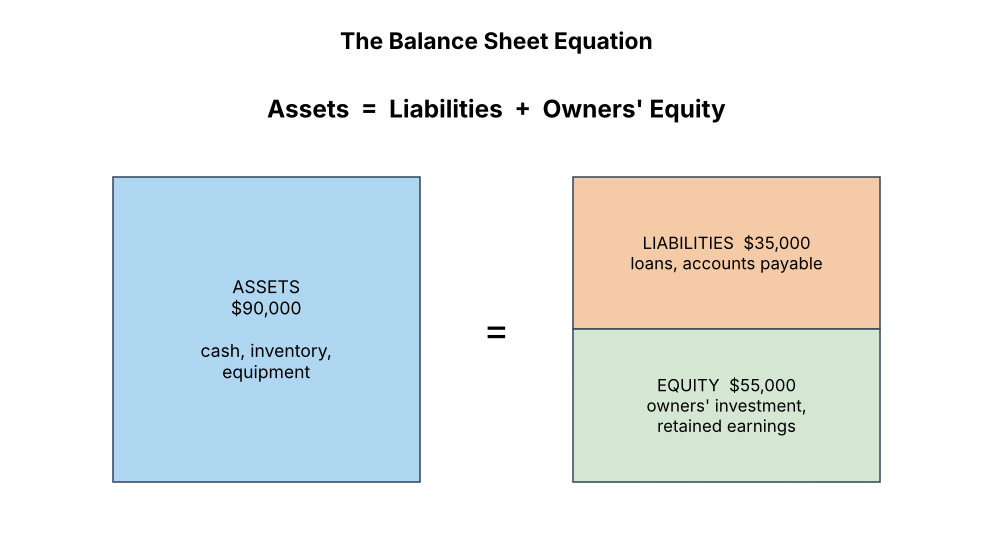
Owners’ equity is the value of the business to its owners. Net worth is the household version of the same idea. Both follow the same logic:
\(\text{assets}-\text{liabilities}=\text{owners}^{\prime}\text{ equity (or net worth)}\)
For example, a bakery that borrows $10,000 from a bank gains $10,000 in cash (an asset) and $10,000 in debt (a liability), so its owners’ equity does not change on the day of the loan.
Why Businesses Prepare Financial Statements
Businesses record every transaction and use that data to prepare reports and financial statements that summarize performance. According to the CED, financial statements are used to:
- Monitor the business’s financial health.
- Guide decision making.
- Inform shareholders, investors, and lenders accurately.
- Comply with laws and reporting regulations.
Generally accepted accounting principles (GAAP) require corporations that sell ownership shares to the public to consistently disclose all positive and negative financial information for each reporting period, typically quarterly (every three months) or annually.
Why Consumers Track Their Money
Consumers usually are not required to record or report their transactions. Still, an organized system such as a budget helps them monitor their finances and make decisions that match their goals. Many people also hire financial advisors for planning and decision making, or accountants for tax preparation.
The parallel is useful: a business reviews its statements to decide whether to expand, and a household reviews its budget to decide whether it can afford a car payment. Both are using records of the past to make a better decision about the future.
Who Does What: Accounting vs. Finance
| Role | Main job | Primary audience |
|---|---|---|
| Accounting department | Identifies and records all transactions in a period; prepares financial statements | The whole business |
| Managerial accountants | Provide financial information and analysis for planning and decision making | Internal stakeholders, such as managers |
| Financial accountants | Provide financial information and analysis for outside reporting | External stakeholders: shareholders, investors, lenders |
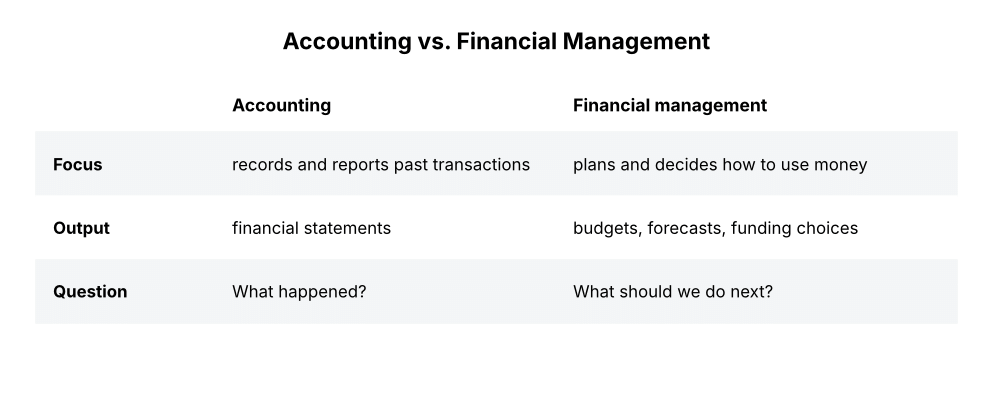
| Finance department | Analyzes the data accounting compiles and recommends strategies to maintain or improve performance | Leadership |
Worked Example: Routing the Right Report
A sporting goods chain needs three things this month.
- The CEO asks whether the new soccer line is profitable enough to expand. A managerial accountant prepares an internal product-line analysis.
- A bank reviewing a loan wants the company’s annual financial statements. Financial accountants prepare them for this external stakeholder.
- Leadership wants a plan to cut costs after a slow quarter. The finance department analyzes the accounting data and recommends closing two underperforming stores.
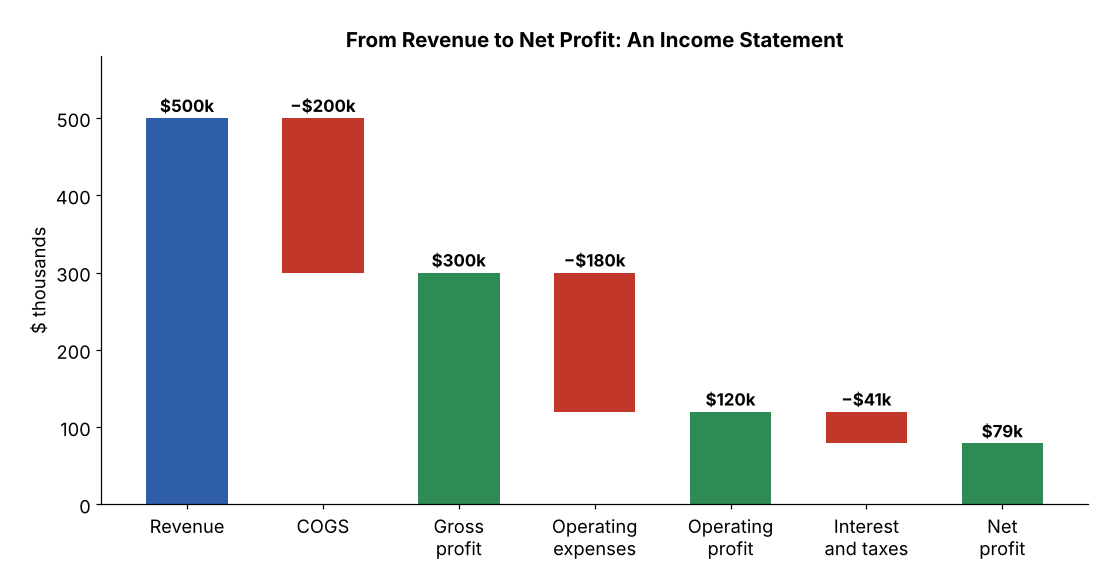
Why does this matter? Later topics in this unit cover the three main financial statements. Knowing who prepares them, who reads them, and why makes those statements much easier to interpret on the exam.
Test-Taking Strategies
Mnemonic Devices and Memory Shortcuts
Remember “Managerial = Managers (inside); Financial = Funders (outside).” For the purposes of statements, think “Monitor, Guide, Inform, Comply.”
Cross-Topic Connections
- Topic 1.7: Organization, Roles, and Responsibilities first introduces the accounting and finance departments.
- Topic 1.6: Business Ethics explains internal and external stakeholders.
- Topic 3.1: Saving for Future Purchases covers the personal assets consumers track.
- Topic 3.2: Borrowing, Credit, and Debt covers the liabilities on the other side of net worth.
Common Question Formats
- A transaction asking how it affects assets, liabilities, or equity.
- A request for information asking which role would provide it.
- A question asking why public corporations must follow GAAP.
Frequent Student Mistakes
- Mixing up managerial and financial accountants.
- Thinking GAAP only requires reporting good news. It requires positive and negative information.
- Assuming borrowing increases owners’ equity. It adds equal assets and liabilities.
Test-Day Shortcuts
Identify the audience in the question. Inside the business points to managerial accounting; outside investors and lenders point to financial accounting.
Time Management Tips
The AP Business with Personal Finance Exam on May 4, 2027, is fully digital in Bluebook. Unit 3 questions often include financial data. Note the question’s audience and time period before doing any math, so you use the right numbers the first time.
Check for Understanding
Think you’ve got it? Complete the quiz below to make sure. Download your results at the end.