
Maximize your score with these resources:
- Albert.io AP® Business with Personal Finance question banks
- Free AP® Business with Personal Finance score calculator
On shows where entrepreneurs pitch to investors, a founder might ask for $100,000 in exchange for 10% of the company. The investors grill them: How much have you sold? What does each unit cost? Why should we trust these projections? Every one of those questions is about the same thing. Someone is being asked to hand over money today in exchange for a share of an uncertain future. Topic 3.5 explains why businesses need outside money, where it comes from, what lenders and investors get in return, and how to pitch for it.
This article covers Topic 3.5: Financial Capital in Unit 3, Part 2, Business Finance and Accounting. The topic asks you to explain why businesses seek external financial capital, determine possible sources, describe benefits and risks for lenders and investors, and develop and evaluate a funding pitch.
By the end, you should be able to:
- Explain bootstrapping and use a break-even calculation to judge the need for outside capital.
- Compare loans and equity financing, including bonds and stock.
- Calculate an annual rate of return and explain the link between risk and return.
- Describe what makes a funding pitch convincing.
Why Businesses Need External Capital
Many entrepreneurs start by bootstrapping, using personal savings, personal bank loans, or personal credit. They then compare their personal funds to the business’s needs and calculate how many units they must sell in a period to break even, meaning cover all costs for that period. If their own money cannot cover startup and operating costs until the business breaks even, they seek external financial capital.
A common way to estimate the break-even quantity is:
\(\text{break-even units}=\dfrac{\text{fixed costs}}{\text{price per unit}-\text{variable cost per unit}}\)
Example: A candle maker has $3,000 in monthly fixed costs, sells candles for $20, and spends $8 per candle on materials. She must sell \(\dfrac{3{,}000}{20-8}=250\) candles a month to break even.
Established businesses also raise capital to develop new products, replace fixed assets, and grow sales. Both new and established businesses use outside capital to manage cash flow, because revenue can arrive irregularly while expenses must always be paid.
Sources of Financial Capital
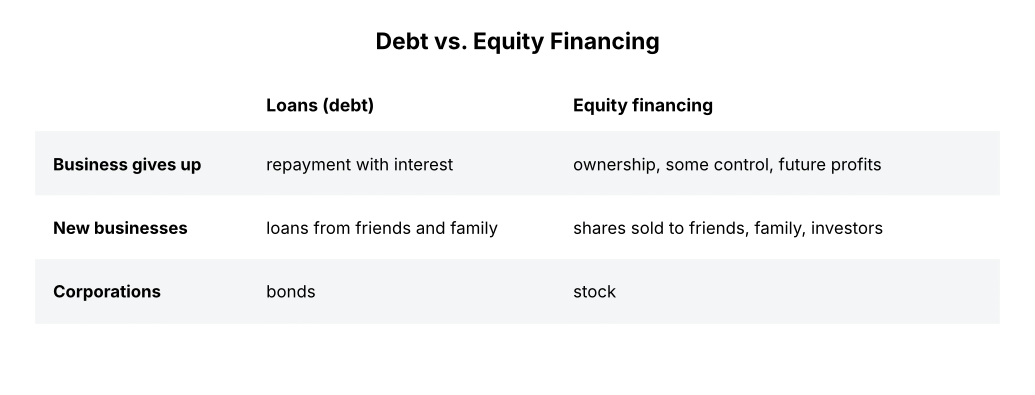
| Loans (debt) | Equity financing | |
|---|---|---|
| What the business gives up | Must repay with interest; interest is a business expense | Ownership shares, some control over decisions, and part of future profits |
| New businesses (under about two years) | Loans from the owners’ friends and family | Selling shares to friends, family, or outside investors |
| Established businesses (two years or more, proven revenue) | Business bank loans | Selling shares |
| Corporations | Bonds: a loan from an investor to the business | Stock: ownership shares sold privately or publicly |
What Lenders and Investors Get
In return for capital, lenders and investors receive financial assets, either loans (including bonds) or shares of stock, which can be resold in a secondary market.
- Lenders and bondholders earn interest.
- Shareholders may earn dividends, a share of profits, although some corporations reinvest earnings instead.
- Anyone who sells an asset for more than they paid earns a capital gain. Prices change with business performance, investor demand, and PESTEL forces.
Annual rate of return:
\(\text{rate of return}=\dfrac{\text{income}+\text{capital gain}}{\text{price of the asset}}\)
If you buy a share for $50, receive a $2 dividend, and sell it a year later for $54, your return is \(\dfrac{2+4}{50}=0.12\), or 12%.
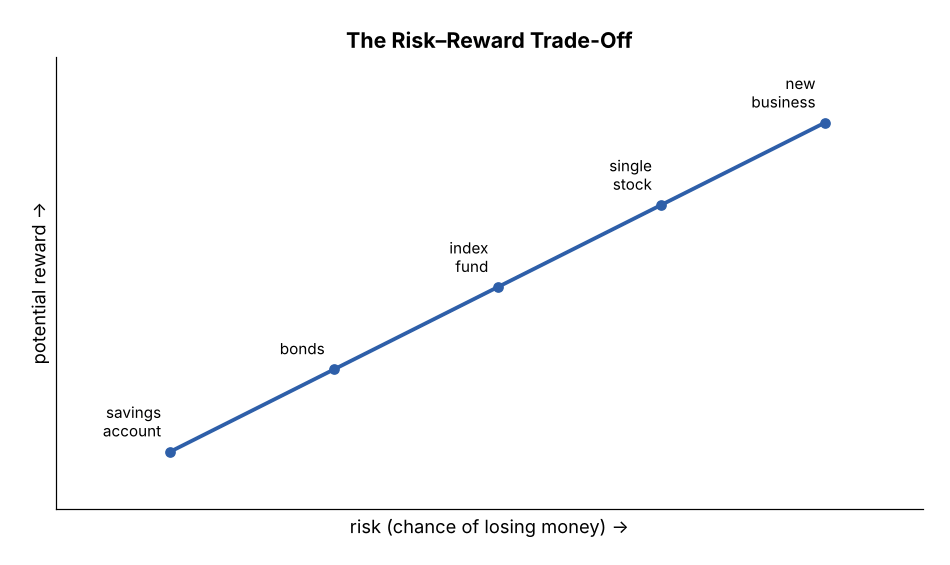
Risks: Lenders lose if the business cannot pay interest or repay. Investors can lose dividends and stock value, or their entire stake if the business closes. Risk tolerance varies, and lenders and investors expect higher returns for riskier assets.
Pitching for Capital
Lenders and investors usually want a business plan with the value proposition, market research, marketing strategy, and financial projections. Owners summarize it in a polished pitch. A request is more likely to succeed when it shows:
- Evidence of product-market fit and a clear basis for projections.
- Lower risk and higher projected returns.
- A qualified leadership team.
- A value proposition and mission that align with the funders’ goals.
For established businesses, funders estimate a valuation, what the business and each ownership share are worth, using financial reports, projections, and industry data.
Why does this matter? Tasks 2 and 3 of Unit 3, Part 2 in the Business Canvas Project ask you to identify funding sources and develop a pitch to lenders or investors.
Test-Taking Strategies
Mnemonic Devices and Memory Shortcuts
“Bonds borrow, Stocks share.” A bond makes you a lender; a stock makes you an owner. For returns, “income plus gain, over price paid.”
Cross-Topic Connections
- Topic 3.4: Business Expenses supplies the fixed and variable costs used in break-even analysis.
- Topic 1.7: Organization, Roles, and Responsibilities explains why corporations have greater access to funding.
- Topic 3.2: Borrowing, Credit, and Debt covers how lenders judge risk for personal loans.
- AP® Macroeconomics Topic 4.1: Financial Assets explains why bond prices and interest rates move in opposite directions.
Common Question Formats
- A funding choice asking whether it is debt or equity financing.
- Price, dividend, and sale data asking for the rate of return.
- A pitch asking what evidence would make it more convincing.
Frequent Student Mistakes
- Thinking a bondholder owns part of the company. A bondholder is a lender.
- Leaving dividends out of the rate of return.
- Assuming every corporation pays dividends.
Test-Day Shortcuts
If a funding option means giving up control or future profits, it is equity. If it means fixed repayments with interest, it is debt.
Time Management Tips
The AP Business with Personal Finance Exam on May 4, 2027, is fully digital in Bluebook, and calculators are permitted. Write each formula before plugging in numbers. That keeps rate-of-return and break-even questions to about a minute each.
Check for Understanding
Think you’ve got it? Complete the quiz below to make sure. Download your results at the end.