
Why can you rewrite \(7+x+3\) as \(x+10\) without changing its value? The answer is the properties of real numbers. These rules are the legal moves of algebra, and every simplification or equation step you take is justified by one of them.
This article covers Topic 1.3: Properties of Real Numbers in Unit 1, Foundations of Algebra. The topic asks you to classify real numbers and to name and apply the properties that let you rearrange and simplify expressions.
By the end, you should be able to:
- Classify a number as natural, whole, integer, rational, or irrational.
- State the commutative, associative, identity, inverse, and distributive properties.
- Name the property that justifies a given step in a simplification.
- Use properties to perform mental math and simplify expressions efficiently.
Classifying Real Numbers
The real numbers include every number that can be placed on a number line. They split into nested sets, where each set sits inside the next larger one.
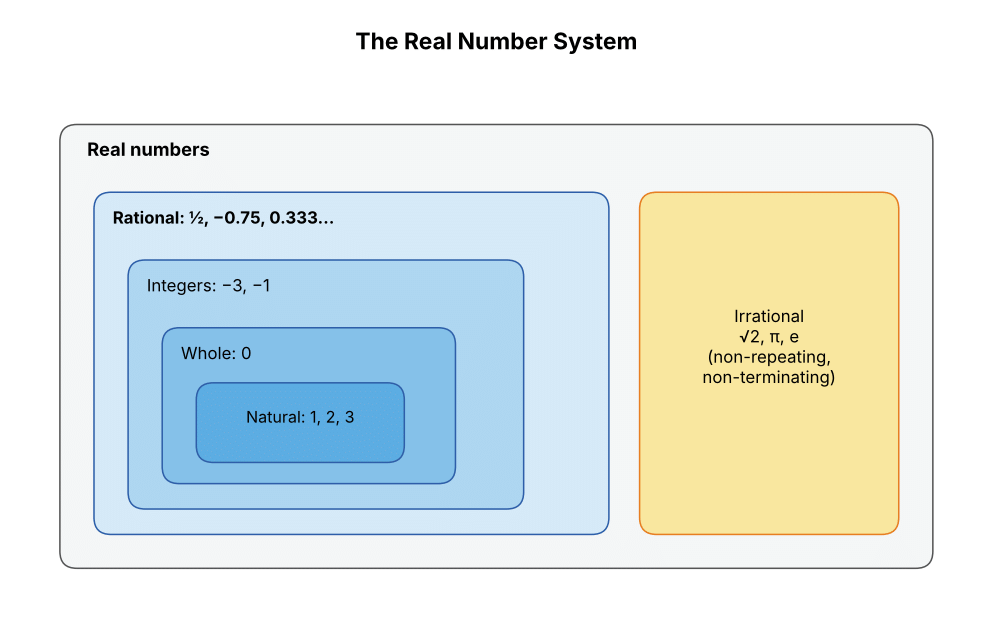
| Set | Description | Examples |
|---|---|---|
| Natural numbers | The counting numbers. | \(1, 2, 3, 4\) |
| Whole numbers | The natural numbers plus zero. | \(0, 1, 2, 3\) |
| Integers | Whole numbers and their opposites. | \(-3, 0, 5\) |
| Rational numbers | Any number that can be written as a fraction of two integers. Decimals terminate or repeat. | \(\frac{2}{3}\), \(-0.75\), \(0.\overline{3}\) |
| Irrational numbers | Numbers that cannot be written as a fraction. Decimals never end or repeat. | \(\sqrt{2}\), \(\pi\) |
Why does this matter? Classification questions test the nesting. Every integer is also rational, because \(-3\) can be written as \(\frac{-3}{1}\). A number like \(\sqrt{9}\) looks irrational but equals 3, so it is natural, whole, integer, and rational all at once. Always simplify before you classify.
The Core Properties
Each property describes something that is always true for real numbers \(a\), \(b\), and \(c\).
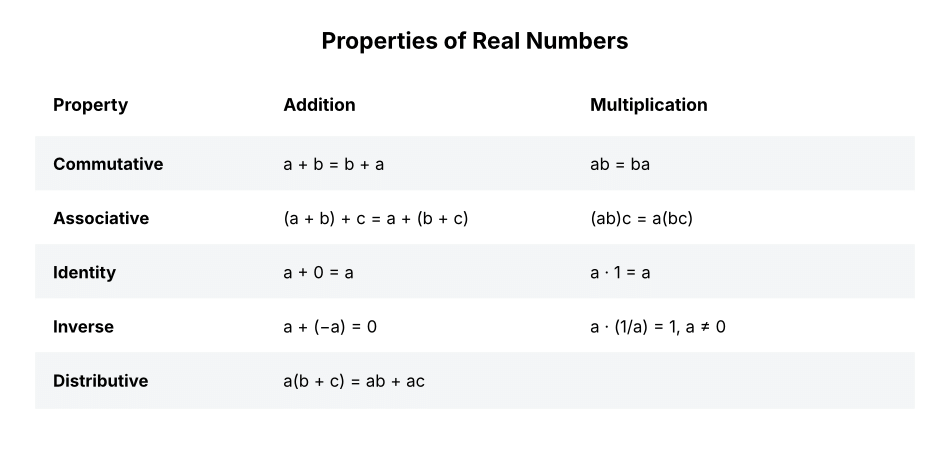
| Property | Addition | Multiplication |
|---|---|---|
| Commutative (order can change) | \(a+b=b+a\) | \(ab=ba\) |
| Associative (grouping can change) | \((a+b)+c=a+(b+c)\) | \((ab)c=a(bc)\) |
| Identity | \(a+0=a\) | \(a\cdot 1=a\) |
| Inverse | \(a+(-a)=0\) | \(a\cdot\frac{1}{a}=1\) when \(a\neq 0\) |
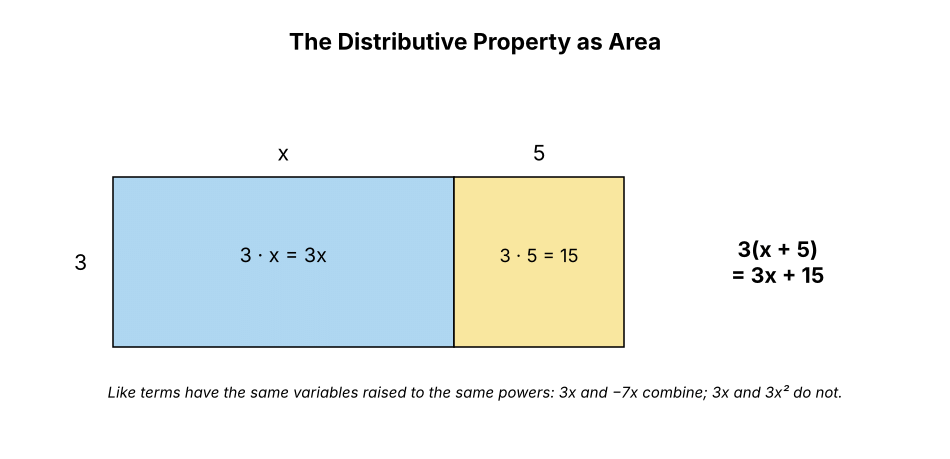
The distributive property links the two operations: \(a(b+c)=ab+ac\). It is the only property that involves both multiplication and addition in the same statement, and it is the engine behind combining like terms and factoring.
Two further facts round out the list:
- Multiplicative property of zero: \(a\cdot 0=0\). Any product with a zero factor is zero, which becomes essential when you solve quadratics by factoring.
- Subtraction and division are not commutative or associative. \(8-3\neq 3-8\) and \(12\div 2\neq 2\div 12\). Rewriting subtraction as adding a negative, as in \(8+(-3)\), lets you use the addition properties safely.
Naming the Property in a Step
Many questions show a step and ask which property justifies it. Look at what changed between the two sides.
- Only the order changed: \(5+y=y+5\) is commutative.
- Only the parentheses moved: \((2\cdot x)\cdot 4=2\cdot(x\cdot 4)\) is associative.
- A number was multiplied into a group: \(3(x+4)=3x+12\) is distributive.
- Something canceled to 0 or 1: \(6+(-6)=0\) is the additive inverse, and \(\frac{1}{4}\cdot 4=1\) is the multiplicative inverse.
- Something was added or multiplied without changing the value: \(x\cdot 1=x\) is the multiplicative identity.
Worked example: Simplify \(4\cdot 17\cdot 25\) mentally. Use the commutative property to reorder: \(4\cdot 25\cdot 17\). Use the associative property to group: \((4\cdot 25)\cdot 17=100\cdot 17=1700\). Recognizing friendly pairs turns a hard product into an easy one.
Why does this matter? These names show up again when you justify steps in solving equations and in geometry proofs. A teacher who asks you to “show your reasoning” expects these exact property names next to each line.
Test-Taking Strategies
Mnemonic Devices and Memory Shortcuts
Commutative sounds like “commute,” and commuters move around, so the numbers change places. Associative sounds like “associate,” so the numbers change who they group with. Identity keeps a number’s identity, and inverse undoes it back to 0 or 1.
Cross-Topic Connections
- The properties justify every step of evaluating in Topic 1.2: Order of Operations.
- Inverse operations are how you isolate a variable in Topic 2.1: Solving One-Step Equations.
- The distributive property is used constantly in Topic 2.3: Solving Multi-Step Equations.
- Rational and irrational numbers return when you simplify roots in Topic 8.1: Simplifying Radicals.
Common Question Formats
- Name the property shown by a single equation such as \(m+0=m\).
- Choose which sets a number belongs to from a list of classifications.
- Identify the property used between two lines of a worked solution.
- Decide whether a statement like “subtraction is commutative” is true, and give a counterexample if not.
Frequent Student Mistakes
- Confusing commutative and associative. Check whether the order changed or only the parentheses moved.
- Calling \(\sqrt{16}\) irrational. Simplify first: it equals 4, which is rational.
- Distributing to only the first term, as in \(2(x+5)=2x+5\). The 2 must multiply every term inside.
Test-Day Shortcuts
For “name the property” questions, cover one side of the equation and compare the visible side with the hidden one in your head. If a decimal repeats or ends, label it rational immediately and move on.
Time Management Tips
Property identification items on Algebra 1 unit tests and end-of-course exams are quick wins, usually 30 to 45 seconds each. Bank that time for longer equation-solving questions. If you hesitate between two property names, write out what changed, then decide.