
Ask ten people to simplify \(8+4\cdot 3\) and some will say 36 while others say 20. Only one answer is correct, and the reason is the order of operations. This short set of rules lets everyone read a math expression the same way, and every later Algebra 1 topic depends on it.
This article covers Topic 1.2: Order of Operations in Unit 1, Foundations of Algebra. The topic asks you to simplify and evaluate numerical and algebraic expressions by applying operations in the agreed-upon sequence.
By the end, you should be able to:
- List the steps of the order of operations and explain why the convention exists.
- Simplify expressions that contain grouping symbols, exponents, and all four operations.
- Handle multiplication and division, and addition and subtraction, from left to right.
- Avoid the classic traps involving negative signs, fraction bars, and nested grouping.
The Order of Operations Step by Step
The order of operations is a convention, not a law of nature. Mathematicians agreed on it so that a written expression has exactly one value. The sequence has four levels.
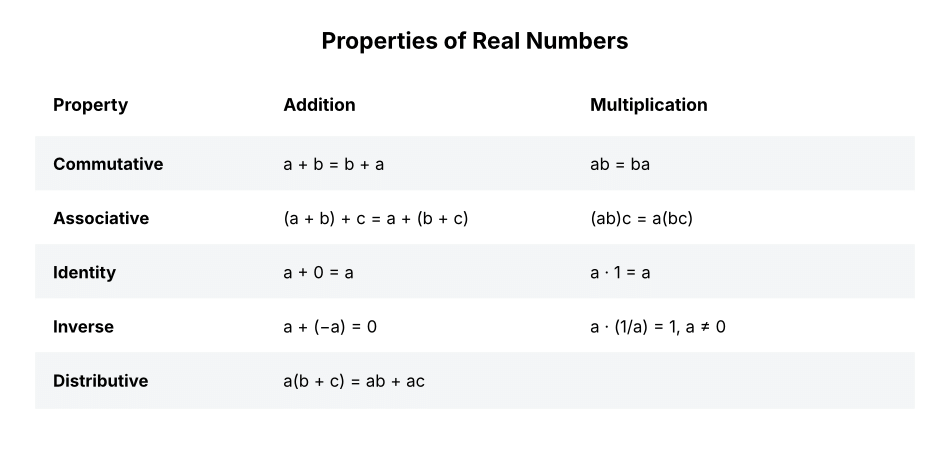
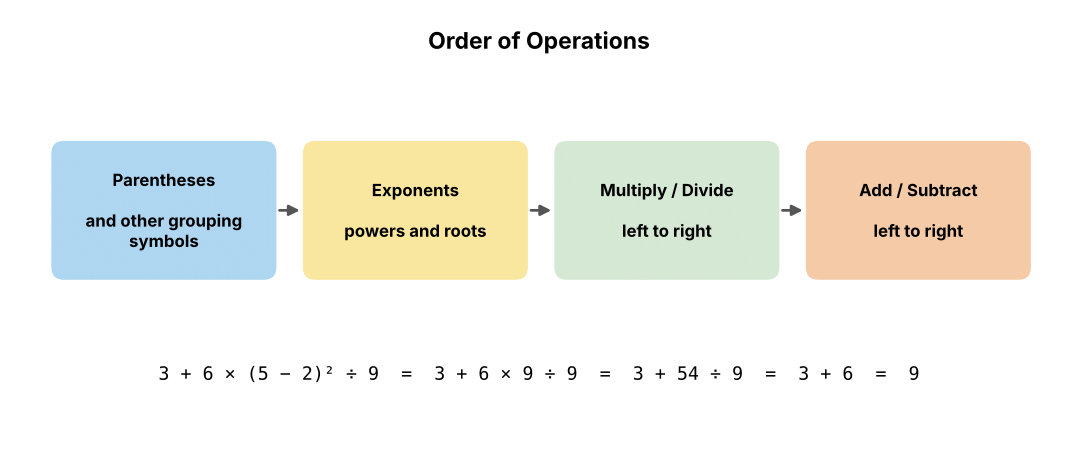
| Level | What You Do | Example |
|---|---|---|
| 1. Grouping | Simplify inside parentheses, brackets, absolute value bars, and above or below fraction bars. | \(2(5+3)=2(8)\) |
| 2. Exponents | Evaluate powers and roots. | \(4+3^{2}=4+9\) |
| 3. Multiply and Divide | Work from left to right. Neither operation outranks the other. | \(12\div 4\cdot 3=3\cdot 3=9\) |
| 4. Add and Subtract | Work from left to right. Neither operation outranks the other. | \(10-4+2=6+2=8\) |
Why does this matter? Levels 3 and 4 each contain a pair of operations with equal rank. The acronym PEMDAS lists M before D and A before S, which tricks students into always multiplying first or always adding first. In \(12\div 4\cdot 3\), dividing first gives 9, while multiplying first gives 1. Left to right is the rule that decides.
Worked Examples
Example 1: Simplify \(18-2(3+1)^{2}\div 4\).
- Grouping: \(3+1=4\), giving \(18-2(4)^{2}\div 4\).
- Exponent: \(4^{2}=16\), giving \(18-2(16)\div 4\).
- Multiply and divide left to right: \(2(16)=32\), then \(32\div 4=8\).
- Subtract: \(18-8=10\).
Example 2: Simplify \(\frac{6+9}{5}+2^{3}\).
- A fraction bar groups everything above it, so the numerator is \(15\) and \(\frac{15}{5}=3\).
- Exponent: \(2^{3}=8\).
- Add: \(3+8=11\).
Example 3: Evaluate \(-x^{2}+3x\) when \(x=-2\).
- Substitute with parentheses: \(-(-2)^{2}+3(-2)\).
- Exponent first: \((-2)^{2}=4\), so the first term is \(-4\).
- Multiply: \(3(-2)=-6\).
- Add: \(-4+(-6)=-10\).
Why does this matter? Example 3 shows the most tested trap. The negative sign in front of \(x^{2}\) is applied after the exponent, so \(-x^{2}\) is always negative or zero. Students who square the negative sign along with the 2 get \(+4\) and end with \(-2\) instead of \(-10\).
Grouping Symbols and Nested Expressions
Expressions often contain grouping symbols inside other grouping symbols. Work from the innermost group outward, and treat each type of symbol the same way.
- Parentheses and brackets: In \(3[4+(6-2)^{2}]\), simplify \(6-2=4\) first, then \(4^{2}=16\), then \(4+16=20\), and finally \(3\cdot 20=60\).
- Fraction bars: The bar acts like parentheses around the entire numerator and the entire denominator. Simplify each part completely before dividing.
- Absolute value bars: Simplify the inside first, then take the absolute value. \(|2-9|=|-7|=7\).
- Implied multiplication: A number touching parentheses, like \(5(2)\), means multiply. It ranks the same as any other multiplication.
Why does this matter? Calculators follow these same rules, but only for what you type. If you enter a fraction like \(\frac{6+9}{5}\) without parentheses around the numerator, the calculator divides 9 by 5 first and adds 6. Knowing how grouping works lets you type expressions correctly and catch a calculator result that looks wrong.
Test-Taking Strategies
Mnemonic Devices and Memory Shortcuts
Use GEMS: Grouping, Exponents, Multiply or Divide, Subtract or Add. Unlike PEMDAS, GEMS writes the paired operations together, which reminds you to go left to right within each pair. The word “Grouping” also covers fraction bars and absolute value, not just parentheses.
Cross-Topic Connections
- You evaluate expressions with this order in Topic 1.1: Variables and Algebraic Expressions.
- Solving an equation reverses the order of operations, as you’ll see in Topic 2.2: Solving Two-Step Equations.
- Multi-step equations stack several layers of operations, covered in Topic 2.3: Solving Multi-Step Equations.
- Exponent rules build on Level 2, explored in Topic 7.1: Properties of Exponents.
Common Question Formats
- Simplify a numerical expression with three or four operations and choose the correct value.
- Identify the step where a sample student solution went wrong.
- Evaluate an algebraic expression for a negative input value.
- Insert parentheses to make a statement true, such as making \(2+3\cdot 4\) equal 20.
Frequent Student Mistakes
- Multiplying before dividing every time. Correct it by working left to right across Level 3.
- Treating \(-3^{2}\) as 9. The exponent applies only to the 3, so the value is \(-9\).
- Dividing only part of a numerator by the denominator. Simplify the whole numerator first.
Test-Day Shortcuts
Underline the first operation you will perform, then rewrite the expression after each step. This one-line-per-step habit makes errors easy to spot on “find the mistake” questions. When answer choices differ wildly, a quick estimate can eliminate two of them before you finish.
Time Management Tips
On Algebra 1 unit tests and end-of-course exams, a pure order of operations item should take about a minute. If an expression has nested groups, budget a little longer and write every intermediate line. Do not skip steps to save time, because a single sign slip costs more time to find later.