
Every equation you solve in Algebra 1 starts as an expression. If you can read, write, and evaluate expressions with confidence, solving equations becomes a matter of undoing steps you already understand. If you can’t, every later unit feels like guesswork.
This article covers Topic 1.1: Variables and Algebraic Expressions in Unit 1, Foundations of Algebra. The topic asks you to translate between words and symbols, identify the parts of an expression, and evaluate expressions for given values.
By the end, you should be able to:
- Explain what a variable represents and why algebra uses letters.
- Name the terms, coefficients, constants, and factors in an expression.
- Translate verbal phrases into algebraic expressions and back again.
- Evaluate an expression by substituting values and following the order of operations.
What Variables and Expressions Are
A variable is a letter or symbol that stands for a number you don’t know yet or a number that can change. In \(3n+5\), the letter \(n\) could be the number of tickets sold, the hours worked, or any other quantity. Using a letter lets you describe a whole pattern with one short statement instead of listing every case.
An algebraic expression combines numbers, variables, and operations, but it has no equals sign. That missing equals sign is the key difference between an expression and an equation:
- Expression: \(4x-7\). You can simplify it or evaluate it, but you cannot “solve” it because it makes no claim.
- Equation: \(4x-7=13\). It states that two expressions are equal, so there is a specific value of \(x\) that makes it true.
The Parts of an Expression
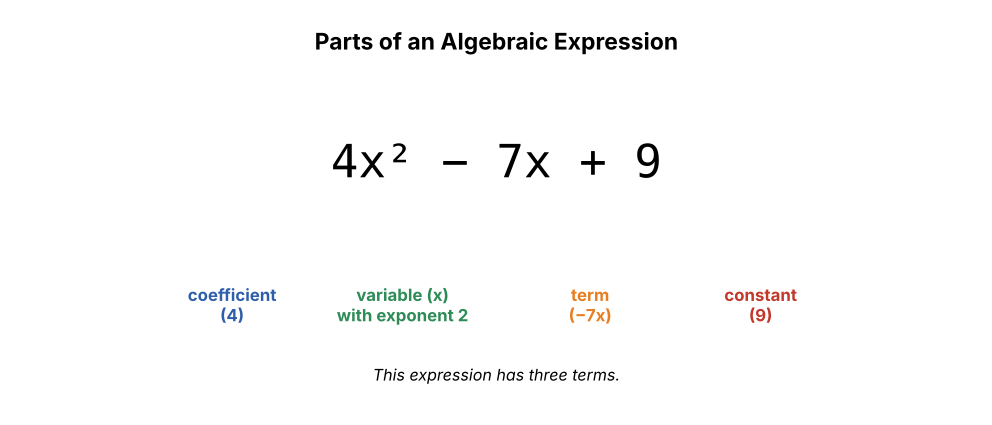
Teachers and test writers use precise vocabulary for the pieces of an expression. Knowing these names helps you follow directions such as “combine like terms” or “identify the coefficient.” The table uses the expression \(5x^{2}-3x+8\).
| Part | Definition | Example in \(5x^{2}-3x+8\) |
|---|---|---|
| Term | A piece of the expression separated by addition or subtraction. | \(5x^{2}\), \(-3x\), and \(8\) |
| Coefficient | The number multiplied by a variable. Its sign comes with it. | \(5\) and \(-3\) |
| Constant | A term with no variable, so its value never changes. | \(8\) |
| Factor | Any quantity being multiplied within a term. | In \(5x^{2}\), the factors are \(5\), \(x\), and \(x\) |
| Exponent | Tells how many times a base is used as a factor. | The \(2\) in \(x^{2}\) |
Why does this matter? Most errors in early algebra come from misreading the sign attached to a term. The second term above is \(-3x\), not \(3x\). When you later combine like terms or substitute values, carrying that negative sign with its term keeps your answer correct.
Translating Words Into Expressions
Word problems turn into algebra through key phrases. Each phrase signals an operation, and the order of the words matters for subtraction and division.
| Operation | Key Phrases | Phrase and Expression |
|---|---|---|
| Addition | sum, more than, increased by, total | “7 more than a number” becomes \(n+7\) |
| Subtraction | difference, less than, decreased by | “5 less than a number” becomes \(n-5\) |
| Multiplication | product, times, twice, of | “twice a number” becomes \(2n\) |
| Division | quotient, divided by, per, ratio | “a number divided by 4” becomes \(\frac{n}{4}\) |
Watch the phrase “less than.” It reverses the order you read it in. “Five less than a number” means you start with the number and take 5 away, so the expression is \(n-5\), never \(5-n\).
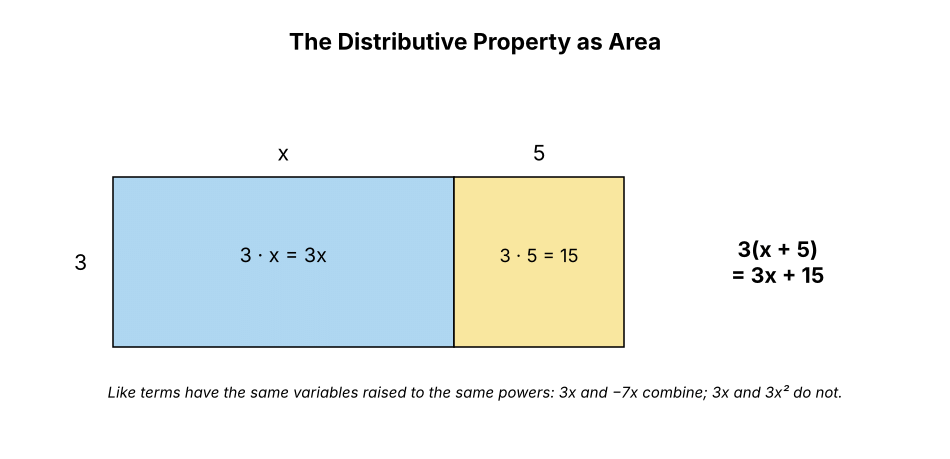
Grouping words also matter. “Three times the sum of a number and 2” means the sum happens first, so you need parentheses: \(3(n+2)\). Without them, \(3n+2\) describes a different quantity entirely.
Evaluating Expressions
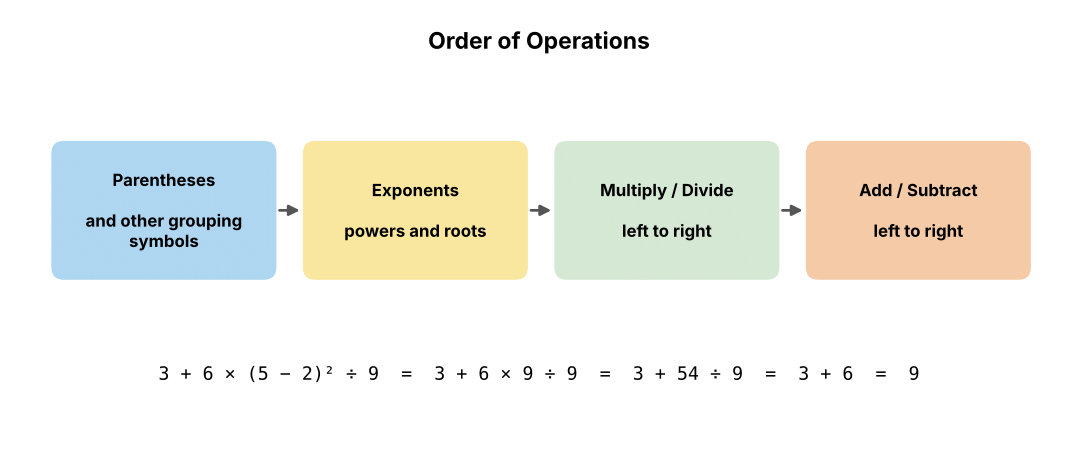
To evaluate an expression, replace each variable with its given value and simplify using the order of operations. Use parentheses when you substitute, especially for negative numbers.
Worked example: Evaluate \(2a^{2}-3b\) when \(a=-4\) and \(b=5\).
- Substitute with parentheses: \(2(-4)^{2}-3(5)\).
- Apply the exponent first: \((-4)^{2}=16\), so you have \(2(16)-3(5)\).
- Multiply: \(32-15\).
- Subtract: \(17\).
Why does this matter? Skipping the parentheses in step 1 is the most common evaluation error. Writing \(-4^{2}\) instead of \((-4)^{2}\) gives \(-16\), because the exponent applies only to the 4. One missing pair of parentheses changes the final answer from 17 to \(-47\).
Test-Taking Strategies
Mnemonic Devices and Memory Shortcuts
Remember “Expressions Explain, Equations Equal.” An expression describes a quantity, while an equation claims two quantities are equal. For “less than,” think “flip it”: the number mentioned second in the phrase comes first in the expression.
Cross-Topic Connections
- Evaluating expressions depends on the order of operations, which you need again in Topic 2.1: Solving One-Step Equations.
- Translating multi-part phrases prepares you for Topic 2.3: Solving Multi-Step Equations.
- Coefficients and constants reappear as slope and intercept in Topic 5.2: Slope-Intercept Form.
- Exponents inside terms connect to the rules in Topic 7.1: Properties of Exponents.
Common Question Formats
- Match a verbal phrase to the correct expression from four choices, often with “less than” traps.
- Identify the coefficient or constant in a given expression.
- Evaluate an expression for given values, frequently including a negative number.
- Write an expression that models a short real-world situation, such as a phone plan with a fixed fee plus a per-minute charge.
Frequent Student Mistakes
- Writing \(5-n\) for “5 less than a number.” Correct it by starting with the number: \(n-5\).
- Dropping the sign from a coefficient. In \(7-2x\), the coefficient is \(-2\), not \(2\).
- Substituting a negative value without parentheses, which changes how exponents apply.
Test-Day Shortcuts
On multiple-choice translation questions, plug in a simple value like \(n=10\) and test each choice against the words. For evaluation questions, write every substitution inside parentheses before doing any arithmetic, which takes seconds and prevents sign errors.
Time Management Tips
Algebra 1 unit tests and end-of-course exams usually open with short vocabulary and evaluation items, so aim to finish each in under a minute. Save extra time for multi-step word problems later in the test. If a translation question stalls you, mark it, move on, and return once the rest of the section is done.