
Before you can solve \(3(x+2)-x=14\), you need to turn the left side into something simpler. Two skills do that work: the distributive property and combining like terms. Together they shrink long, messy expressions into short ones, and they appear in nearly every equation you will solve this year.
This article covers Topic 1.4: Combining Like Terms and the Distributive Property in Unit 1, Foundations of Algebra. The topic asks you to identify like terms, distribute a factor across a sum or difference, and simplify expressions completely.
By the end, you should be able to:
- Decide whether two terms are like terms.
- Combine like terms by adding or subtracting their coefficients.
- Distribute positive and negative factors across parentheses.
- Simplify expressions that require both skills in the correct order.
Identifying Like Terms
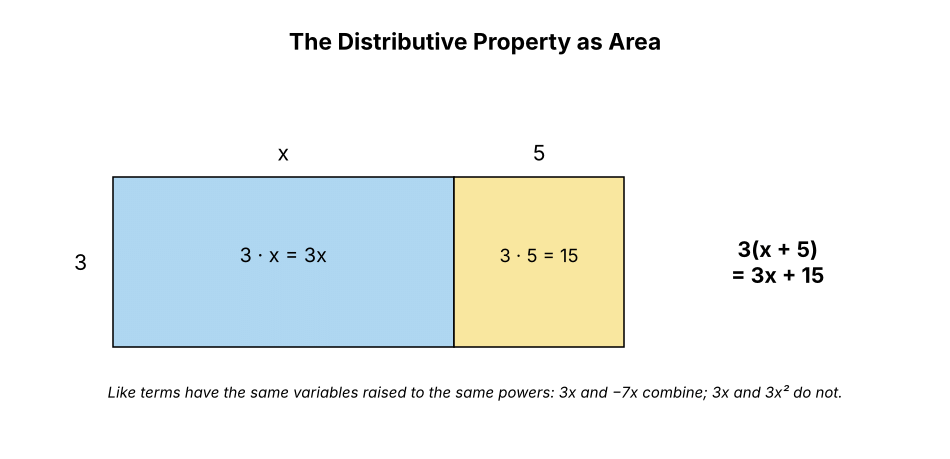
Like terms have exactly the same variable part, meaning the same variables raised to the same exponents. Only their coefficients may differ.
| Pair | Like Terms? | Reason |
|---|---|---|
| \(4x\) and \(-9x\) | Yes | Both have the variable part \(x\). |
| \(3x^{2}\) and \(3x\) | No | The exponents differ, so the variable parts differ. |
| \(5ab\) and \(-2ba\) | Yes | Multiplication is commutative, so \(ab\) and \(ba\) match. |
| \(7\) and \(-12\) | Yes | Constants are like terms with each other. |
| \(6y\) and \(6\) | No | One has a variable and one does not. |
To combine like terms, add or subtract the coefficients and keep the variable part unchanged. For example, \(4x-9x=-5x\). The variable part works like a unit label: 4 apples minus 9 apples is \(-5\) apples, and the word “apples” never changes.
Why does this matter? The most common error is changing the exponent while combining, such as writing \(x^{2}+x^{2}=x^{4}\). Adding like terms only changes the coefficient, so the correct result is \(2x^{2}\). Exponents change when you multiply, which is a different skill.
The Distributive Property
The distributive property says \(a(b+c)=ab+ac\). The factor outside the parentheses multiplies every term inside. It also works with subtraction and with a factor on the right side.
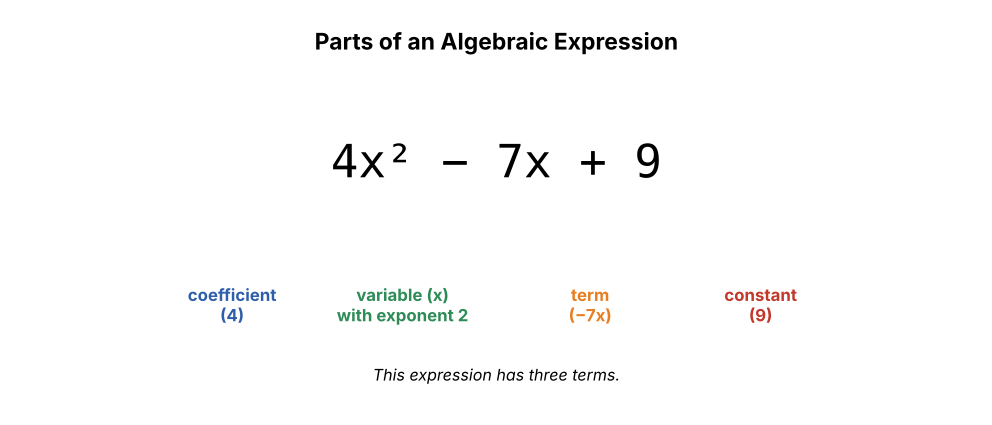
- Positive factor: \(5(2x+3)=10x+15\). Multiply 5 by each term.
- Negative factor: \(-4(x-6)=-4x+24\). The negative multiplies both terms, so \(-4\) times \(-6\) becomes positive 24.
- Subtracting a group: \(-(3x-2)=-3x+2\). A minus sign in front of parentheses means multiply by \(-1\), which flips every sign inside.
- Variable factor: \(x(x+7)=x^{2}+7x\). Here the exponent does change, because you are multiplying \(x\) by \(x\).
Why does this matter? Sign errors with a negative factor cause more lost points than any other part of this topic. Draw an arrow from the outside factor to each inside term before multiplying, and you will never skip a term or a sign.
Putting Both Skills Together
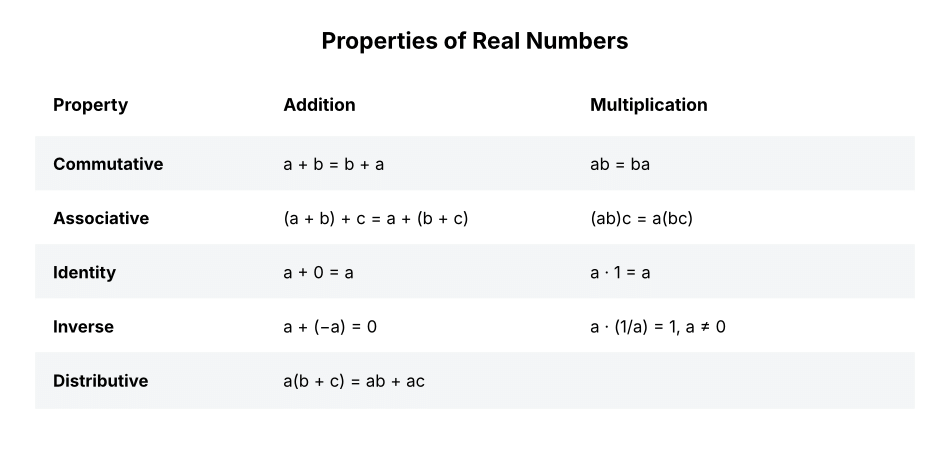
Simplify in this order: distribute first, then combine like terms. Distributing first removes the parentheses so that every like term is visible.
Worked example 1: Simplify \(3(x+2)-x+4\).
- Distribute: \(3x+6-x+4\).
- Group like terms: \(3x-x\) and \(6+4\).
- Combine: \(2x+10\).
Worked example 2: Simplify \(2(4y-1)-3(y-5)\).
- Distribute the 2: \(8y-2\).
- Distribute the \(-3\): \(-3y+15\).
- Write it all out: \(8y-2-3y+15\).
- Combine: \(5y+13\).
Example 2 shows why the sign belongs to the factor. The \(-3\) multiplies \(-5\) to give positive 15. Students who distribute only a 3 end up with \(5y-17\), which is wrong.
Why does this matter? A fully simplified expression has no parentheses left and no two like terms remaining. Use that as your finish-line check. If you can still find two terms with the same variable part, or a factor waiting outside a group, you are not done yet. Teachers often award partial credit for correct distribution even when the final combination slips, so always show the distributed line before you combine.
Test-Taking Strategies
Mnemonic Devices and Memory Shortcuts
Think “D before C”: Distribute before you Combine. For like terms, remember “same letters, same powers.” For a negative outside parentheses, say “the negative visits everyone,” which reminds you to change every sign inside.
Cross-Topic Connections
- The distributive property itself is introduced in Topic 1.3: Properties of Real Numbers.
- Simplifying each side is the first stage of Topic 2.3: Solving Multi-Step Equations.
- Rearranging formulas often needs distribution, as in Topic 2.5: Solving Literal Equations.
- Combining like radicals follows the same logic in Topic 8.2: Operations with Radicals.
Common Question Formats
- Choose the simplified form of an expression from four options.
- Decide which expressions are equivalent to a given expression, sometimes with more than one correct choice.
- Write and simplify an expression for a perimeter, such as a rectangle with sides \(x+3\) and \(2x\).
- Find and correct the error in a student’s simplification.
Frequent Student Mistakes
- Distributing to the first term only: \(4(x+3)=4x+3\). Multiply every term to get \(4x+12\).
- Combining unlike terms, such as turning \(3x+2\) into \(5x\). These terms have different variable parts and must stay separate.
- Dropping the negative with a subtracted group. \(10-(x+4)\) becomes \(6-x\), not \(14-x\).
Test-Day Shortcuts
Check an equivalence question by substituting \(x=2\) into the original and each answer choice. Equivalent expressions give the same value. Avoid \(x=0\) or \(x=1\), because they can make wrong choices look correct.
Time Management Tips
Simplification items on Algebra 1 unit tests and end-of-course exams typically take one to two minutes. Write each distributed line in full instead of combining in your head. If the result does not match any answer choice, re-check the signs on your distribution first, since that is where most errors hide.