
Factoring trinomials like \(x^{2}+7x+12\) is one of the most practiced skills in Algebra 1, and for good reason. It is the fastest way to solve many quadratic equations, find the zeros of a parabola, and simplify rational expressions later on. Once you see the pattern behind it, factoring becomes a quick search for two numbers rather than guesswork.
This article covers Topic 9.4: Factoring Trinomials in Unit 9, Polynomials and Factoring. The topic asks you to factor trinomials of the form \(x^{2}+bx+c\) and \(ax^{2}+bx+c\), including those with negative terms and a common factor.
By the end, you should be able to:
- Factor \(x^{2}+bx+c\) by finding two numbers with a given sum and product.
- Use the signs of \(b\) and \(c\) to predict the signs in the factors.
- Factor \(ax^{2}+bx+c\) using the ac method and grouping.
- Factor completely by removing a GCF first and recognizing prime trinomials.
Factoring When the Leading Coefficient Is 1
When you multiply \((x+m)(x+n)\), you get \(x^{2}+(m+n)x+mn\). So to factor \(x^{2}+bx+c\), find two numbers \(m\) and \(n\) that multiply to \(c\) and add to \(b\).
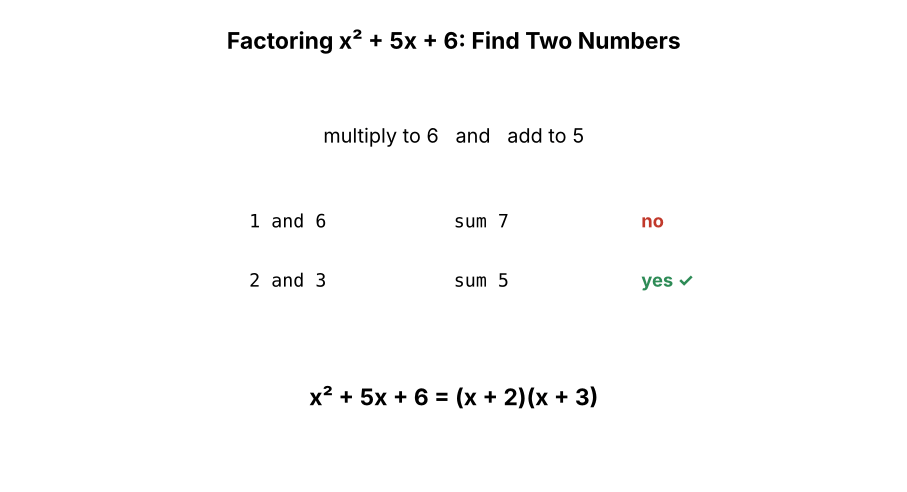
Worked example 1: Factor \(x^{2}+7x+12\).
- List factor pairs of 12: 1 and 12, 2 and 6, 3 and 4.
- Find the pair that adds to 7: 3 and 4.
- Write the factors: \((x+3)(x+4)\).
The signs of \(b\) and \(c\) tell you which signs to look for before you start listing pairs.
| Signs in \(x^{2}+bx+c\) | Signs of the Two Numbers | Example |
|---|---|---|
| \(c\) positive, \(b\) positive | Both positive | \(x^{2}+7x+12=(x+3)(x+4)\) |
| \(c\) positive, \(b\) negative | Both negative | \(x^{2}-9x+20=(x-4)(x-5)\) |
| \(c\) negative, \(b\) positive | Opposite signs, larger one positive | \(x^{2}+2x-15=(x+5)(x-3)\) |
| \(c\) negative, \(b\) negative | Opposite signs, larger one negative | \(x^{2}-4x-21=(x-7)(x+3)\) |
Why does this matter? A negative \(c\) always means the numbers have opposite signs, because only a positive times a negative gives a negative product. Using the sign table first cuts your search in half and prevents choosing a pair that has the right product but the wrong sum.
Factoring When the Leading Coefficient Is Not 1
For \(ax^{2}+bx+c\) with \(a\neq 1\), the ac method turns the trinomial into a four-term polynomial you can factor by grouping.
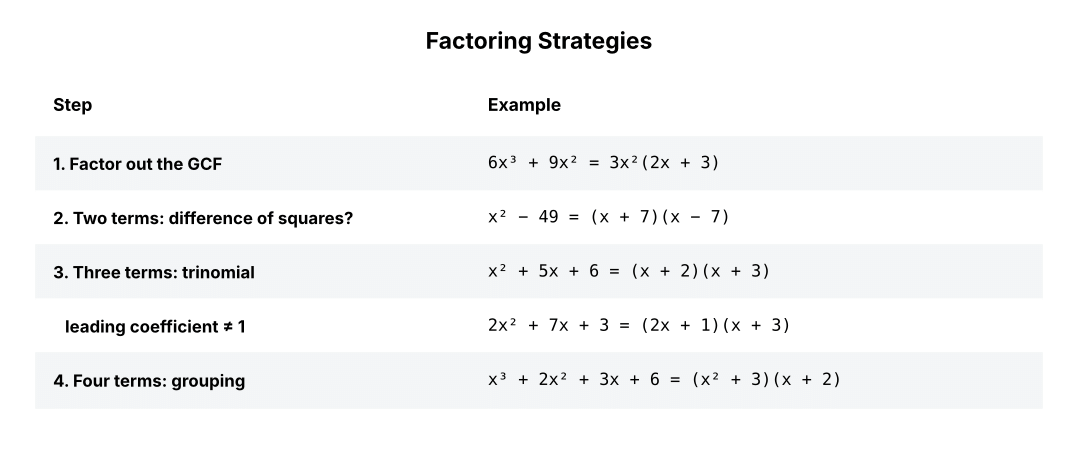
Worked example 2: Factor \(2x^{2}+7x+3\).
- Multiply \(a\) and \(c\): \(2\cdot 3=6\).
- Find two numbers that multiply to 6 and add to 7: 1 and 6.
- Split the middle term: \(2x^{2}+x+6x+3\).
- Group: \((2x^{2}+x)+(6x+3)\).
- Factor each group: \(x(2x+1)+3(2x+1)\).
- Factor out the common binomial: \((2x+1)(x+3)\).
Worked example 3: Factor \(6x^{2}-x-12\).
- Multiply: \(ac=6\cdot(-12)=-72\).
- Find numbers that multiply to \(-72\) and add to \(-1\): 8 and \(-9\).
- Split: \(6x^{2}+8x-9x-12\).
- Group and factor: \(2x(3x+4)-3(3x+4)\).
- Result: \((3x+4)(2x-3)\).
Why does this matter? In Example 3, the second group is factored with \(-3\), not 3. That negative is what makes both binomials match. If your two binomials differ only by sign, factor a negative out of the second group.
Factoring Completely
Always check for a GCF before anything else. Removing it makes the remaining trinomial smaller and easier to factor.
Worked example 4: Factor \(3x^{2}-12x-36\) completely.
- Factor out the GCF of 3: \(3(x^{2}-4x-12)\).
- Find numbers that multiply to \(-12\) and add to \(-4\): \(-6\) and 2.
- Result: \(3(x-6)(x+2)\).
Some trinomials cannot be factored using integers. These are called prime. For example, \(x^{2}+3x+5\) is prime because no pair of integers multiplies to 5 and adds to 3. You will solve equations involving prime trinomials with the quadratic formula instead.
Why does this matter? A trinomial is not factored completely until each factor cannot be broken down further. An answer like \((2x-12)(x+3)\) still has a common factor of 2 inside the first binomial, so it would lose credit on a “factor completely” question.
Test-Taking Strategies
Mnemonic Devices and Memory Shortcuts
Remember “Multiply to \(c\), add to \(b\)” for leading coefficient 1, and “Multiply \(ac\), split \(b\), then group” for everything else. For signs, think “a negative product means a fight,” so the two numbers have opposite signs.
Cross-Topic Connections
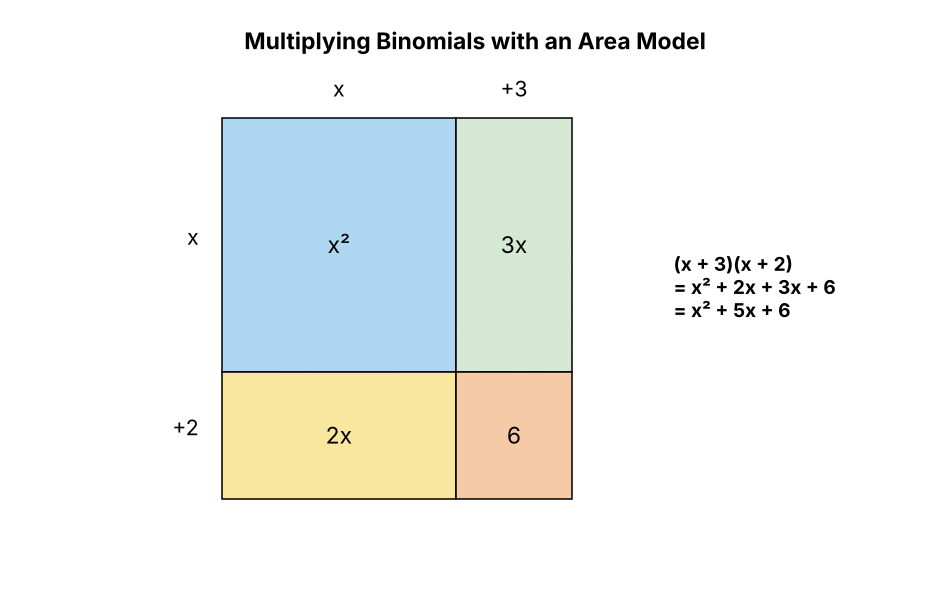
- Factoring reverses the FOIL products from Topic 9.2: Multiplying Polynomials.
- The GCF and grouping steps come from Topic 9.3: Factoring Out the Greatest Common Factor.
- Factored trinomials give the solutions in Topic 10.3: Solving Quadratic Equations by Factoring.
- Prime trinomials require Topic 10.5: The Quadratic Formula and the Discriminant.
Common Question Formats
- Choose the factored form of a trinomial from four options.
- Identify one factor of a given trinomial.
- Factor a trinomial completely, including a GCF.
- Decide whether a trinomial is prime.
Frequent Student Mistakes
- Finding numbers with the right product but the wrong sum, especially with negative signs.
- Skipping the GCF, which leaves a factor that can still be factored.
- Splitting the middle term correctly but grouping with the wrong sign in the second pair.
Test-Day Shortcuts
On multiple-choice items, multiply the answer choices instead of factoring from scratch. Check only the middle term, since the first and last terms usually match in every choice. The correct choice is the one whose Outer plus Inner products equal \(bx\).
Time Management Tips
Trinomials with a leading coefficient of 1 take about a minute on Algebra 1 unit tests and end-of-course exams. Allow two to three minutes for the ac method. If listing factor pairs takes too long, write them in order from the smallest so you never skip a pair.