
Proving two polygons similar normally requires checking every angle and every side ratio. Triangles are different. Just like the congruence shortcuts, three similarity shortcuts let you prove triangles similar from far less information. The most useful one, AA, needs only two angles, which is why similar triangles show up so often in diagrams with parallel lines and shadows.
This article covers Topic 7.2: Proving Triangles Similar in Unit 7, Similarity. The topic asks you to apply the AA Similarity Postulate and the SSS and SAS Similarity Theorems, write similarity statements, and use similar triangles to find missing lengths.
By the end, you should be able to:
- Apply the AA Similarity Postulate.
- Apply the SSS and SAS Similarity Theorems.
- Identify similar triangles inside overlapping figures.
- Use similar triangles to solve indirect measurement problems.
The Three Similarity Shortcuts
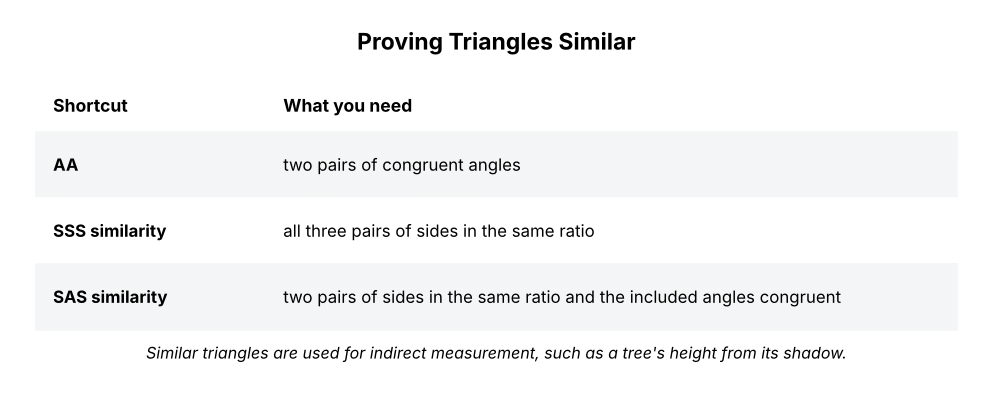
| Shortcut | What You Need |
|---|---|
| AA Similarity | Two angles of one triangle are congruent to two angles of the other. |
| SSS Similarity | All three pairs of corresponding sides are proportional. |
| SAS Similarity | Two pairs of sides are proportional, and the included angles are congruent. |
AA works because if two angles match, the third angles must also match by the Triangle Sum Theorem. Matching angles force the triangles to have the same shape, so the sides are automatically proportional.
Why does this matter? Compare these with the congruence shortcuts. For congruence, sides must be equal. For similarity, sides need only be proportional. And AA, which proves nothing about congruence, is the most powerful similarity shortcut of all.
Using AA
Worked example 1: In \(\triangle ABC\), \(\overline{DE}\) connects points on \(\overline{AB}\) and \(\overline{AC}\) with \(\overline{DE}\parallel\overline{BC}\). Explain why \(\triangle ADE\sim\triangle ABC\).
- \(\angle A\) is shared by both triangles, so \(\angle A\cong\angle A\) by the reflexive property.
- \(\overline{DE}\parallel\overline{BC}\), so \(\angle ADE\cong\angle ABC\) as corresponding angles.
- Two pairs of angles are congruent, so \(\triangle ADE\sim\triangle ABC\) by AA.
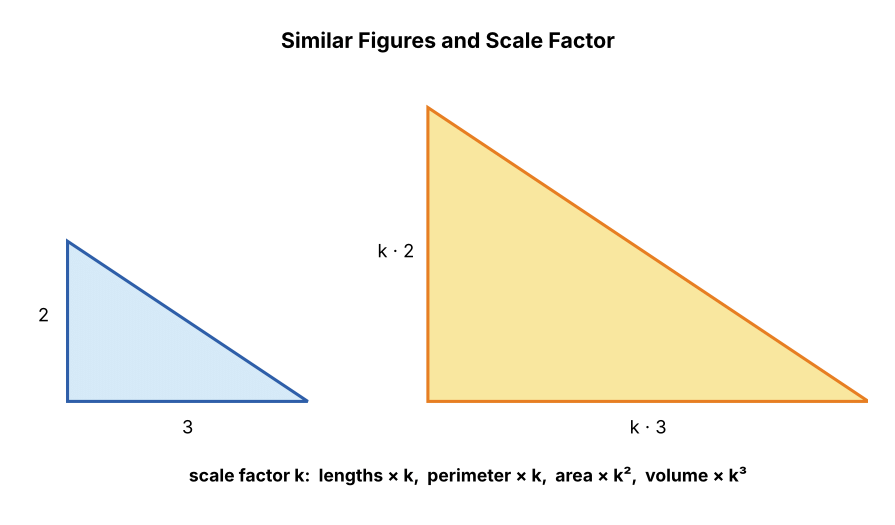
If \(AD=4\), \(AB=10\), and \(BC=15\), then \(\frac{DE}{15}=\frac{4}{10}\), so \(DE=6\). Notice the proportion uses \(AB\), the whole side, not \(DB\), the leftover piece.
Using SSS and SAS Similarity
Worked example 2: \(\triangle PQR\) has sides 6, 8, and 12. \(\triangle XYZ\) has sides 9, 12, and 18. Are they similar?
- Order each set from shortest to longest and compare ratios.
- \(\frac{9}{6}=1.5\), \(\frac{12}{8}=1.5\), and \(\frac{18}{12}=1.5\).
- All three ratios are equal, so the triangles are similar by SSS Similarity.
Worked example 3: In \(\triangle JKL\), \(JK=5\), \(JL=7\), and \(m\angle J=40^{\circ}\). In \(\triangle MNO\), \(MN=10\), \(MO=14\), and \(m\angle M=40^{\circ}\). The ratios \(\frac{10}{5}\) and \(\frac{14}{7}\) both equal 2, and the included angles match, so \(\triangle JKL\sim\triangle MNO\) by SAS Similarity.
Indirect Measurement
Similar triangles let you measure things you cannot reach, such as the height of a tree or a building.
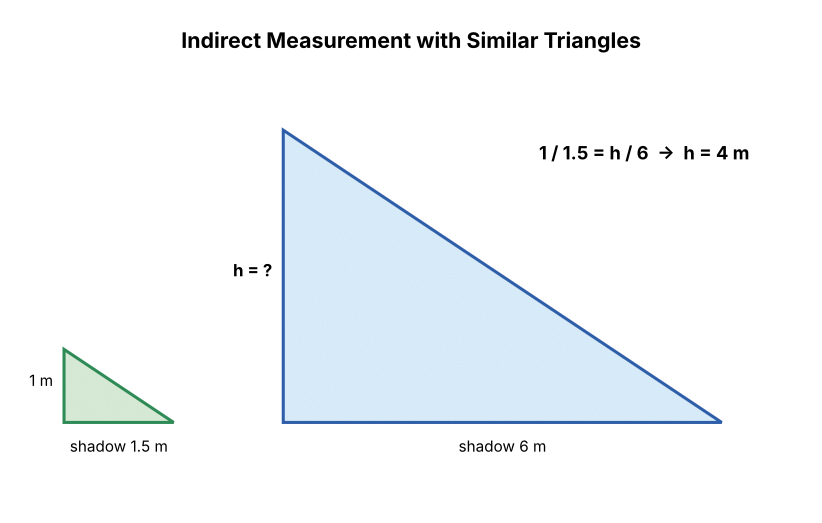
Worked example 4: A 6-foot person casts a 4-foot shadow. At the same time, a flagpole casts a 22-foot shadow. How tall is the flagpole?
- The sun’s rays hit both objects at the same angle, and both stand vertically, so the triangles are similar by AA.
- Set up the proportion: \(\frac{6}{4}=\frac{h}{22}\).
- Solve: \(4h=132\), so \(h=33\) feet.
Why does this matter? Indirect measurement is how surveyors, architects, and early astronomers found distances they could not measure directly. On tests, the setup is always the same: identify two similar right triangles and match height to height and shadow to shadow.
Overlapping Triangles
Many diagrams show one triangle inside another, sharing an angle. Redraw them as two separate triangles, side by side, oriented the same way. Label the matching vertices, then write your proportion. This one habit prevents most mismatched-side errors in similarity problems.
Why does this matter? Once triangles are proven similar, you can conclude that any pair of corresponding sides is proportional and any pair of corresponding angles is congruent. That works like CPCTC for similarity, and it is how similarity proofs lead to new length relationships, including the proportionality theorems in the next topic.
Test-Taking Strategies
Mnemonic Devices and Memory Shortcuts
“Two angles are all you need.” For SSS and SAS similarity, “sides proportional, not equal.” When pieces overlap, “pull them apart before you set them up.”
Cross-Topic Connections
- The definition of similarity comes from Topic 7.1: Ratios and Similar Polygons.
- Parallel lines supply matching angles, from Topic 3.1: Angles Formed by Parallel Lines and Transversals.
- The third angle follows from Topic 5.1: Classifying Triangles and the Triangle Sum Theorem.
- Compare these shortcuts with Topic 5.2: Triangle Congruence: SSS and SAS.
Common Question Formats
- Decide which shortcut proves two triangles similar.
- Find a missing length in nested or overlapping triangles.
- Solve a shadow or mirror indirect measurement problem.
- Complete a similarity statement with vertices in order.
Frequent Student Mistakes
- Using the leftover segment instead of the whole side in nested triangles.
- Requiring sides to be equal rather than proportional.
- Matching sides by position on the page instead of by corresponding angles.
Test-Day Shortcuts
For SSS similarity, sort both triangles’ sides from shortest to longest and divide in order. If the three quotients match, the triangles are similar. This avoids guessing which sides correspond.
Time Management Tips
Similarity shortcut items on Geometry unit tests and end-of-course exams take about a minute. Nested-triangle and indirect measurement problems take two to three minutes. Sketching the separated triangles is worth the extra seconds.