
A model car, a map, and a blueprint all share one feature: they have exactly the same shape as the real thing, just a different size. In geometry, figures like these are called similar. Similarity extends congruence to figures that can be resized, and it powers indirect measurement, scale drawings, and the trigonometry you will meet later in the course.
This article covers Topic 7.1: Ratios and Similar Polygons in Unit 7, Similarity. The topic asks you to define similar polygons, write similarity statements, find scale factors, and use proportions to find missing side lengths and perimeters.
By the end, you should be able to:
- Define similar polygons using angles and side ratios.
- Write a similarity statement with corresponding vertices in order.
- Find a scale factor and use it to find missing lengths.
- Explain how perimeters and areas of similar figures compare.
What Makes Polygons Similar
Two polygons are similar if two conditions both hold:
- Corresponding angles are congruent.
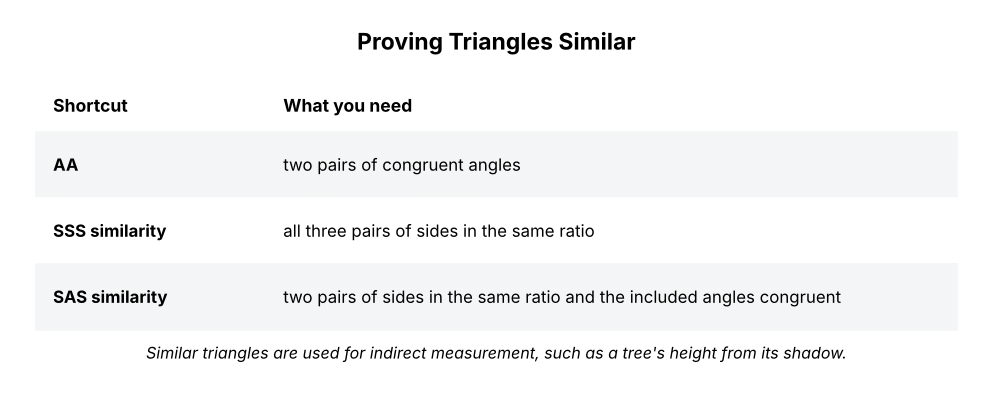
- Corresponding side lengths are proportional. Every pair of matching sides has the same ratio.
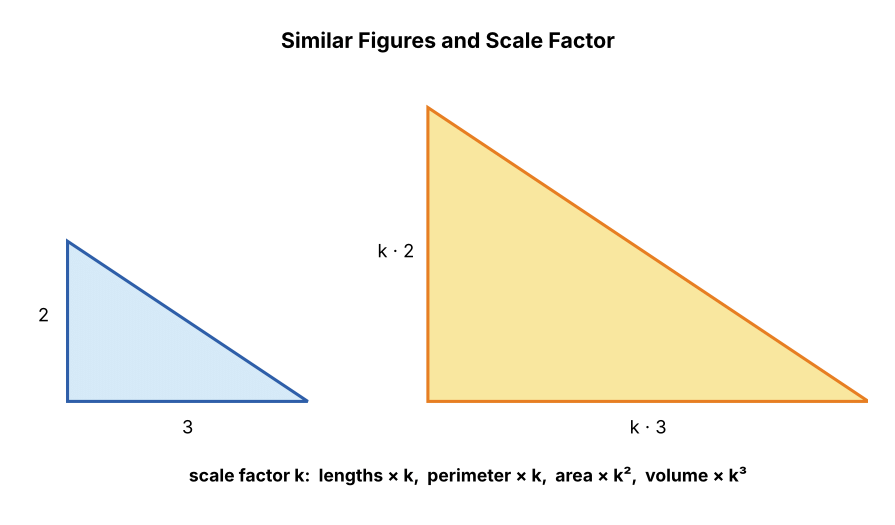
The symbol for similarity is \(\sim\). As with congruence, the order of the letters in \(ABCD\sim EFGH\) tells you which vertices correspond: \(A\) matches \(E\), \(B\) matches \(F\), and so on.
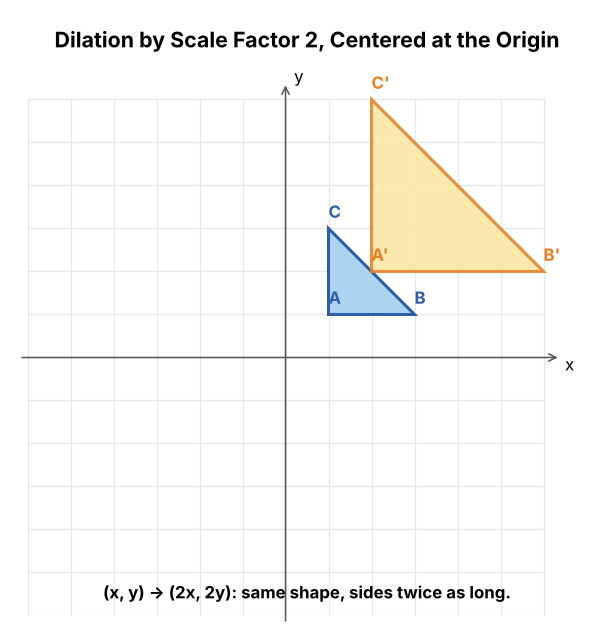
In terms of transformations, two figures are similar if a sequence of rigid motions and dilations maps one onto the other. The dilation changes the size, and the rigid motions line the figures up.
Why does this matter? Both conditions are required for polygons with more than three sides. A square and a non-square rhombus have proportional sides, since all sides are equal in each, but their angles differ. A square and a non-square rectangle have equal angles, but their sides are not proportional. Neither pair is similar.
Scale Factor
The scale factor is the ratio of corresponding side lengths. If \(\triangle ABC\sim\triangle DEF\) with \(AB=6\) and \(DE=15\), the scale factor from \(ABC\) to \(DEF\) is \(\frac{15}{6}=\frac{5}{2}\). From \(DEF\) to \(ABC\), it is the reciprocal, \(\frac{2}{5}\).
Worked example 1: Quadrilateral \(PQRS\sim WXYZ\). \(PQ=8\), \(QR=12\), \(WX=10\). Find \(XY\).
- Write a proportion with matching sides: \(\frac{PQ}{WX}=\frac{QR}{XY}\).
- Substitute: \(\frac{8}{10}=\frac{12}{XY}\).
- Cross multiply: \(8\cdot XY=120\), so \(XY=15\).
You can also use the scale factor directly. From \(PQRS\) to \(WXYZ\), the scale factor is \(\frac{10}{8}=1.25\), so \(XY=1.25\cdot 12=15\).
Why does this matter? The scale factor depends on direction. Going from the smaller figure to the larger gives a factor greater than 1, and going the other way gives its reciprocal. Decide which figure you are starting from before multiplying. A quick reasonableness check helps: if the image figure is larger, every missing length you compute for it should be larger too.
Scale drawings and maps use the same idea. A map scale of 1 inch to 20 miles is a scale factor, and every distance on the map is proportional to the real distance it represents.
Checking Whether Figures Are Similar
Worked example 2: Rectangle \(A\) is 4 by 10. Rectangle \(B\) is 6 by 15. Are they similar?
- All angles are right angles, so the angles match.
- Compare ratios of matching sides: \(\frac{6}{4}=1.5\) and \(\frac{15}{10}=1.5\).
- The ratios are equal, so the rectangles are similar with scale factor 1.5.
Rectangle \(C\), which is 6 by 12, is not similar to rectangle \(A\), because \(\frac{6}{4}=1.5\) but \(\frac{12}{10}=1.2\).
Perimeter and Area of Similar Figures
| Measure | Ratio for Scale Factor \(k\) | If \(k=3\) |
|---|---|---|
| Side lengths | \(k\) | 3 times as long |
| Perimeter | \(k\) | 3 times as long |
| Area | \(k^{2}\) | 9 times as large |
| Volume (similar solids) | \(k^{3}\) | 27 times as large |
Worked example 3: Two similar triangles have a scale factor of \(\frac{2}{3}\). The larger has an area of 45 square units. Find the area of the smaller.
- The area ratio is \(\left(\frac{2}{3}\right)^{2}=\frac{4}{9}\).
- Multiply: \(45\cdot\frac{4}{9}=20\) square units.
Why does this matter? Area depends on two dimensions, so it scales by the square of the scale factor. Using the scale factor alone for area is one of the most common errors on similarity questions.
Test-Taking Strategies
Mnemonic Devices and Memory Shortcuts
“Same shape, scaled size.” For ratios, remember “1D gets \(k\), 2D gets \(k^{2}\), 3D gets \(k^{3}\).” Keep proportions consistent with “small over large equals small over large.”
Cross-Topic Connections
- Similarity is built on Topic 4.4: Dilations.
- Solving proportions uses Algebra 1 Topic 2.6: Ratios, Rates, and Proportions.
- Congruence is similarity with a scale factor of 1, as in Topic 5.2: Triangle Congruence: SSS and SAS.
- The triangle midsegment creates a half-size similar triangle, as in Topic 5.5: Midsegments, Bisectors, Medians, and Altitudes.
Common Question Formats
- Find a missing side length in similar polygons.
- Determine whether two polygons are similar.
- Find the scale factor from a pair of corresponding sides.
- Find a perimeter or area using the scale factor.
Frequent Student Mistakes
- Setting up a proportion with sides that do not correspond.
- Using the scale factor instead of its square for area.
- Assuming figures are similar because their angles match, without checking side ratios for polygons with four or more sides.
Test-Day Shortcuts
Write the similarity statement’s vertices in two rows, one above the other. Matching sides are the pairs of letters in the same columns. That visual alignment prevents mismatched proportions.
Time Management Tips
Similar polygon items on Geometry unit tests and end-of-course exams usually take one to two minutes. Area and perimeter questions take about the same time once you remember to square for area.