
Zoom in on a photo and everything gets bigger, but the shapes stay the same. That is a dilation. Unlike translations, reflections, and rotations, a dilation changes size, so it is not a rigid motion. It is, however, the transformation that defines similarity, which makes it the bridge from congruence to similar figures later in the course.
This article covers Topic 4.4: Dilations in Unit 4, Transformations. The topic asks you to perform dilations with a given center and scale factor, find the scale factor from a figure and its image, and describe what a dilation preserves and what it changes.
By the end, you should be able to:
- Define a dilation by its center and scale factor.
- Classify a dilation as an enlargement or a reduction.
- Dilate figures about the origin and about other centers.
- Explain how a dilation affects lengths, angles, and lines.
Center and Scale Factor
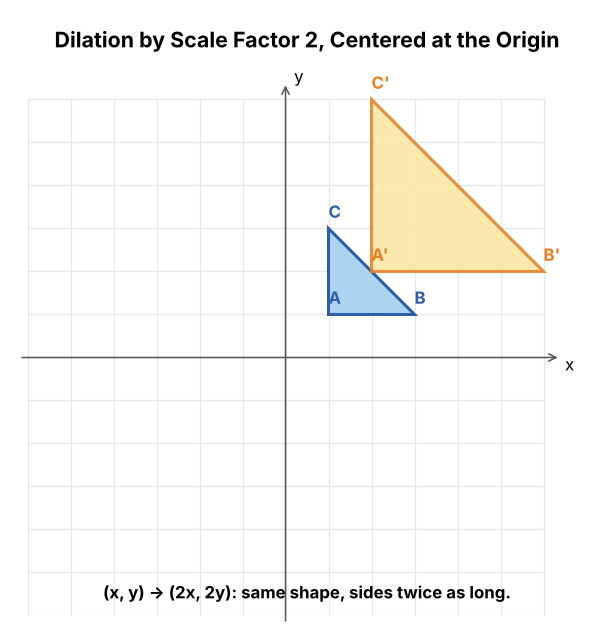
A dilation with center \(C\) and scale factor \(k\) maps each point \(P\) to \(P^{\prime}\) on ray \(\overrightarrow{CP}\) so that \(CP^{\prime}=k\cdot CP\). The center stays fixed, and every other point moves along a line through the center.
| Scale Factor | Type | Effect |
|---|---|---|
| \(k\gt 1\) | Enlargement | The image is larger and farther from the center. |
| \(0\lt k\lt 1\) | Reduction | The image is smaller and closer to the center. |
| \(k=1\) | Identity | The image matches the preimage exactly. |
Some courses also allow negative scale factors, which dilate and then rotate the image \(180^{\circ}\) about the center. The size change depends on \(|k|\).
Think of a dilation as a projector. The center is the bulb, and every point of the image lies on a straight line from the bulb through the matching point of the preimage. Moving the screen farther away enlarges the picture, and moving it closer shrinks it, but the shape on the screen never changes.
Dilating About the Origin
When the center is the origin, multiply every coordinate by the scale factor: \((x,y)\rightarrow(kx,ky)\).
Worked example 1: Dilate rectangle \(ABCD\) with \(A(2,1)\), \(B(6,1)\), \(C(6,4)\), and \(D(2,4)\) by a scale factor of \(\frac{1}{2}\) about the origin.
- \(A^{\prime}(1,0.5)\), \(B^{\prime}(3,0.5)\), \(C^{\prime}(3,2)\), and \(D^{\prime}(1,2)\).
- Original width: \(AB=4\). Image width: \(A^{\prime}B^{\prime}=2\), which is half.
- Original height: 3. Image height: 1.5, also half.
Worked example 2: Point \(P(3,-2)\) maps to \(P^{\prime}(12,-8)\) under a dilation about the origin. Find the scale factor. Divide an image coordinate by its preimage coordinate: \(\frac{12}{3}=4\), and \(\frac{-8}{-2}=4\). The scale factor is 4.
Dilating About Another Center
For a center \((a,b)\) other than the origin, find each point’s position relative to the center, scale it, and add the center back.
Worked example 3: Dilate \(Q(7,5)\) by a scale factor of 3 about the center \((1,2)\).
- Position relative to the center: \((7-1,5-2)=(6,3)\).
- Scale: \((18,9)\).
- Add the center back: \(Q^{\prime}(19,11)\).
Why does this matter? Multiplying \((7,5)\) by 3 directly would give \((21,15)\), the image for a dilation about the origin, not about \((1,2)\). Questions often include that answer as a trap. Always check which center is given.
What Dilations Preserve and Change
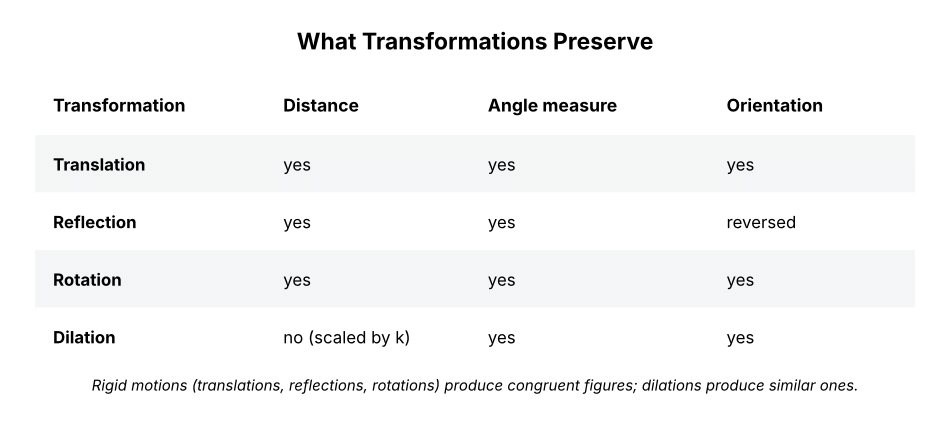
- Angle measures are preserved. Every angle in the image matches its preimage, so the shape stays the same.
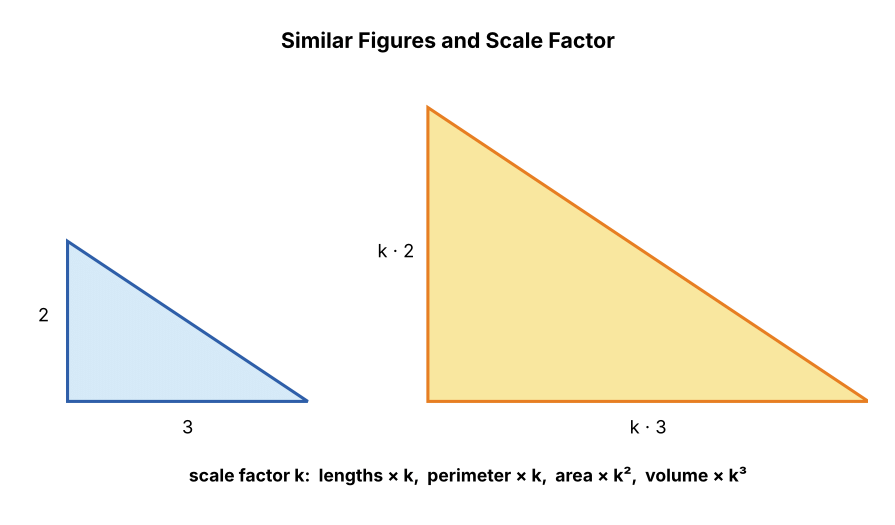
- Lengths are multiplied by \(|k|\). A side of 5 under a scale factor of 3 becomes 15.
- Perimeter scales by \(|k|\), and area scales by \(k^{2}\). Doubling every length makes the area four times as large.
- Lines map to parallel lines. A segment that does not pass through the center maps to a parallel segment. A segment through the center maps to a segment on the same line.
Why does this matter? The area rule is a frequent test item. If a photo is enlarged by a factor of 3, its area grows by a factor of 9, not 3. Squaring the scale factor for area, and cubing it for volume, comes up again with similar figures and solids.
Test-Taking Strategies
Mnemonic Devices and Memory Shortcuts
“Bigger than 1 grows, between 0 and 1 shrinks.” For areas, “length times \(k\), area times \(k\) squared.” For finding \(k\), use “image over preimage.”
Cross-Topic Connections
- Moving the center to the origin borrows from Topic 4.1: Translations.
- Dilations are not rigid motions, unlike Topic 4.3: Rotations.
- Image segments are parallel, which you can check with Topic 3.3: Slopes of Parallel and Perpendicular Lines.
- The scale factor is a ratio, as in Algebra 1 Topic 2.6: Ratios, Rates, and Proportions.
Common Question Formats
- Find the image of a point or polygon after a dilation about the origin.
- Find the scale factor from a figure and its image.
- Decide whether a dilation is an enlargement or a reduction.
- Find the new perimeter or area after a dilation.
Frequent Student Mistakes
- Dividing preimage by image when finding the scale factor, which gives the reciprocal.
- Using the origin rule when the center is a different point.
- Multiplying area by \(k\) instead of \(k^{2}\).
Test-Day Shortcuts
If an image point and its preimage are both given, check that they line up with the center. If the center, the point, and its image are not collinear, the transformation is not a dilation with that center.
Time Management Tips
Dilations about the origin on Geometry unit tests and end-of-course exams take about a minute. Allow two minutes for other centers or area questions. Write the scale factor at the top of your work so you apply it consistently.