
Slide a book across a table without turning it, and you have performed a translation. Every point of the book moves the same distance in the same direction. Translations are the simplest of the rigid transformations, and they introduce the notation and vocabulary you will use for reflections, rotations, and dilations.
This article covers Topic 4.1: Translations in Unit 4, Transformations. The topic asks you to describe translations with coordinate rules and vectors, perform translations on the coordinate plane, and explain why translations preserve size and shape.
By the end, you should be able to:
- Define a transformation, preimage, image, and rigid motion.
- Write a translation as a coordinate rule and as a vector.
- Translate figures on the coordinate plane and label the image correctly.
- Describe what a translation preserves and combine two translations into one.
Transformation Vocabulary
A transformation is a rule that moves or changes a figure. The original figure is the preimage, and the result is the image. Image points are labeled with prime marks, so the image of point \(A\) is \(A^{\prime}\), read “A prime.”
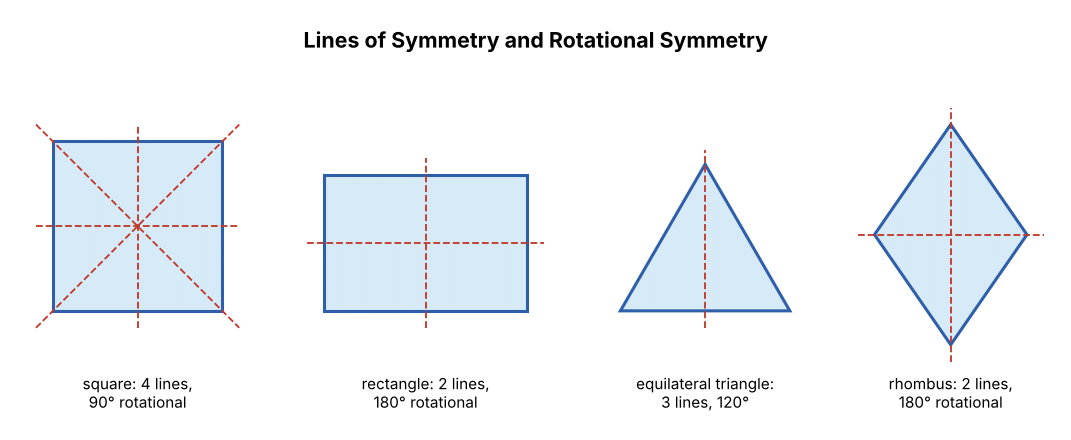
A rigid motion, also called an isometry, preserves distance and angle measure. The image is congruent to the preimage. Translations, reflections, and rotations are rigid motions. Dilations are not, because they change size.
Describing a Translation
A translation moves every point of a figure the same distance in the same direction. You can describe it two ways.
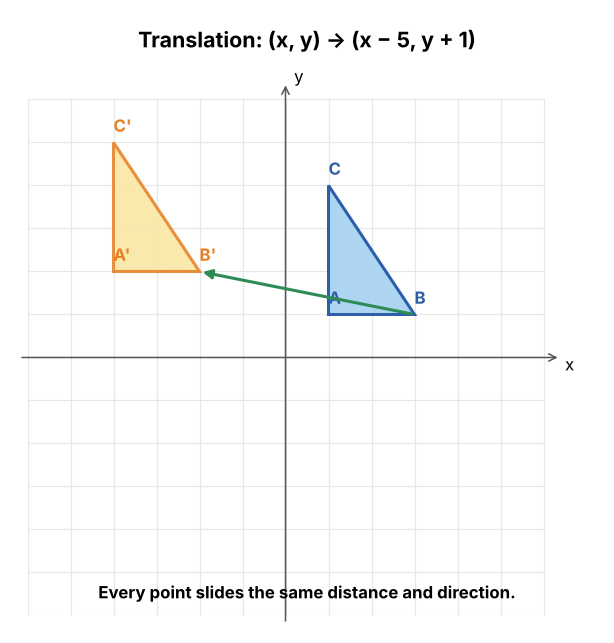
| Description | Notation | Meaning |
|---|---|---|
| Coordinate rule | \((x,y)\rightarrow(x+a,y+b)\) | Add \(a\) to every \(x\)-coordinate and \(b\) to every \(y\)-coordinate. |
| Vector | \(\langle a,b\rangle\) | An arrow showing the horizontal change \(a\) and vertical change \(b\). |
| Words | “5 units right and 2 units down” | The same as \(\langle 5,-2\rangle\). |
A positive \(a\) moves right and a negative \(a\) moves left. A positive \(b\) moves up and a negative \(b\) moves down.
Translating on the Coordinate Plane
Worked example 1: Triangle \(ABC\) has vertices \(A(1,2)\), \(B(4,6)\), and \(C(5,1)\). Translate it using \((x,y)\rightarrow(x-3,y+2)\).
- \(A(1,2)\rightarrow A^{\prime}(-2,4)\)
- \(B(4,6)\rightarrow B^{\prime}(1,8)\)
- \(C(5,1)\rightarrow C^{\prime}(2,3)\)
Check by comparing a side before and after. \(AB=\sqrt{3^{2}+4^{2}}=5\), and \(A^{\prime}B^{\prime}=\sqrt{3^{2}+4^{2}}=5\). The length is unchanged, as it should be for a rigid motion.
Worked example 2: Point \(P(-2,7)\) is translated to \(P^{\prime}(3,4)\). Write the rule.
- Horizontal change: \(3-(-2)=5\).
- Vertical change: \(4-7=-3\).
- Rule: \((x,y)\rightarrow(x+5,y-3)\), or the vector \(\langle 5,-3\rangle\).
Why does this matter? Finding the rule always means subtracting preimage from image, in that order. Reversing the subtraction gives the rule for undoing the translation, which is a common wrong answer choice.
What Translations Preserve
Translations keep everything about a figure except its location:
- Side lengths and angle measures stay the same, so the image is congruent to the preimage.
- Orientation stays the same. If the vertices read \(A\), \(B\), \(C\) clockwise, the image vertices also read clockwise.
- Parallel segments stay parallel, and each segment is parallel to its image or lies on the same line.
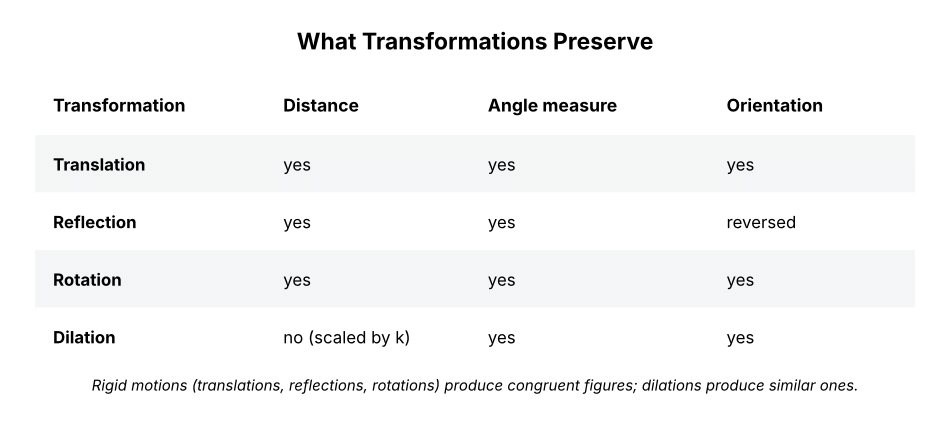
Segments connecting each point to its image, such as \(\overline{AA^{\prime}}\) and \(\overline{BB^{\prime}}\), are all parallel and the same length. That property defines a translation.
Why does this matter? Because orientation is preserved, a translation can never map a figure onto its mirror image. If two congruent figures face opposite directions, the transformation between them must include a reflection. Checking orientation first tells you which kinds of transformations to consider.
Combining Translations
Two translations in a row always equal a single translation. Add the vectors: \(\langle 3,-1\rangle\) followed by \(\langle{-5},4\rangle\) equals \(\langle{-2},3\rangle\). The order does not matter, since addition is commutative.
Why does this matter? Later, you will show that two figures are congruent by describing a sequence of rigid motions that maps one onto the other. Translations are usually the first step, sliding one vertex onto its matching vertex before any turning or flipping.
Test-Taking Strategies
Mnemonic Devices and Memory Shortcuts
“Translation is a slide, no turn, no flip.” For signs, remember “\(x\) is right and left, \(y\) is up and down,” just like moving along the axes. For finding a rule, use “image minus preimage.”
Cross-Topic Connections
- Lengths are checked with the distance formula from Topic 1.2: Measuring Segments and the Distance Formula.
- Segments joining points to images are parallel, using Topic 3.3: Slopes of Parallel and Perpendicular Lines.
- Coordinates and ordered pairs come from Topic 1.1: Points, Lines, and Planes.
- Shifting a graph up or down mirrors the vertical change in Algebra 1 Topic 10.1: Graphing Quadratic Functions.
Common Question Formats
- Find the image of a point or polygon under a translation rule.
- Write the rule or vector given a point and its image.
- Choose the graph that shows a correct translation.
- Combine two translations into one rule.
Frequent Student Mistakes
- Applying the horizontal change to \(y\) and the vertical change to \(x\).
- Subtracting image minus preimage in the wrong order when finding the rule.
- Forgetting to translate every vertex, which distorts the image.
Test-Day Shortcuts
Translate just one vertex first and compare it with the answer choices. Usually only one choice puts that vertex in the right spot. Then check a second vertex to confirm.
Time Management Tips
Translation items on Geometry unit tests and end-of-course exams usually take under a minute. Graphing a full polygon takes one to two minutes. Make a small table of preimage and image coordinates to stay organized.