
Throw a ball, and its height over time traces a curve called a parabola. Bridges, satellite dishes, and fountains follow the same shape. In Algebra 1, you graph these curves from quadratic functions and read key features straight from the graph: where it peaks, where it crosses the ground, and which way it opens.
This article covers Topic 10.1: Graphing Quadratic Functions in Unit 10, Quadratic Functions and Equations. The topic asks you to graph \(y=ax^{2}+bx+c\), identify the vertex, axis of symmetry, intercepts, and direction, and interpret these features in context.
By the end, you should be able to:
- Name the key features of a parabola.
- Use \(a\) to predict direction and width.
- Find the axis of symmetry and vertex with \(x=-\frac{b}{2a}\).
- Graph a quadratic accurately and interpret its features in a real situation.
Key Features of a Parabola
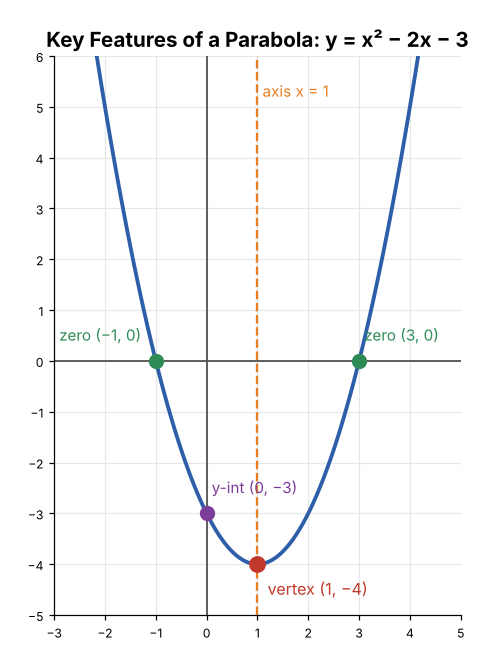
The graph of a quadratic function \(y=ax^{2}+bx+c\), where \(a\neq 0\), is a U-shaped curve called a parabola.
| Feature | Definition | How to Find It |
|---|---|---|
| Vertex | The turning point, either the minimum or maximum. | Use \(x=-\frac{b}{2a}\), then substitute to find \(y\). |
| Axis of symmetry | The vertical line through the vertex that splits the parabola into mirror halves. | \(x=-\frac{b}{2a}\) |
| \(y\)-intercept | Where the graph crosses the \(y\) axis. | The point \((0, c)\). |
| \(x\)-intercepts | Where the graph crosses the \(x\) axis. Also called zeros or roots. | Solve \(ax^{2}+bx+c=0\). |
| Direction | Whether the parabola opens up or down. | Up if \(a\gt 0\), down if \(a\lt 0\). |
Why does this matter? The direction tells you whether the vertex is a minimum or a maximum. If \(a\gt 0\), the parabola opens up and the vertex is the lowest point. If \(a\lt 0\), it opens down and the vertex is the highest point. Questions about “maximum height” or “minimum cost” are really asking for the vertex.
How \(a\) Changes the Shape
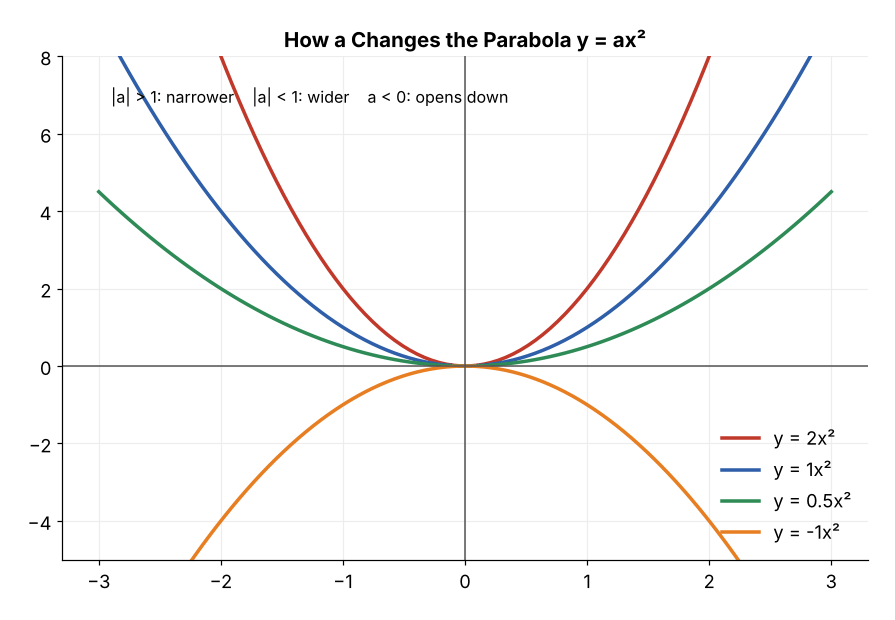
Compared with the parent function \(y=x^{2}\), the value of \(a\) stretches, compresses, or flips the graph.
- \(|a|\gt 1\): The parabola is narrower, because outputs grow faster. \(y=3x^{2}\) is skinnier than \(y=x^{2}\).
- \(0\lt|a|\lt 1\): The parabola is wider. \(y=\frac{1}{2}x^{2}\) is flatter than \(y=x^{2}\).
- \(a\lt 0\): The parabola is reflected over the \(x\) axis and opens down.
Graphing Step by Step
Worked example: Graph \(y=x^{2}-4x-5\).
- Direction: \(a=1\), so it opens up and has a minimum.
- Axis of symmetry: \(x=-\frac{-4}{2(1)}=2\).
- Vertex: Substitute \(x=2\): \(y=4-8-5=-9\). The vertex is \((2,-9)\).
- \(y\)-intercept: \((0,-5)\).
- Mirror point: The \(y\)-intercept is 2 units left of the axis, so \((4,-5)\) is also on the graph.
- \(x\)-intercepts: Factor \(x^{2}-4x-5=(x-5)(x+1)=0\), so \(x=5\) or \(x=-1\).
- Sketch: Plot all points and draw a smooth U-shape through them.
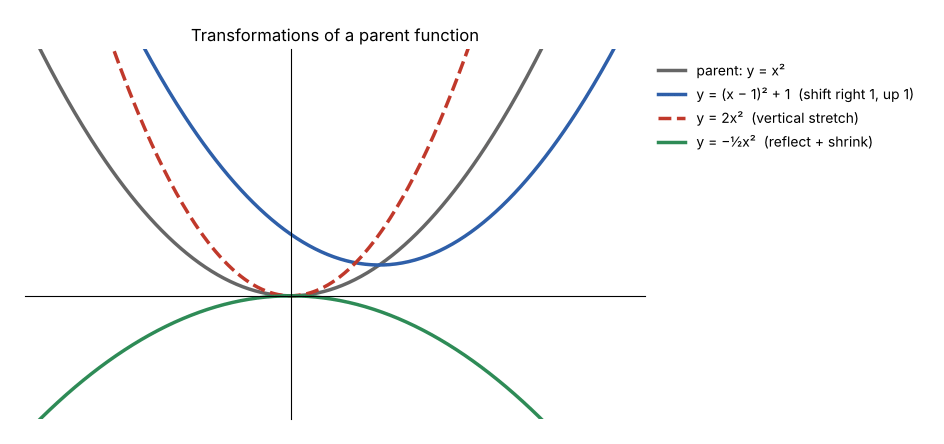
The \(x\)-intercepts sit 3 units on either side of the axis at \(x=2\). That symmetry is a built-in check: the zeros are always equally distant from the axis of symmetry.
Not every parabola crosses the \(x\) axis. A parabola can have two \(x\)-intercepts, one (when the vertex sits on the axis), or none (when the vertex is above the axis and the graph opens up, or below it and the graph opens down).
Quadratics in Context
A ball is thrown upward, and its height in feet after \(t\) seconds is \(h(t)=-16t^{2}+32t+48\).
- Opens down: Since \(a=-16\), the vertex is a maximum.
- Time of maximum height: \(t=-\frac{32}{2(-16)}=1\) second.
- Maximum height: \(h(1)=-16+32+48=64\) feet.
- Starting height: \(h(0)=48\) feet, the \(y\)-intercept.
- Landing time: Solve \(-16t^{2}+32t+48=0\). Dividing by \(-16\) gives \(t^{2}-2t-3=0\), so \((t-3)(t+1)=0\) and \(t=3\) seconds. The negative solution makes no sense for time.
Why does this matter? Context questions combine every feature in one problem. Matching each question phrase to a feature, such as “highest point” to the vertex and “hits the ground” to a zero, turns a long word problem into a short checklist.
Test-Taking Strategies
Mnemonic Devices and Memory Shortcuts
Remember “positive a smiles, negative a frowns.” For the axis of symmetry, say “negative b over two a.” For context problems, use “vertex for the extreme, zeros for the ground.”
Cross-Topic Connections
- Parabolas are functions that pass the test from Topic 4.1: Relations and Functions.
- A parabola’s range is set by its vertex, as shown in Topic 4.3: Domain and Range.
- Finding the zeros uses Topic 9.4: Factoring Trinomials.
- Vertex and intercept forms are compared in Topic 10.2: Forms of Quadratic Functions.
Common Question Formats
- Identify the vertex, axis of symmetry, or intercepts from a graph or equation.
- Match a quadratic equation to its graph.
- Find a maximum height or minimum cost in a word problem.
- Describe how changing \(a\) affects the graph.
Frequent Student Mistakes
- Dropping the negative in \(x=-\frac{b}{2a}\), which places the axis on the wrong side.
- Reporting only the \(x\) value when asked for the vertex. The vertex is an ordered pair.
- Keeping a negative time or distance as a solution in a context problem.
Test-Day Shortcuts
To match a graph quickly, check three things in order: direction from the sign of \(a\), the \(y\)-intercept from \(c\), and the axis of symmetry. Most wrong choices fail one of these checks immediately.
Time Management Tips
Feature-identification items on Algebra 1 unit tests and end-of-course exams take about a minute. Full graphing or context problems can take three to four minutes, so set up a feature checklist before calculating. Use symmetry to plot extra points instead of substituting more values.