
A vending machine is a good model of a function. Press B4 and you always get the same snack. If pressing B4 sometimes gave chips and sometimes gave a cookie, the machine would be broken. Functions work the same way: each input leads to exactly one output. This idea is the foundation for everything you will graph and model in the rest of Algebra 1.
This article covers Topic 4.1: Relations and Functions in Unit 4, Functions. The topic asks you to identify relations that are functions from ordered pairs, tables, mappings, graphs, and equations.
By the end, you should be able to:
- Define a relation, an input, and an output.
- Decide whether a relation is a function in any representation.
- Apply the vertical line test to a graph.
- Explain why certain equations, such as \(x=y^{2}\), are not functions.
Relations, Inputs, and Outputs
A relation is any set of ordered pairs \((x, y)\). The first value, \(x\), is the input, and the second value, \(y\), is the output. A relation can pair inputs and outputs in any way at all.
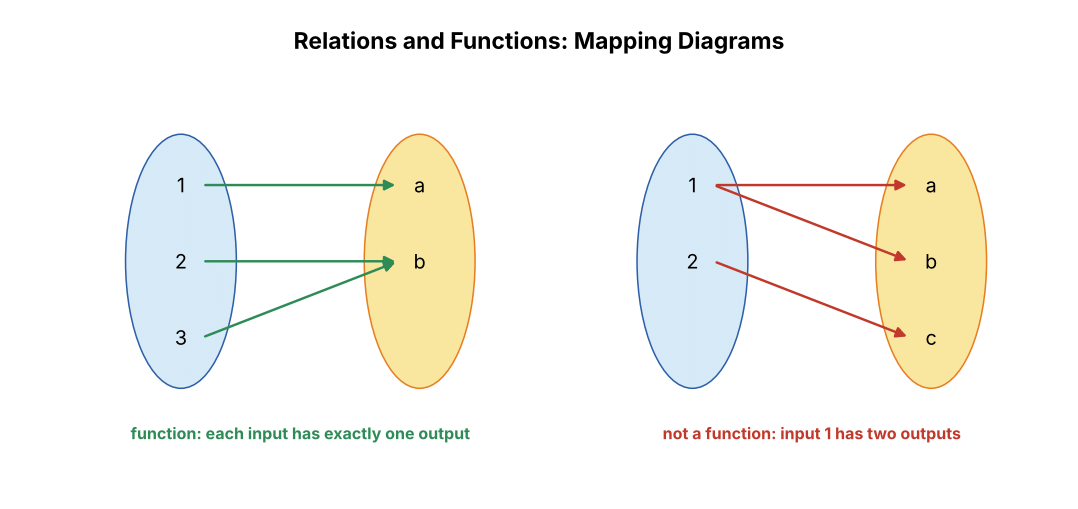
A function is a special relation in which every input has exactly one output. Outputs are allowed to repeat. Inputs are not allowed to lead to two different outputs.
| Relation | Function? | Reason |
|---|---|---|
| \(\{(1, 4), (2, 5), (3, 6)\}\) | Yes | Each input appears once with one output. |
| \(\{(1, 4), (2, 4), (3, 4)\}\) | Yes | Outputs repeat, but each input still has one output. |
| \(\{(1, 4), (1, 7), (2, 5)\}\) | No | Input 1 leads to both 4 and 7. |
| \(\{(0, 0), (2, 3), (2, 3)\}\) | Yes | The pair \((2, 3)\) is listed twice, but input 2 still has only one output. |
Why does this matter? The second row trips up many students. A function can send many inputs to the same output, just as many students can earn the same grade. What breaks a function is one input giving two outputs, as in the third row.
Checking Each Representation
The same rule applies no matter how a relation is shown. Only the way you look for repeated inputs changes.
- Tables: Scan the input column. If any input value appears twice with different outputs, the relation is not a function.
- Mapping diagrams: Look at each input oval. If any input has two arrows leaving it, the relation is not a function. Two arrows arriving at one output are fine.
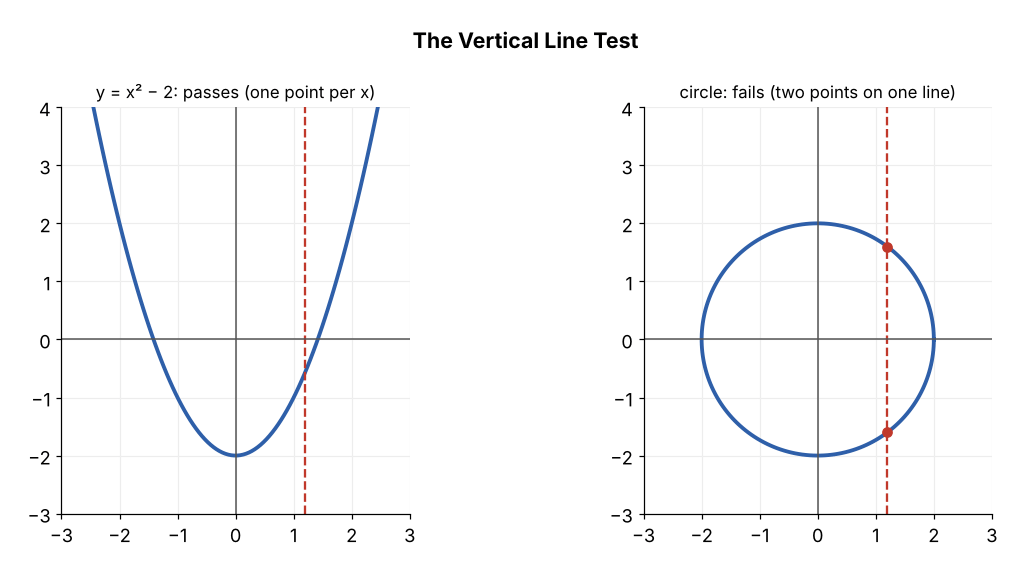
- Graphs: Use the vertical line test. If any vertical line crosses the graph more than once, two points share an \(x\) value, so the graph is not a function.
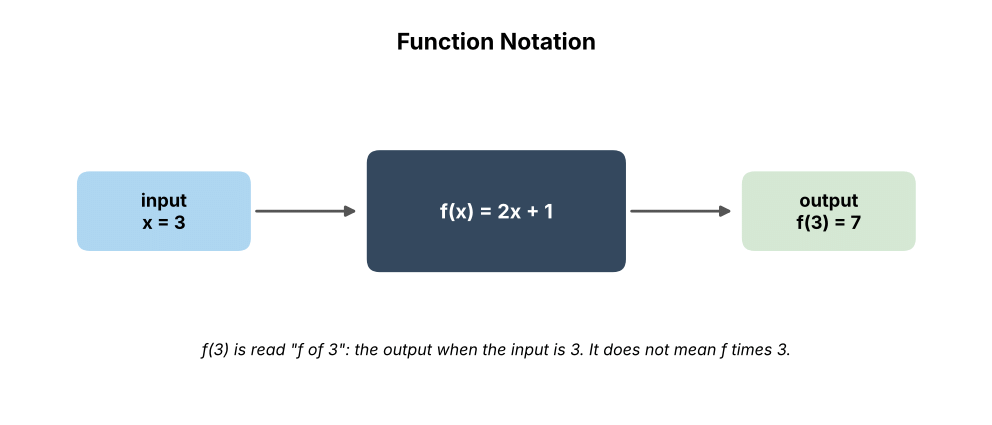
- Equations: Solve for \(y\) or test an input. If one \(x\) value produces two \(y\) values, the equation is not a function.
The Vertical Line Test and Equations
The vertical line test works because every point on a vertical line has the same \(x\) value. If a vertical line touches the graph twice, those two points have the same input and different outputs.
| Graph | Passes the Test? | Function? |
|---|---|---|
| A non-vertical line, such as \(y=2x+1\) | Yes | Yes |
| A parabola opening up, such as \(y=x^{2}\) | Yes | Yes |
| A vertical line, such as \(x=3\) | No | No |
| A circle, such as \(x^{2}+y^{2}=25\) | No | No |
| A sideways parabola, such as \(x=y^{2}\) | No | No |
Worked example: Is \(x=y^{2}\) a function? Test the input \(x=4\). Then \(y^{2}=4\), so \(y=2\) or \(y=-2\). One input has two outputs, so it is not a function. Compare \(y=x^{2}\): the input \(x=2\) gives only \(y=4\), so that equation is a function.
Why does this matter? Functions are what allow you to make predictions. If a relation gave two different outputs for one input, a model could not tell you how much a 5-gigabyte phone plan costs or how tall a plant will be after 3 weeks. That reliability is why Algebra 1 focuses on functions.
Test-Taking Strategies
Mnemonic Devices and Memory Shortcuts
Remember “Don’t Repeat X.” If an \(x\) value repeats with a different \(y\), it is not a function. For mappings, think “one arrow out of each input.” For graphs, picture a vertical pencil sliding across the page.
Cross-Topic Connections
- Inputs and outputs connect to substitution in Topic 1.1: Variables and Algebraic Expressions.
- Non-vertical lines are functions, which is why Topic 5.2: Slope-Intercept Form writes them as \(y=mx+b\).
- Vertical lines fail the test, as discussed in Topic 5.6: Horizontal and Vertical Lines.
- Parabolas that open up or down pass the test, as you’ll see in Topic 10.2: Forms of Quadratic Functions.
Common Question Formats
- Choose which table, mapping, or set of ordered pairs represents a function.
- Apply the vertical line test to several graphs.
- Find a value that would make a relation not a function when added.
- Decide whether a real-world pairing, such as students and birthdays, is a function.
Frequent Student Mistakes
- Rejecting a relation because outputs repeat. Repeated outputs are allowed.
- Using a horizontal line test instead of a vertical one.
- Assuming every equation is a function. Check for inputs that produce two outputs, especially when \(y\) is squared.
Test-Day Shortcuts
For tables and ordered pairs, scan only the inputs first. If no input repeats, the relation is a function immediately. For real-world pairs, ask “Can one input have two outputs?” Each student has one birthday, so student to birthday is a function, but birthday to student usually is not.
Time Management Tips
Function identification items on Algebra 1 unit tests and end-of-course exams are among the quickest, often 30 seconds each. Use the saved time on later modeling questions. If a graph is hard to read, check a few vertical lines at the edges where curves often double back.