
How long is a segment? On a ruler, you subtract. On the coordinate plane, you need the distance formula. Both methods rest on the same few postulates, and together they let you find lengths, solve for unknown pieces of segments, and set up nearly every measurement problem in geometry.
This article covers Topic 1.2: Measuring Segments and the Distance Formula in Unit 1, Foundations of Geometry. The topic asks you to measure segments on a number line, apply the Segment Addition Postulate, and use the distance formula on the coordinate plane.
By the end, you should be able to:
- Find a segment length on a number line using absolute value.
- Use the Segment Addition Postulate to solve for unknown lengths.
- Recognize congruent segments and use congruence notation.
- Find the distance between two points with the distance formula.
Length on a Number Line
The Ruler Postulate says that points on a line can be matched with real numbers, called coordinates. The distance between two points is the absolute value of the difference of their coordinates.
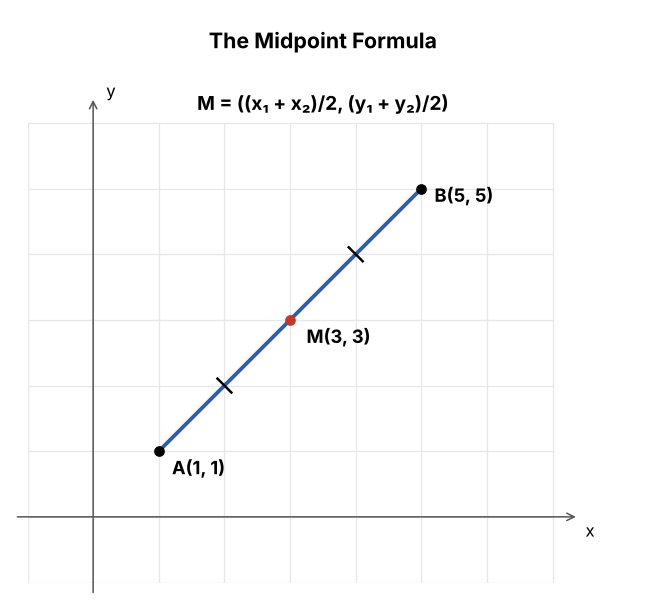
If point \(A\) is at \(-3\) and point \(B\) is at 5, then \(AB=|5-(-3)|=8\). The absolute value guarantees a positive length no matter which point you subtract first, since \(|-3-5|=8\) as well.
Why does this matter? Length is never negative. If you ever compute a negative length, you have either dropped the absolute value or made a sign error with a negative coordinate.
The Segment Addition Postulate
If point \(B\) lies between \(A\) and \(C\) on the same line, then \(AB+BC=AC\). The parts add up to the whole.
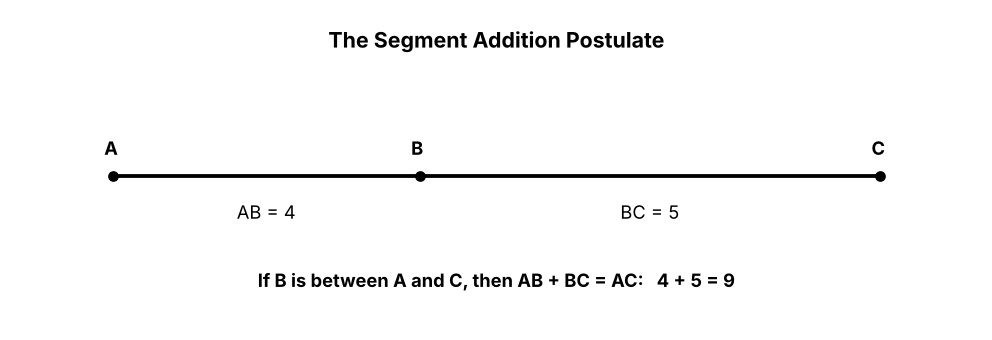
Worked example 1: \(B\) is between \(A\) and \(C\), with \(AB=2x+3\), \(BC=4x-1\), and \(AC=26\). Find \(x\) and \(AB\).
- Write the postulate: \((2x+3)+(4x-1)=26\).
- Combine like terms: \(6x+2=26\).
- Solve: \(6x=24\), so \(x=4\).
- Substitute: \(AB=2(4)+3=11\). Check: \(BC=15\), and \(11+15=26\).
The postulate extends to more than three points. If \(A\), \(B\), \(C\), and \(D\) are collinear in that order, then \(AB+BC+CD=AD\). Problems with a long segment broken into several labeled pieces use exactly this idea, so write one equation that adds every piece and set it equal to the total.
The postulate also works backward. If \(AB+BC=AC\), then \(B\) must lie on \(\overline{AC}\) between \(A\) and \(C\). If the sum is greater than \(AC\), then \(B\) is not on the segment at all. This test is a quick way to decide whether three points are collinear when you know all three distances.
Always finish by substituting back. The question often asks for a length, not for \(x\), and stopping at \(x=4\) is a common way to lose a point.
Congruent Segments
Segments with equal lengths are congruent. You write \(\overline{AB}\cong\overline{CD}\) for the segments and \(AB=CD\) for their lengths. In diagrams, matching tick marks show congruent segments.
| Statement | Correct Use | Why |
|---|---|---|
| \(\overline{AB}\cong\overline{CD}\) | Yes | Congruence compares figures. |
| \(AB=CD\) | Yes | Equality compares numbers. |
| \(\overline{AB}=\overline{CD}\) | No | Two different segments are not the same set of points. |
| \(AB\cong CD\) | No | Numbers are equal, not congruent. |
Why does this matter? Proofs are graded on precise notation. Using \(\cong\) for figures and \(=\) for measures shows you understand the difference between an object and its size, and it keeps proof statements valid.
The Distance Formula
On the coordinate plane, the distance between \((x_{1},y_{1})\) and \((x_{2},y_{2})\) is:
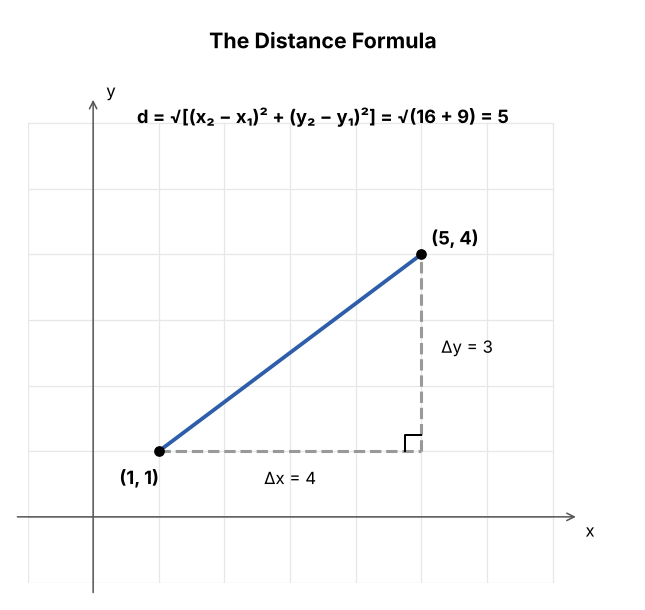
\(d=\sqrt{(x_{2}-x_{1})^{2}+(y_{2}-y_{1})^{2}}\)
The formula is the Pythagorean Theorem in disguise. The horizontal change and vertical change form the legs of a right triangle, and the distance is the hypotenuse.
Worked example 2: Find the distance between \((-2,1)\) and \((4,9)\).
- Horizontal change: \(4-(-2)=6\).
- Vertical change: \(9-1=8\).
- Substitute: \(d=\sqrt{6^{2}+8^{2}}=\sqrt{36+64}=\sqrt{100}=10\).
Worked example 3: Find the distance between \((1,3)\) and \((4,5)\).
- Changes: \(4-1=3\) and \(5-3=2\).
- Substitute: \(d=\sqrt{9+4}=\sqrt{13}\approx 3.61\).
Why does this matter? Many answers will not be whole numbers. Leave them in simplest radical form, such as \(\sqrt{13}\), unless the question asks for a decimal. Exact answers are often required on proofs about congruent sides.
Test-Taking Strategies
Mnemonic Devices and Memory Shortcuts
Think “Part plus part equals whole” for segment addition. For the distance formula, say “run squared plus rise squared, then root,” which reminds you it is the Pythagorean Theorem on a grid.
Cross-Topic Connections
- Segments are defined from lines in Topic 1.1: Points, Lines, and Planes.
- Solving segment equations uses Algebra 1 Topic 2.3: Solving Multi-Step Equations.
- Distance on a number line is absolute value, from Algebra 1 Topic 3.3: Absolute Value Equations and Inequalities.
- Radical answers are simplified using Algebra 1 Topic 8.1: Simplifying Radicals.
Common Question Formats
- Find a segment length from coordinates on a number line.
- Use segment addition with algebraic expressions to find \(x\) or a length.
- Find the distance between two points on the coordinate plane.
- Decide whether two segments are congruent by comparing lengths.
Frequent Student Mistakes
- Stopping at \(x\) when the question asks for a length.
- Subtracting a negative coordinate incorrectly, such as treating \(4-(-2)\) as 2.
- Adding the coordinates instead of subtracting them inside the distance formula.
Test-Day Shortcuts
Watch for Pythagorean triples. Changes of 3 and 4 give a distance of 5, and changes of 6 and 8 give 10. Recognizing these saves the square root step entirely.
Time Management Tips
Segment and distance items on Geometry unit tests and end-of-course exams usually take one to two minutes. Sketch a quick number line or right triangle before computing, which takes seconds and prevents sign errors.