
The midpoint of a segment is the point exactly halfway between its endpoints. Finding it is one of the most common calculations in coordinate geometry. It shows up when you locate the center of a circle, prove that diagonals bisect each other, or find where a perpendicular bisector crosses a segment.
This article covers Topic 1.3: The Midpoint Formula in Unit 1, Foundations of Geometry. The topic asks you to find midpoints on a number line and on the coordinate plane, find a missing endpoint from a midpoint, and use the definition of a midpoint to solve for unknown lengths.
By the end, you should be able to:
- Define a midpoint and a segment bisector.
- Find the midpoint of a segment on a number line and on the coordinate plane.
- Find a missing endpoint when you know one endpoint and the midpoint.
- Use midpoint relationships to set up and solve equations.
Midpoints and Bisectors
The midpoint of \(\overline{AB}\) is the point \(M\) that divides it into two congruent segments, so \(AM=MB\). A segment bisector is any point, line, ray, segment, or plane that passes through the midpoint.
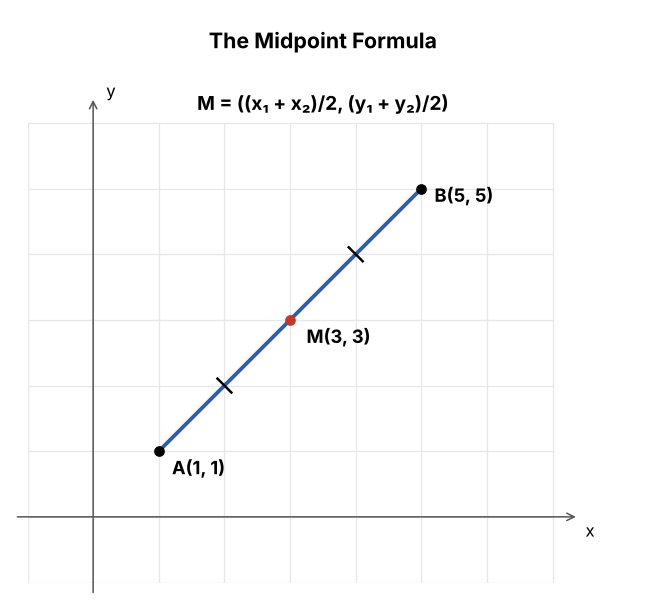
Because the two halves are equal, each half is exactly half the whole: \(AM=\frac{1}{2}AB\), and \(AB=2\cdot AM\). These relationships are the basis for most algebra problems about midpoints.
Worked example 1: \(M\) is the midpoint of \(\overline{AB}\), with \(AM=3x+5\) and \(MB=5x-7\). Find \(AB\).
- Set the halves equal: \(3x+5=5x-7\).
- Solve: \(12=2x\), so \(x=6\).
- Find one half: \(AM=3(6)+5=23\).
- Double it: \(AB=46\).
Why does this matter? The final step trips up many students. The question asks for the whole segment, so after finding one half you must double it. Reread the question before writing your final answer.
Midpoint on a Number Line
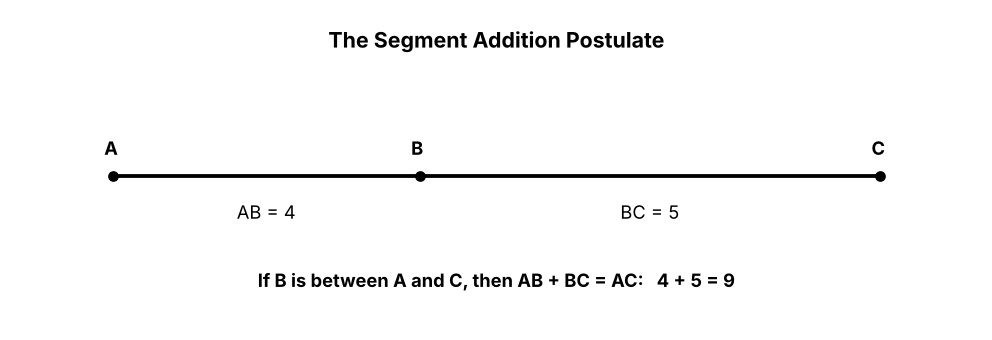
On a number line, the midpoint coordinate is the average of the endpoint coordinates. For endpoints at \(-4\) and 10, the midpoint is \(\frac{-4+10}{2}=3\). Check: 3 is 7 units from each endpoint.
The Midpoint Formula
On the coordinate plane, average the \(x\)-coordinates and average the \(y\)-coordinates separately. For endpoints \((x_{1},y_{1})\) and \((x_{2},y_{2})\):
\(M=\left(\frac{x_{1}+x_{2}}{2},\frac{y_{1}+y_{2}}{2}\right)\)
Worked example 2: Find the midpoint of the segment with endpoints \((-3,8)\) and \((7,-2)\).
- Average the \(x\)-coordinates: \(\frac{-3+7}{2}=2\).
- Average the \(y\)-coordinates: \(\frac{8+(-2)}{2}=3\).
- The midpoint is \((2,3)\).
| Formula | Operation | Result |
|---|---|---|
| Midpoint formula | Add coordinates, then divide by 2. | A point. |
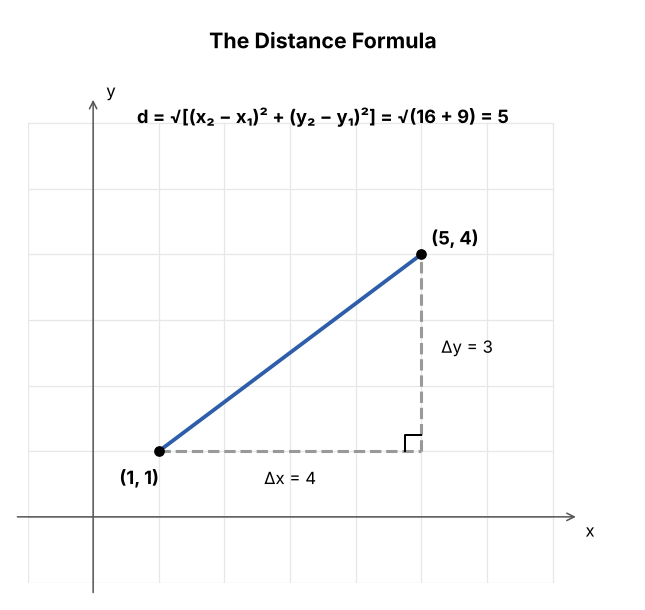
| Distance formula | Subtract coordinates, square, add, then take the root. | A number. |
| Slope formula | Subtract \(y\) values, subtract \(x\) values, then divide. | A number. |
Why does this matter? The midpoint formula adds, while the distance and slope formulas subtract. Mixing them up is the most frequent error in coordinate geometry. Remember that a midpoint answer is always an ordered pair, while distance and slope answers are single numbers.
Finding a Missing Endpoint
Sometimes you know one endpoint and the midpoint and need the other endpoint. Think of the midpoint as a halfway stop: the second half of the trip repeats the first half.
Worked example 3: \(M(4,1)\) is the midpoint of \(\overline{AB}\), and \(A\) is at \((1,-3)\). Find \(B\).
- From \(A\) to \(M\), \(x\) changes by \(4-1=3\) and \(y\) changes by \(1-(-3)=4\).
- Repeat the same changes from \(M\): \(x=4+3=7\) and \(y=1+4=5\).
- So \(B\) is \((7,5)\).
You can also solve with equations: \(\frac{1+x}{2}=4\) gives \(x=7\), and \(\frac{-3+y}{2}=1\) gives \(y=5\). Both methods agree.
Midpoints in Proofs and Figures
Midpoints appear throughout later geometry. The diagonals of a parallelogram bisect each other, so they share a midpoint. The center of a circle is the midpoint of any diameter. A perpendicular bisector passes through a segment’s midpoint at a right angle. Each of these facts turns into a midpoint calculation on the coordinate plane.
Why does this matter? Coordinate proofs often ask you to show that two segments bisect each other. The fastest method is to compute both midpoints. If they are the same point, the segments bisect each other.
Test-Taking Strategies
Mnemonic Devices and Memory Shortcuts
Say “Midpoint means average.” For a missing endpoint, think “same step again”: whatever it takes to get from the endpoint to the midpoint, do it once more.
Cross-Topic Connections
- Lengths of the halves are measured as in Topic 1.2: Measuring Segments and the Distance Formula.
- Segments and their notation come from Topic 1.1: Points, Lines, and Planes.
- Setting two halves equal uses Algebra 1 Topic 2.4: Equations with Variables on Both Sides.
- Perpendicular bisectors combine midpoints with Algebra 1 Topic 5.7: Parallel and Perpendicular Lines.
Common Question Formats
- Find the midpoint of a segment given its endpoints.
- Find a missing endpoint from a midpoint.
- Solve for \(x\) when algebraic expressions name the two halves.
- Find the center of a circle from the endpoints of a diameter.
Frequent Student Mistakes
- Subtracting coordinates instead of adding them.
- Finding the midpoint when the question asks for a missing endpoint.
- Reporting half the segment when the question asks for the whole length.
Test-Day Shortcuts
Plot the points roughly before calculating. The midpoint must sit between the endpoints in both directions, so any answer outside that box is wrong. This visual check takes a few seconds.
Time Management Tips
Midpoint items on Geometry unit tests and end-of-course exams usually take under a minute. Missing-endpoint and algebraic midpoint problems take one to two minutes. Write the \(x\) and \(y\) calculations on separate lines to avoid mixing them.