
Look in a mirror and your reflection appears the same distance behind the glass as you stand in front of it, but flipped left to right. Geometric reflections work the same way. A line acts as the mirror, and every point lands the same distance on the other side. Reflections are the only basic rigid motion that reverses orientation, which makes them essential for describing congruence.
This article covers Topic 4.2: Reflections in Unit 4, Transformations. The topic asks you to reflect figures across lines on the coordinate plane, use coordinate rules for common lines of reflection, and identify the line of reflection between a figure and its image.
By the end, you should be able to:
- Define a reflection using perpendicular bisectors.
- Apply coordinate rules for reflections across the axes and the lines \(y=x\) and \(y=-x\).
- Reflect figures across horizontal and vertical lines such as \(x=2\).
- Find the line of reflection given a figure and its image.
What a Reflection Does
A reflection across a line \(m\) maps each point \(P\) to an image \(P^{\prime}\) so that \(m\) is the perpendicular bisector of \(\overline{PP^{\prime}}\). In plain terms, \(P\) and \(P^{\prime}\) are the same distance from the line, and the segment joining them crosses the line at a right angle. A point that lies on the line of reflection is its own image.
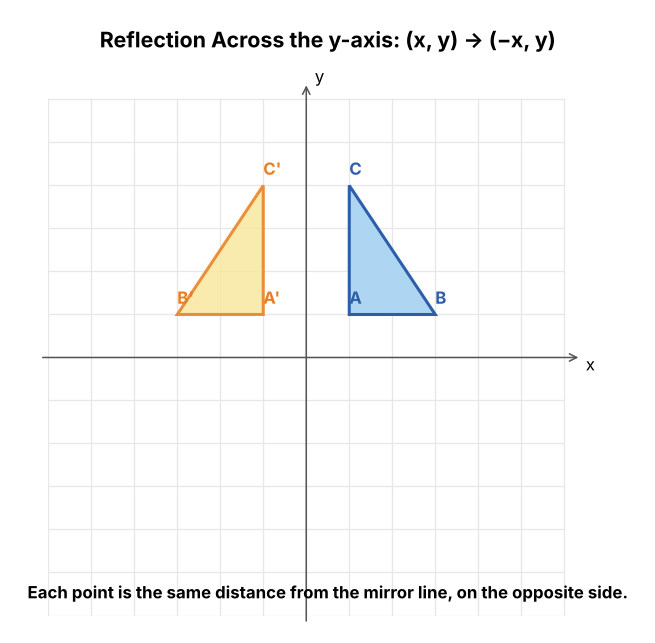
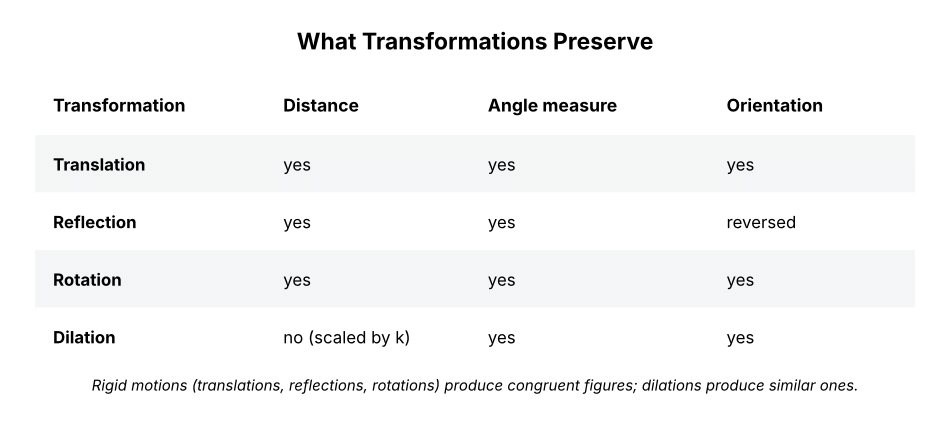
Reflections are rigid motions, so they preserve lengths and angle measures. They reverse orientation: if the vertices of a triangle read clockwise in the preimage, they read counterclockwise in the image.
Coordinate Rules
| Line of Reflection | Rule | Example With \((3,-2)\) |
|---|---|---|
| \(x\)-axis | \((x,y)\rightarrow(x,-y)\) | \((3,2)\) |
| \(y\)-axis | \((x,y)\rightarrow(-x,y)\) | \((-3,-2)\) |
| \(y=x\) | \((x,y)\rightarrow(y,x)\) | \((-2,3)\) |
| \(y=-x\) | \((x,y)\rightarrow(-y,-x)\) | \((2,-3)\) |
Why does this matter? Students often switch the axis rules. Reflecting across the \(x\)-axis flips the point up or down, so the \(y\)-coordinate changes. A useful check: a reflection across the \(x\)-axis moves a point straight up or down, perpendicular to the axis, so its left-right position never changes. The \(x\)-coordinate stays fixed and only the sign of \(y\) flips. Across the \(y\)-axis, the point moves straight left or right, so \(y\) stays fixed and the sign of \(x\) flips. Plotting one point quickly confirms which rule you need.
Reflecting Across Other Lines
For a horizontal or vertical line that is not an axis, count the distance to the line and go the same distance past it.
Worked example 1: Reflect \(A(1,4)\) across the line \(x=3\).
- \(A\) is 2 units left of \(x=3\).
- Its image is 2 units right of the line, at \(x=5\).
- The \(y\)-coordinate is unchanged, so \(A^{\prime}\) is \((5,4)\).
A general rule for \(x=k\) is \((x,y)\rightarrow(2k-x,y)\). For \(y=k\), it is \((x,y)\rightarrow(x,2k-y)\). Plugging in example 1: \(2(3)-1=5\), which matches.
Worked example 2: Reflect triangle \(PQR\) with \(P(2,1)\), \(Q(5,3)\), and \(R(4,-1)\) across the line \(y=x\).
- Swap each pair of coordinates.
- \(P^{\prime}(1,2)\), \(Q^{\prime}(3,5)\), and \(R^{\prime}(-1,4)\).
Finding the Line of Reflection
If you know a point and its image, the line of reflection is the perpendicular bisector of the segment joining them.
Worked example 3: \(B(-1,3)\) maps to \(B^{\prime}(5,3)\). Find the line of reflection.
- Find the midpoint: \(\left(\frac{-1+5}{2},3\right)=(2,3)\).
- The segment is horizontal, so the perpendicular bisector is vertical.
- The line of reflection is \(x=2\).
For slanted segments, find the midpoint and the opposite reciprocal slope, then write the line through the midpoint with that slope.
Lines of Symmetry
A figure has line symmetry if a reflection across some line maps the figure onto itself. A rectangle that is not a square has 2 lines of symmetry, a square has 4, and a regular hexagon has 6. A regular polygon with \(n\) sides always has \(n\) lines of symmetry.
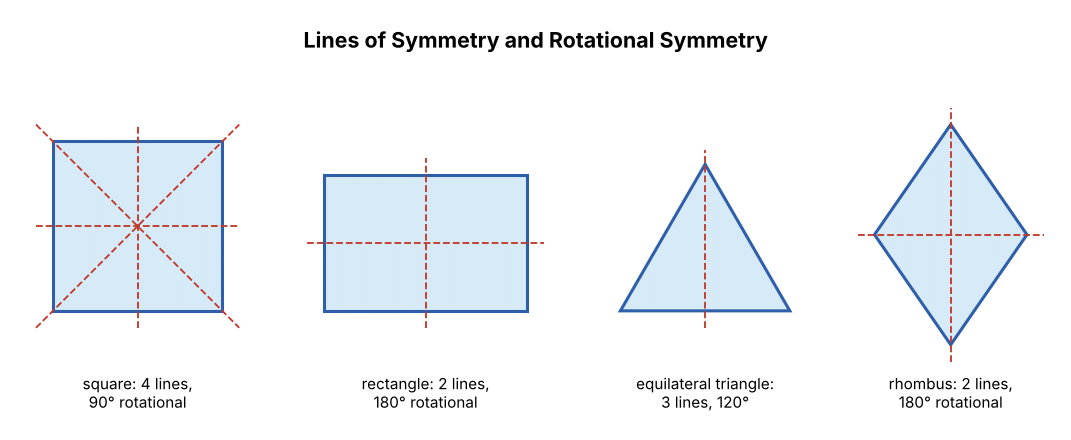
Why does this matter? Symmetry questions ask you to apply reflections without coordinates. Picture folding the figure along the line. If the halves match exactly, the line is a line of symmetry.
Test-Taking Strategies
Mnemonic Devices and Memory Shortcuts
“Reflect over \(x\), negate \(y\). Reflect over \(y\), negate \(x\).” For \(y=x\), just swap. For \(y=-x\), “swap and negate both.”
Cross-Topic Connections
- The other slide-type rigid motion is Topic 4.1: Translations.
- The line of reflection passes through a midpoint, from Topic 1.3: The Midpoint Formula.
- Perpendicular bisectors use opposite reciprocal slopes from Topic 3.3: Slopes of Parallel and Perpendicular Lines.
- Reflections across \(x=k\) relate to Algebra 1 Topic 5.6: Horizontal and Vertical Lines.
Common Question Formats
- Find the image of a point across an axis or the line \(y=x\).
- Reflect a polygon across a vertical or horizontal line.
- Identify the line of reflection from a figure and its image.
- Count the lines of symmetry in a polygon.
Frequent Student Mistakes
- Negating the wrong coordinate when reflecting across an axis.
- Reflecting across \(x=3\) as if it were the \(x\)-axis.
- Forgetting that reflections reverse orientation.
Test-Day Shortcuts
Sketch the mirror line lightly and fold the paper in your mind. For lines like \(x=3\), count grid squares to the line and the same number past it. Counting is faster and safer than any formula.
Time Management Tips
Reflection items on Geometry unit tests and end-of-course exams usually take about a minute. Finding a slanted line of reflection takes two to three minutes, so set up the midpoint and slope first.