
The hands of a clock, a spinning fan, and a turning Ferris wheel all show rotations. Every point travels along a circle around a fixed center, turning through the same angle. On the coordinate plane, rotations about the origin by \(90^{\circ}\), \(180^{\circ}\), and \(270^{\circ}\) follow simple coordinate rules, and knowing them saves a lot of graphing time.
This article covers Topic 4.3: Rotations in Unit 4, Transformations. The topic asks you to rotate figures about a point, apply the coordinate rules for rotations about the origin, and identify rotational symmetry.
By the end, you should be able to:
- Describe a rotation by its center, angle, and direction.
- Apply the coordinate rules for \(90^{\circ}\), \(180^{\circ}\), and \(270^{\circ}\) rotations about the origin.
- Rotate a polygon and verify that size and shape are preserved.
- Find the order and angle of rotational symmetry for a figure.
Describing a Rotation
A rotation turns every point of a figure through the same angle about a fixed point called the center of rotation. Three facts describe it completely:
- Center: The fixed point, often the origin. It is the only point that does not move.
- Angle: How far each point turns, measured from the center.
- Direction: Counterclockwise is the default in geometry. A clockwise rotation is usually stated explicitly or written with a negative angle.
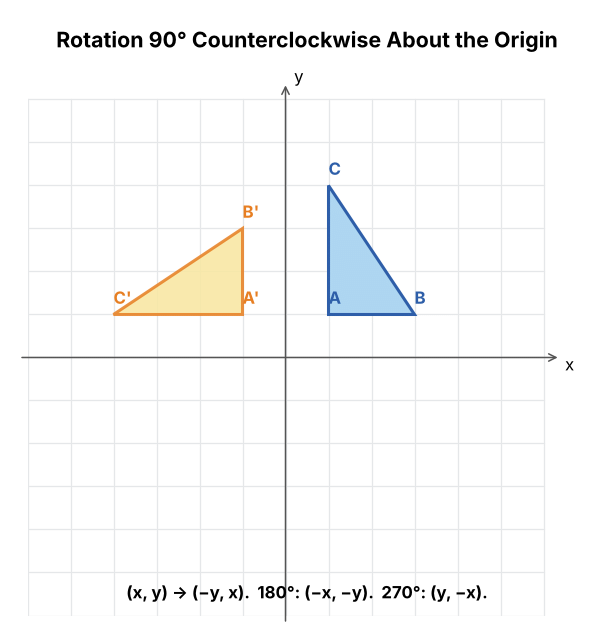
Each point and its image are the same distance from the center, and the angle formed by the point, the center, and the image equals the rotation angle. Rotations are rigid motions, and unlike reflections, they preserve orientation.
Coordinate Rules About the Origin
| Counterclockwise Rotation | Rule | Example With \((4,1)\) |
|---|---|---|
| \(90^{\circ}\) | \((x,y)\rightarrow(-y,x)\) | \((-1,4)\) |
| \(180^{\circ}\) | \((x,y)\rightarrow(-x,-y)\) | \((-4,-1)\) |
| \(270^{\circ}\) | \((x,y)\rightarrow(y,-x)\) | \((1,-4)\) |
| \(360^{\circ}\) | \((x,y)\rightarrow(x,y)\) | \((4,1)\) |
A clockwise rotation of \(90^{\circ}\) is the same as a counterclockwise rotation of \(270^{\circ}\). That equivalence means you only need to memorize the counterclockwise rules.
Why does this matter? The \(90^{\circ}\) and \(270^{\circ}\) rules both swap the coordinates, and they differ only in which one becomes negative. A quick quadrant check catches mix-ups: rotating \((4,1)\) from Quadrant I counterclockwise by \(90^{\circ}\) must land in Quadrant II, where \(x\) is negative and \(y\) is positive.
Rotating a Polygon
Worked example 1: Rotate triangle \(ABC\) with \(A(1,2)\), \(B(4,2)\), and \(C(1,5)\) by \(90^{\circ}\) counterclockwise about the origin.
- Apply \((x,y)\rightarrow(-y,x)\) to each vertex.
- \(A^{\prime}(-2,1)\), \(B^{\prime}(-2,4)\), and \(C^{\prime}(-5,1)\).
- Check a side: \(AB=3\) and \(A^{\prime}B^{\prime}=3\). The lengths match.
Worked example 2: Point \(P(-3,5)\) is rotated \(180^{\circ}\) about the origin. Negate both coordinates to get \(P^{\prime}(3,-5)\). A \(180^{\circ}\) rotation is the same as reflecting across the origin, so the origin is the midpoint of \(\overline{PP^{\prime}}\).
For a center other than the origin, translate so the center sits at the origin, rotate, then translate back. To rotate \((5,3)\) by \(90^{\circ}\) about \((2,1)\): subtract the center to get \((3,2)\), rotate to \((-2,3)\), and add the center back to get \((0,4)\).
Why does this matter? Applying the origin rule directly to \((5,3)\) would give \((-3,5)\), which is far from the correct image. Whenever the center is not the origin, the translate, rotate, translate routine is the reliable method.
Rotational Symmetry
A figure has rotational symmetry if a rotation of less than \(360^{\circ}\) about its center maps it onto itself. The smallest such angle is the angle of rotational symmetry, and the number of positions that match in a full turn is the order.
- A regular polygon with \(n\) sides has rotational symmetry of order \(n\), with angle \(\frac{360^{\circ}}{n}\). A regular pentagon has angle \(72^{\circ}\).
- A parallelogram has order 2 and angle \(180^{\circ}\).
- A scalene triangle has no rotational symmetry.
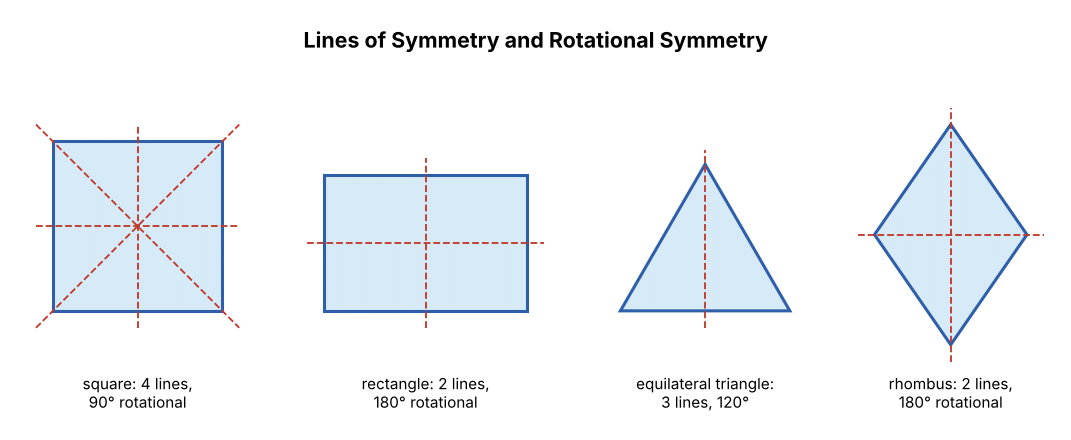
Why does this matter? Symmetry questions often list several angles and ask which map a figure onto itself. Any multiple of the smallest angle works. For a regular hexagon, \(60^{\circ}\), \(120^{\circ}\), \(180^{\circ}\), \(240^{\circ}\), and \(300^{\circ}\) all work.
Test-Taking Strategies
Mnemonic Devices and Memory Shortcuts
For \(90^{\circ}\) counterclockwise, remember “swap, then negate the new \(x\).” For \(180^{\circ}\), “negate both.” For \(270^{\circ}\), “swap, then negate the new \(y\).” Turning counterclockwise moves through the quadrants in order: I, II, III, IV.
Cross-Topic Connections
- Rotations combine with slides from Topic 4.1: Translations when the center is not the origin.
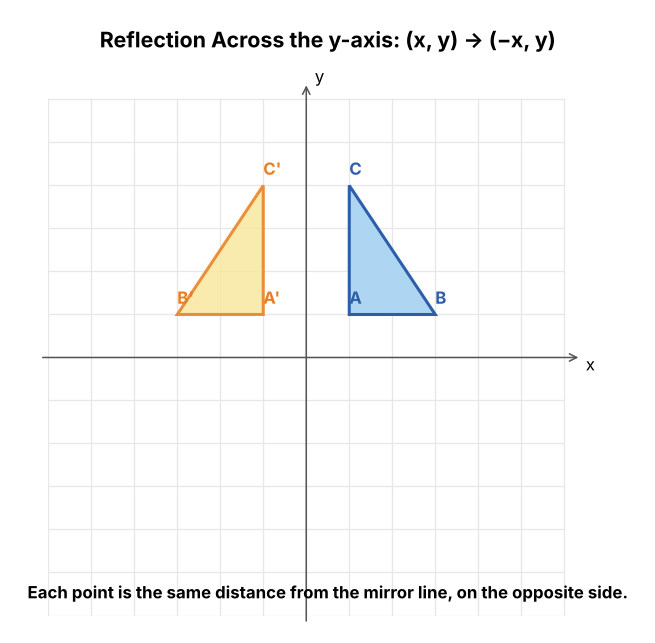
- Rotations preserve orientation, unlike Topic 4.2: Reflections.
- Rotation angles are measured as in Topic 1.4: Measuring and Classifying Angles.
- A \(90^{\circ}\) rotation turns a segment into a perpendicular one, as in Topic 3.3: Slopes of Parallel and Perpendicular Lines.
Common Question Formats
- Find the image of a point after a rotation about the origin.
- Identify the rotation that maps one figure onto another.
- Rotate a polygon and choose the correct graph.
- Find the angles of rotational symmetry for a regular polygon.
Frequent Student Mistakes
- Mixing up the \(90^{\circ}\) and \(270^{\circ}\) rules.
- Rotating clockwise when counterclockwise is the default.
- Rotating about the origin when a different center is given.
Test-Day Shortcuts
Check the quadrant of the image before trusting your rule. You can also rotate your paper a quarter turn and read the new position of the point. Both checks take only seconds.
Time Management Tips
Rotations about the origin on Geometry unit tests and end-of-course exams take about a minute. Rotations about other centers take two to three minutes. Write the translate, rotate, translate steps on separate lines to avoid sign errors.