
Real-world motion rarely happens in one step. A chess knight moves in an L, a car parks by backing up and turning, and a kaleidoscope reflects an image again and again. In geometry, a sequence of transformations is called a composition. Compositions let you describe exactly how one congruent figure maps onto another, and they explain why figures with symmetry look the way they do.
This article covers Topic 4.5: Symmetry and Compositions of Transformations in Unit 4, Transformations. The topic asks you to perform compositions of transformations, describe a sequence that maps one figure onto another, and identify line and rotational symmetry.
By the end, you should be able to:
- Perform a composition of two or more transformations in the correct order.
- Explain why the order of transformations can change the final image.
- Describe a sequence of rigid motions that maps one figure onto another.
- Identify line symmetry and rotational symmetry in polygons and everyday figures.
Compositions of Transformations
A composition applies one transformation and then applies another to the image. The final result is labeled with double primes, such as \(A^{\prime\prime}\), to show two steps.
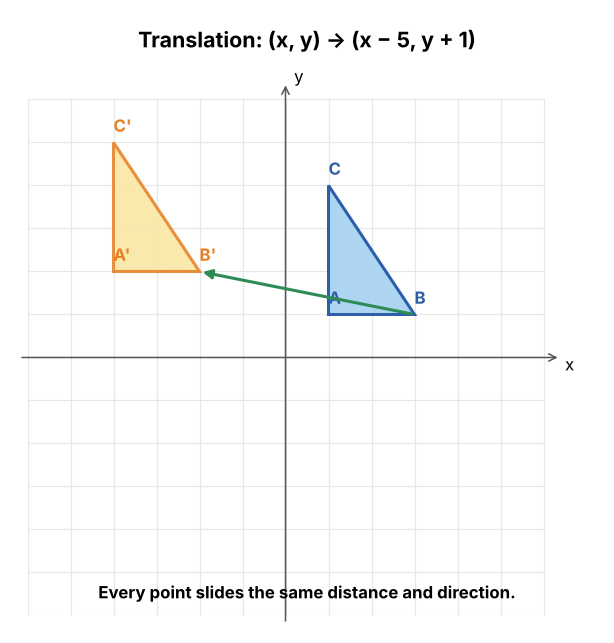
Worked example 1: Translate \(A(2,3)\) by \((x,y)\rightarrow(x+4,y)\), then reflect the image across the \(x\)-axis.
- Translation: \(A^{\prime}(6,3)\).
- Reflection across the \(x\)-axis: \(A^{\prime\prime}(6,-3)\).
A translation followed by a reflection across a line parallel to the translation is called a glide reflection. Footprints in sand form a glide reflection: each step slides forward and flips left to right.
Order Matters
Changing the order of transformations can change the result. Compositions behave like getting dressed: putting on socks and then shoes is not the same as shoes and then socks.
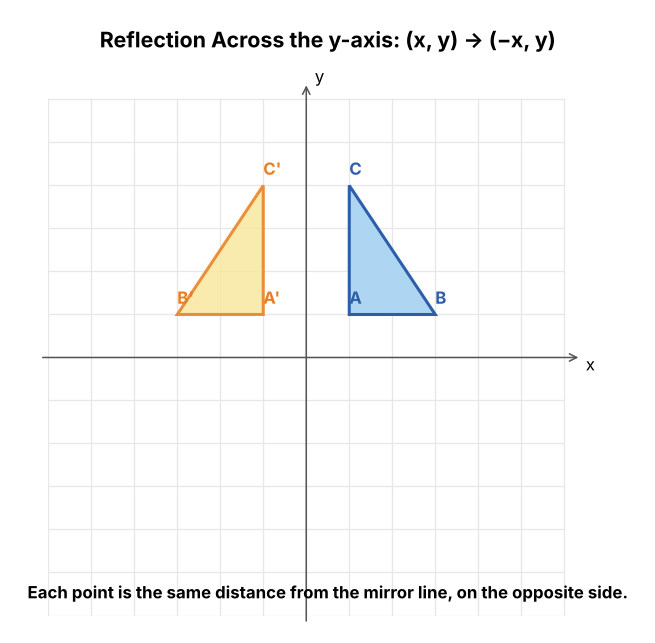
Worked example 2: Start with \(B(1,0)\).
- Rotate \(90^{\circ}\) counterclockwise about the origin, then translate up 2: \(B^{\prime}(0,1)\), then \(B^{\prime\prime}(0,3)\).
- Translate up 2, then rotate \(90^{\circ}\): \(B^{\prime}(1,2)\), then \(B^{\prime\prime}(-2,1)\).
The two orders produce different final points. Always perform the steps in the order stated, from first to last.
Why does this matter? Test items often describe a composition in words and offer the result of the reversed order as a wrong answer. Writing each intermediate point on its own line makes the order visible and prevents that error.
Special Compositions
| Composition | Equivalent Single Transformation |
|---|---|
| Two translations | One translation, found by adding the vectors. |
| Two reflections across parallel lines | A translation twice the distance between the lines, perpendicular to them. |
| Two reflections across intersecting lines | A rotation about the intersection point, through twice the angle between the lines. |
| Reflection across the \(x\)-axis, then the \(y\)-axis | A \(180^{\circ}\) rotation about the origin. |
You can verify the last row with coordinates: \((x,y)\rightarrow(x,-y)\rightarrow(-x,-y)\), which is exactly the \(180^{\circ}\) rotation rule.
Mapping One Figure Onto Another
Two figures are congruent if a sequence of rigid motions maps one onto the other. To describe the sequence:
- Check orientation. If the vertex order is reversed, the sequence must include a reflection.
- Match one vertex. Translate so a vertex lands on its matching vertex.
- Turn or flip the rest. Rotate about that vertex, or reflect, until the remaining vertices line up.
Many different sequences can work. Any correct sequence proves congruence, so choose the one that is easiest to describe clearly.
Why does this matter? This sequence definition of congruence is the foundation for the triangle congruence shortcuts in the next unit. SSS, SAS, and ASA work because, in each case, a sequence of rigid motions can always be found that lines the triangles up exactly. When a question asks you to justify congruence using transformations, describe the steps in order and name the specific line, center, angle, or vector for each one.
Symmetry
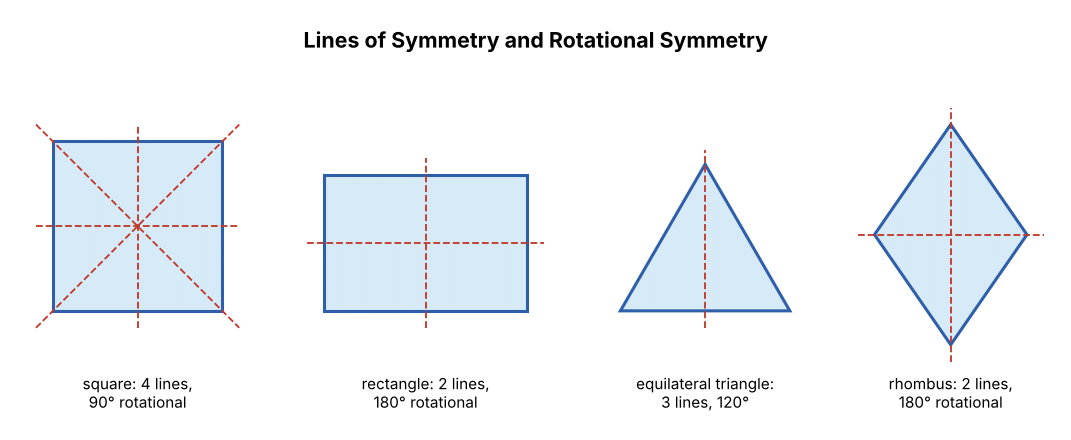
A figure has symmetry if a transformation maps it onto itself.
- Line symmetry: A reflection maps the figure onto itself. An isosceles triangle has one line of symmetry, and a square has four.
- Rotational symmetry: A rotation of less than \(360^{\circ}\) maps the figure onto itself. A regular octagon has rotational symmetry with an angle of \(45^{\circ}\).
- Point symmetry: Rotational symmetry of \(180^{\circ}\). Parallelograms and the letter S have point symmetry.
Test-Taking Strategies
Mnemonic Devices and Memory Shortcuts
“First things first”: perform transformations in the order written. Two flips make a turn when the mirrors cross, and two flips make a slide when the mirrors are parallel.
Cross-Topic Connections
- Translation rules come from Topic 4.1: Translations.
- Reflection rules come from Topic 4.2: Reflections.
- Rotation rules and rotational symmetry come from Topic 4.3: Rotations.
- Size-changing compositions add Topic 4.4: Dilations, which leads to similarity.
Common Question Formats
- Find the final image of a point after two transformations.
- Choose the sequence of rigid motions that maps one figure onto another.
- Identify a single transformation equivalent to a composition.
- Count lines of symmetry or find angles of rotational symmetry.
Frequent Student Mistakes
- Performing transformations in the reverse order.
- Describing a sequence without a reflection when orientation is reversed.
- Applying the second transformation to the preimage instead of the first image.
Test-Day Shortcuts
For “which sequence maps figure A onto figure B” questions, test the answer choices on a single vertex. Only the correct sequence moves that vertex to its match. Check a second vertex to confirm.
Time Management Tips
Composition items on Geometry unit tests and end-of-course exams take one to three minutes. Track each point through each step in a small table. Symmetry items are quick, usually under a minute.