
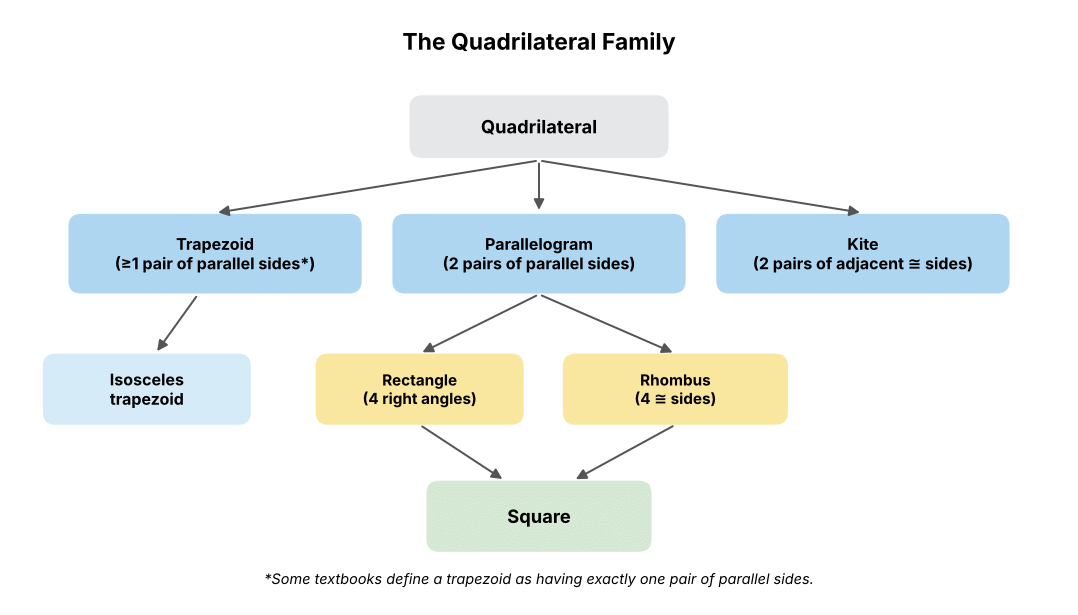
Not every important quadrilateral is a parallelogram. Trapezoids have only one pair of parallel sides, and kites have no parallel sides at all. Each still has dependable properties about its angles, diagonals, and midsegment, and those properties show up frequently in both multiple-choice questions and coordinate proofs.
This article covers Topic 6.4: Trapezoids and Kites in Unit 6, Quadrilaterals and Polygons. The topic asks you to identify the parts of trapezoids and kites, apply the properties of isosceles trapezoids, use the Trapezoid Midsegment Theorem, and apply the properties of kites.
By the end, you should be able to:
- Name the bases, legs, and base angles of a trapezoid.
- Apply the properties of an isosceles trapezoid.
- Use the Trapezoid Midsegment Theorem to find lengths.
- Apply the angle and diagonal properties of a kite.
Trapezoid Basics
A trapezoid is a quadrilateral with exactly one pair of parallel sides. The parallel sides are the bases, and the other two sides are the legs. A trapezoid has two pairs of base angles, one pair at each base.
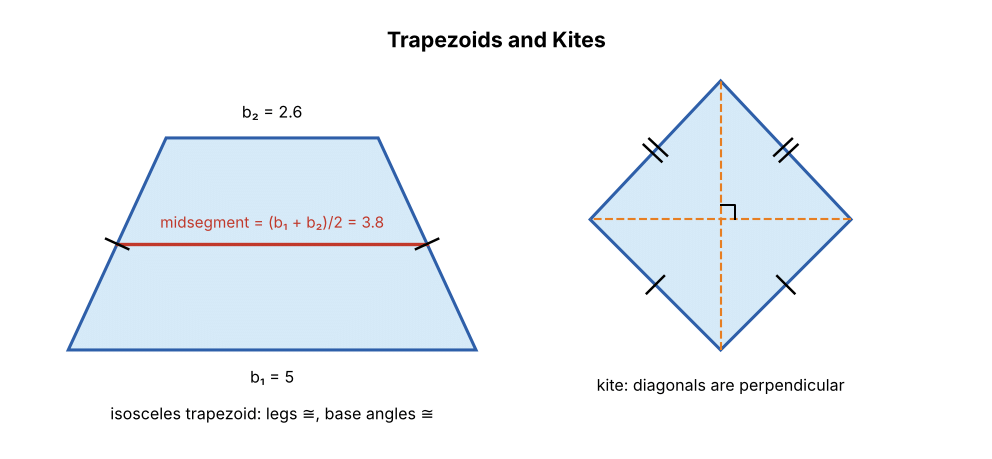
Because the bases are parallel, each leg acts as a transversal. The two angles along the same leg are same-side interior angles, so they are supplementary. In trapezoid \(ABCD\) with \(\overline{AB}\parallel\overline{DC}\), \(m\angle A+m\angle D=180^{\circ}\) and \(m\angle B+m\angle C=180^{\circ}\).
Why does this matter? This supplementary pairing works for every trapezoid, isosceles or not. If you know one angle at a leg, you know the other. It is the most commonly tested trapezoid fact.
Isosceles Trapezoids
An isosceles trapezoid has congruent legs. It has extra properties that a general trapezoid lacks:
- Each pair of base angles is congruent. The two angles at the top base match, and the two at the bottom base match.
- The diagonals are congruent. This mirrors the rectangle, and it is often how you prove a trapezoid is isosceles.
- It has a line of symmetry through the midpoints of both bases.
Worked example 1: In isosceles trapezoid \(PQRS\) with bases \(\overline{PQ}\) and \(\overline{SR}\), \(m\angle P=68^{\circ}\). Find the other angles.
- Base angles at \(\overline{PQ}\) are congruent: \(m\angle Q=68^{\circ}\).
- \(\angle P\) and \(\angle S\) are supplementary along a leg: \(m\angle S=112^{\circ}\).
- Base angles at \(\overline{SR}\) are congruent: \(m\angle R=112^{\circ}\).
The Trapezoid Midsegment Theorem
The midsegment of a trapezoid connects the midpoints of the legs. The Trapezoid Midsegment Theorem states that it is parallel to both bases and its length is the average of the bases:
\(\text{midsegment}=\frac{b_{1}+b_{2}}{2}\)
Worked example 2: A trapezoid has bases of 14 and 22. Find the midsegment. It equals \(\frac{14+22}{2}=18\).
Worked example 3: The midsegment is 15 and one base is 9. Find the other base.
- Set up: \(15=\frac{9+b}{2}\).
- Multiply by 2: \(30=9+b\), so \(b=21\).
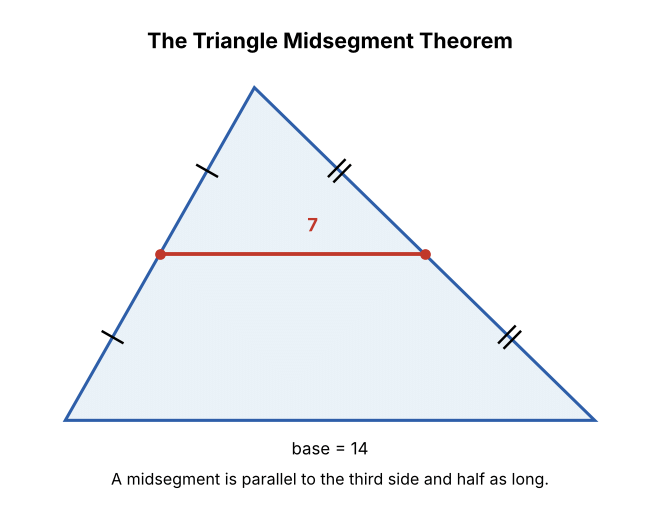
Why does this matter? The trapezoid midsegment is an average, while the triangle midsegment is half of one side. You can see the connection by shrinking one base of a trapezoid to zero: the figure becomes a triangle, and the formula becomes \(\frac{0+b}{2}\), exactly half the remaining base.
Kites
A kite is a quadrilateral with two pairs of consecutive congruent sides, and opposite sides that are not congruent. Its properties:
| Property | Description |
|---|---|
| Diagonals are perpendicular | They cross at a right angle, forming four right triangles. |
| One diagonal bisects the other | The diagonal between the vertices where congruent sides meet splits the other in half. |
| One pair of opposite angles is congruent | The angles between the non-congruent sides match. |
Worked example 4: In kite \(WXYZ\) with \(WX=XY\) and \(WZ=YZ\), \(m\angle X=110^{\circ}\) and \(m\angle Z=50^{\circ}\). Find \(m\angle W\) and \(m\angle Y\).
- The congruent angles are \(\angle W\) and \(\angle Y\), between unequal sides.
- The angle sum is \(360^{\circ}\): \(2x+110+50=360\).
- Solve: \(x=100\), so \(m\angle W=m\angle Y=100^{\circ}\).
Why does this matter? Students often assume the given angles are the congruent pair. In a kite, the angles where equal sides meet usually differ, and the other two angles match.
Test-Taking Strategies
Mnemonic Devices and Memory Shortcuts
“Trapezoid midsegment is the average of the bases.” For kites, “the diagonals make a plus sign, and the matching angles are where different sides meet.” For trapezoid legs, “angles on the same leg add to 180.”
Cross-Topic Connections
- Supplementary leg angles come from Topic 3.1: Angles Formed by Parallel Lines and Transversals.
- The triangle version of the midsegment is in Topic 5.5: Midsegments, Bisectors, Medians, and Altitudes.
- Congruent diagonals parallel the rectangle in Topic 6.3: Rectangles, Rhombuses, and Squares.
- The \(360^{\circ}\) angle sum comes from Topic 6.1: Angles of Polygons.
Common Question Formats
- Find missing angles in an isosceles trapezoid.
- Find a midsegment or a missing base length.
- Find angles or diagonal segments in a kite.
- Classify a quadrilateral as a trapezoid, kite, or parallelogram.
Frequent Student Mistakes
- Making all four trapezoid angles congruent.
- Using half of one base as the trapezoid midsegment.
- Choosing the wrong pair of congruent angles in a kite.
Test-Day Shortcuts
For midsegment problems, double the midsegment to get the sum of the bases, then subtract the known base. For kites, look for the vertex where two different side lengths meet; that is where the congruent angles sit.
Time Management Tips
Trapezoid and kite items on Geometry unit tests and end-of-course exams typically take one to two minutes. Label which sides are parallel or congruent before writing any equation.