
A triangle’s angles always total \(180^{\circ}\). What about a pentagon, a hexagon, or a 20-sided figure? The answer comes from splitting polygons into triangles, and it produces two formulas you will use throughout the quadrilaterals unit: one for interior angles and one for exterior angles.
This article covers Topic 6.1: Angles of Polygons in Unit 6, Quadrilaterals and Polygons. The topic asks you to classify polygons, find the sum of interior and exterior angles, and find individual angle measures in regular polygons.
By the end, you should be able to:
- Classify polygons by number of sides and as convex or concave, regular or irregular.
- Find the sum of the interior angles of any polygon.
- Use the Exterior Angle Sum Theorem for polygons.
- Find each angle of a regular polygon and the number of sides from an angle measure.
Classifying Polygons
A polygon is a closed plane figure made of segments that meet only at their endpoints. Polygons are named by their number of sides.
| Sides | Name | Sides | Name |
|---|---|---|---|
| 3 | Triangle | 7 | Heptagon |
| 4 | Quadrilateral | 8 | Octagon |
| 5 | Pentagon | 9 | Nonagon |
| 6 | Hexagon | 10 | Decagon |
A polygon with \(n\) sides is also called an \(n\)-gon, such as a 12-gon. A polygon is convex if no line containing a side passes through its interior, and concave if at least one does, which creates a “dent.” A regular polygon is both equilateral and equiangular.
The Interior Angle Sum
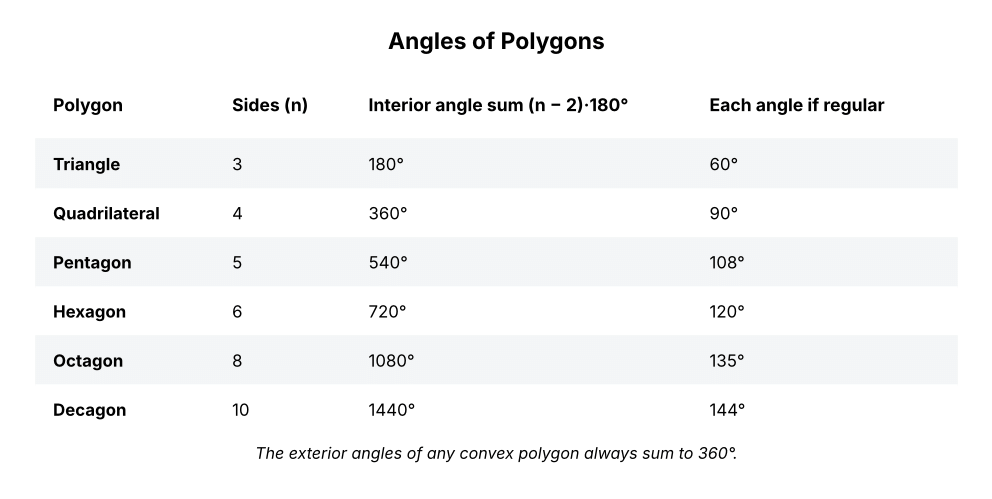
Pick one vertex of a convex polygon and draw every diagonal from it. An \(n\)-gon splits into \(n-2\) triangles, and each triangle contributes \(180^{\circ}\). So the Polygon Interior Angles Theorem states:
\(\text{Sum of interior angles}=(n-2)\cdot 180^{\circ}\)
- Quadrilateral: \((4-2)\cdot 180=360^{\circ}\).
- Pentagon: \((5-2)\cdot 180=540^{\circ}\).
- Hexagon: \((6-2)\cdot 180=720^{\circ}\).
- Decagon: \((10-2)\cdot 180=1440^{\circ}\).
Why does this matter? Understanding the triangle-splitting idea means you never need to memorize a table. If you forget the formula, sketch the polygon, count the triangles from one vertex, and multiply by \(180^{\circ}\).
The Exterior Angle Sum
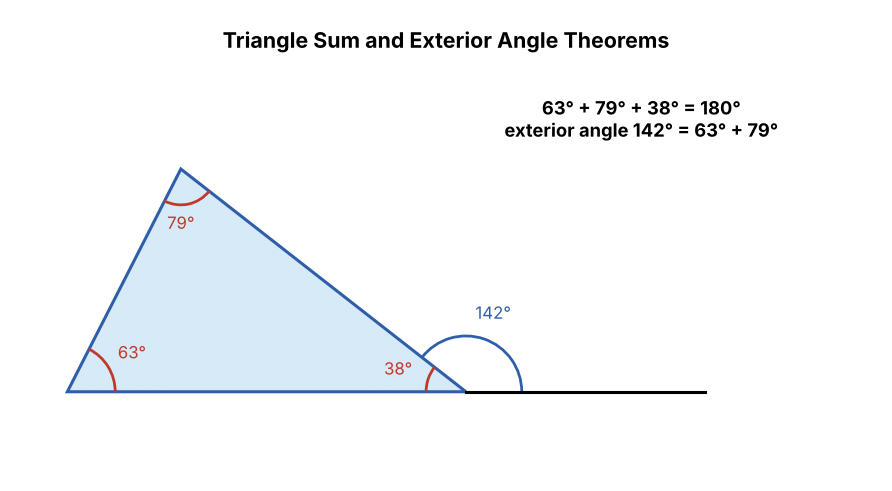
Take one exterior angle at each vertex of a convex polygon. The Polygon Exterior Angles Theorem says their sum is always \(360^{\circ}\), no matter how many sides there are. Walking around the polygon, you turn through each exterior angle and end up facing the original direction, a full turn.
At each vertex, the interior and exterior angles form a linear pair, so they sum to \(180^{\circ}\).
Regular Polygons
In a regular polygon, all interior angles are equal and all exterior angles are equal, so divide the sums by \(n\).
| Measure | Formula | Regular Hexagon |
|---|---|---|
| Each interior angle | \(\frac{(n-2)\cdot 180^{\circ}}{n}\) | \(120^{\circ}\) |
| Each exterior angle | \(\frac{360^{\circ}}{n}\) | \(60^{\circ}\) |
Worked example 1: Each interior angle of a regular polygon measures \(156^{\circ}\). How many sides does it have?
- Find the exterior angle: \(180-156=24^{\circ}\).
- Divide into 360: \(n=\frac{360}{24}=15\).
- The polygon has 15 sides.
Worked example 2: A pentagon has angles of \(100^{\circ}\), \(110^{\circ}\), \(95^{\circ}\), \(120^{\circ}\), and \(x^{\circ}\). Find \(x\).
- The sum must be \(540^{\circ}\).
- Add the known angles: \(100+110+95+120=425\).
- Subtract: \(x=540-425=115\).
Why does this matter? Working through the exterior angle is usually faster than using the interior formula. Solving \(\frac{(n-2)\cdot 180}{n}=156\) takes several algebra steps, while \(\frac{360}{24}\) takes one. If a given interior angle does not produce a whole-number \(n\), no regular polygon has that angle.
Counting Diagonals
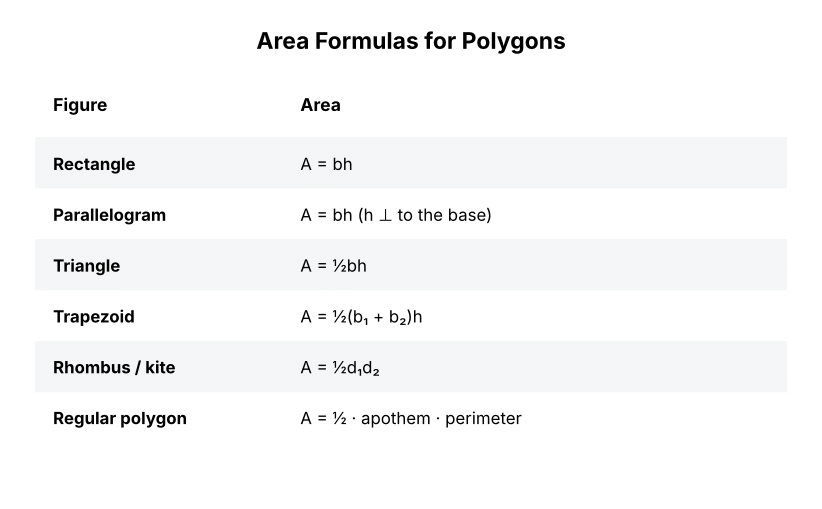
A diagonal connects two vertices that are not next to each other. From each vertex of an \(n\)-gon, you can draw \(n-3\) diagonals, since you cannot connect a vertex to itself or to its two neighbors. Multiplying by \(n\) counts every diagonal twice, once from each end, so the total is:
\(\text{Number of diagonals}=\frac{n(n-3)}{2}\)
A hexagon has \(\frac{6\cdot 3}{2}=9\) diagonals, and an octagon has \(\frac{8\cdot 5}{2}=20\). Notice that the diagonals from a single vertex, \(n-3\) of them, create the \(n-2\) triangles used in the interior angle formula.
Why does this matter? The diagonal count and the angle sum come from the same picture. Drawing diagonals from one vertex is the single most useful sketch for polygon questions, because it reveals both the triangles and the structure of the figure.
Test-Taking Strategies
Mnemonic Devices and Memory Shortcuts
“Inside: take away two, times 180. Outside: always 360.” For regular polygons, find the exterior angle first: “360 over \(n\), then subtract from 180.”
Cross-Topic Connections
- Each triangle contributes \(180^{\circ}\), from Topic 5.1: Classifying Triangles and the Triangle Sum Theorem.
- Interior and exterior angles form linear pairs, as in Topic 1.5: Angle Pair Relationships.
- Regular polygons have rotational symmetry of \(\frac{360^{\circ}}{n}\), as shown in Topic 4.3: Rotations.
- Setting a formula equal to a value uses Algebra 1 Topic 2.3: Solving Multi-Step Equations.
Common Question Formats
- Find the interior angle sum of a polygon with \(n\) sides.
- Find a missing angle in an irregular polygon.
- Find each interior or exterior angle of a regular polygon.
- Find the number of sides from an angle measure.
Frequent Student Mistakes
- Using \(n\cdot 180\) instead of \((n-2)\cdot 180\).
- Thinking the exterior angle sum grows with the number of sides.
- Dividing the interior sum by \(n\) for a polygon that is not regular.
Test-Day Shortcuts
Memorize a few anchors: quadrilateral \(360^{\circ}\), pentagon \(540^{\circ}\), hexagon \(720^{\circ}\). Each extra side adds \(180^{\circ}\), so you can count up from the nearest anchor quickly.
Time Management Tips
Polygon angle items on Geometry unit tests and end-of-course exams take about a minute. Number-of-sides problems go fastest through the exterior angle. Check that your answer for \(n\) is a whole number.