
A parallelogram is a quadrilateral with both pairs of opposite sides parallel. From that one definition come four powerful properties about its sides, angles, and diagonals. These properties let you find missing measures, and their converses let you prove a quadrilateral is a parallelogram. Rectangles, rhombuses, and squares are all parallelograms, so everything in this topic carries forward.
This article covers Topic 6.2: Properties of Parallelograms in Unit 6, Quadrilaterals and Polygons. The topic asks you to apply the properties of parallelograms to find unknown lengths and angles, and to use the converse theorems to prove that a quadrilateral is a parallelogram.
By the end, you should be able to:
- State the four main properties of a parallelogram.
- Use the properties to solve for unknown sides, angles, and diagonal segments.
- Apply the converse theorems to decide whether a quadrilateral is a parallelogram.
- Prove a quadrilateral is a parallelogram on the coordinate plane.
The Four Properties
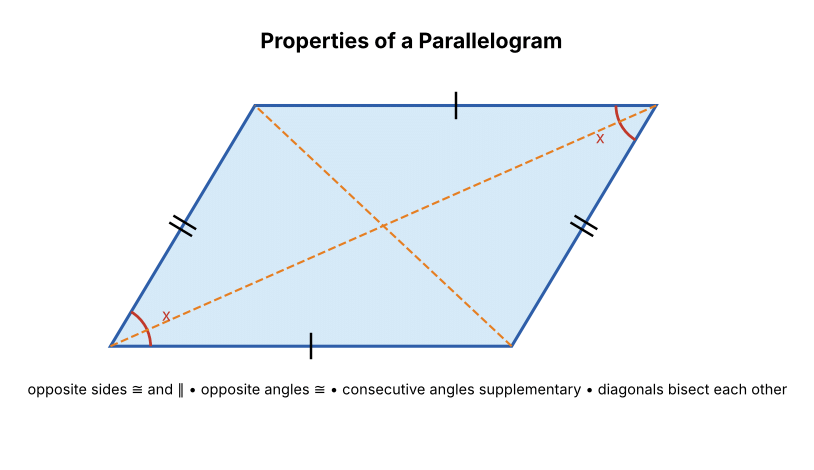
In parallelogram \(ABCD\), with \(\overline{AB}\parallel\overline{DC}\) and \(\overline{AD}\parallel\overline{BC}\):
| Property | Statement | Why It Is True |
|---|---|---|
| Opposite sides congruent | \(AB=DC\) and \(AD=BC\) | A diagonal splits the figure into two congruent triangles by ASA. |
| Opposite angles congruent | \(\angle A\cong\angle C\) and \(\angle B\cong\angle D\) | Corresponding parts of those congruent triangles. |
| Consecutive angles supplementary | \(m\angle A+m\angle B=180^{\circ}\) | They are same-side interior angles between parallel sides. |
| Diagonals bisect each other | Diagonals share a midpoint. | Congruent triangles formed by the diagonals. |
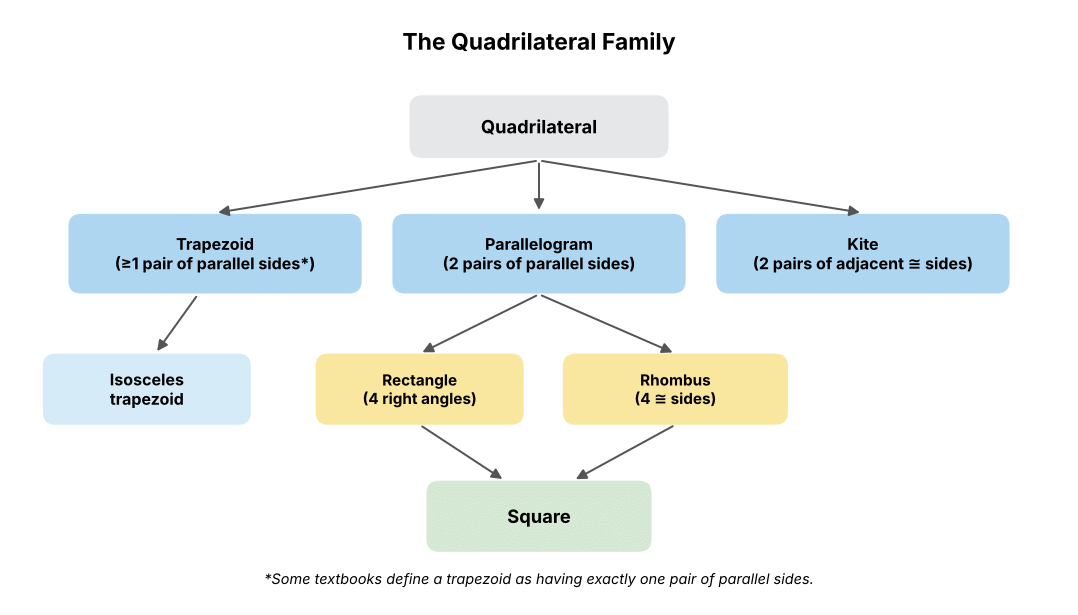
Why does this matter? The diagonals of a parallelogram bisect each other, but they are not necessarily congruent or perpendicular. Those extra properties belong to rectangles and rhombuses. Assuming them in a general parallelogram is a frequent error.
Solving With the Properties
Worked example 1: In parallelogram \(PQRS\), \(m\angle P=(3x+15)^{\circ}\) and \(m\angle Q=(2x+40)^{\circ}\). Find each angle.
- \(\angle P\) and \(\angle Q\) are consecutive, so they are supplementary: \((3x+15)+(2x+40)=180\).
- Solve: \(5x+55=180\), so \(x=25\).
- \(m\angle P=90^{\circ}\) and \(m\angle Q=90^{\circ}\). This parallelogram is actually a rectangle.
Worked example 2: The diagonals of parallelogram \(WXYZ\) meet at \(M\). If \(WM=2y+3\) and \(MY=4y-9\), find \(WY\).
- The diagonals bisect each other, so \(WM=MY\): \(2y+3=4y-9\).
- Solve: \(y=6\), so \(WM=15\).
- The whole diagonal is \(WY=30\).
Side problems work the same way. If opposite sides measure \(5a-2\) and \(3a+10\), set them equal to get \(a=6\), so each of those sides is 28. Always reread the question to see whether it wants \(a\), one side, the whole diagonal, or the perimeter, since each requires a different final step.
Why does this matter? Nearly every parallelogram problem is one of three equation types: two opposite parts set equal, two consecutive angles added to \(180^{\circ}\), or two diagonal halves set equal. Identifying which type you have before writing anything makes these problems quick and reliable.
Proving a Quadrilateral Is a Parallelogram
Each property has a converse. A quadrilateral is a parallelogram if any one of these is true:
- Both pairs of opposite sides are parallel. This is the definition.
- Both pairs of opposite sides are congruent.
- Both pairs of opposite angles are congruent.
- The diagonals bisect each other.
- One pair of opposite sides is both congruent and parallel.
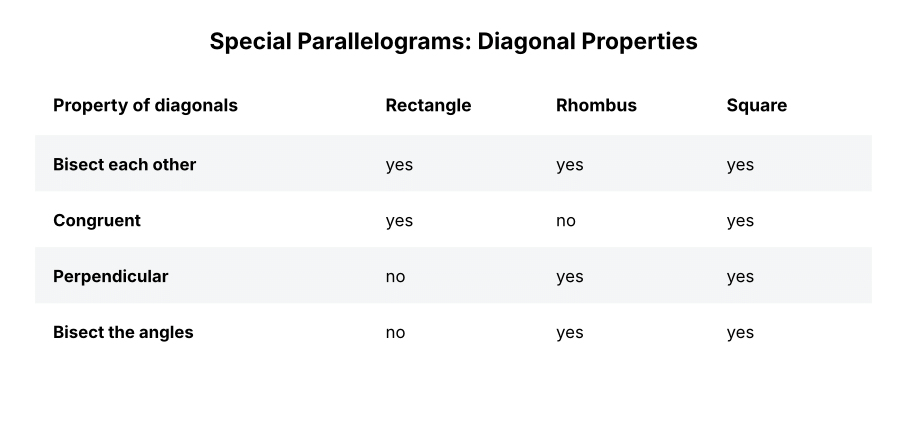
Why does this matter? The last test is the most efficient in coordinate problems, since you check one pair of sides for both equal slope and equal length. Be careful: one pair of parallel sides plus the other pair congruent is not enough, because an isosceles trapezoid fits that description.
Parallelograms on the Coordinate Plane
Worked example 3: Show that \(A(1,1)\), \(B(5,2)\), \(C(6,6)\), and \(D(2,5)\) form a parallelogram.
- Slope of \(\overline{AB}\): \(\frac{2-1}{5-1}=\frac{1}{4}\). Slope of \(\overline{DC}\): \(\frac{6-5}{6-2}=\frac{1}{4}\). These sides are parallel.
- Length of \(\overline{AB}\): \(\sqrt{16+1}=\sqrt{17}\). Length of \(\overline{DC}\): \(\sqrt{16+1}=\sqrt{17}\). These sides are congruent.
- One pair of opposite sides is congruent and parallel, so \(ABCD\) is a parallelogram.
Another method: the midpoint of \(\overline{AC}\) is \((3.5,3.5)\), and the midpoint of \(\overline{BD}\) is also \((3.5,3.5)\). The diagonals bisect each other, which confirms the result.
Test-Taking Strategies
Mnemonic Devices and Memory Shortcuts
“Opposites are equal, neighbors add to 180, diagonals cut in half.” For proving, remember the five tests, with “one pair both ways” as the fastest coordinate check.
Cross-Topic Connections
- Same-side interior angles come from Topic 3.1: Angles Formed by Parallel Lines and Transversals.
- The quadrilateral angle sum of \(360^{\circ}\) comes from Topic 6.1: Angles of Polygons.
- Slope checks use Topic 3.3: Slopes of Parallel and Perpendicular Lines.
- Diagonal midpoints use Topic 1.3: The Midpoint Formula.
Common Question Formats
- Find a missing side, angle, or diagonal segment in a parallelogram.
- Solve for \(x\) using consecutive or opposite angles.
- Decide whether given information proves a quadrilateral is a parallelogram.
- Verify a parallelogram on the coordinate plane.
Frequent Student Mistakes
- Setting consecutive angles equal instead of supplementary.
- Assuming the diagonals are congruent in every parallelogram.
- Accepting one pair parallel and the other pair congruent as proof.
Test-Day Shortcuts
On the coordinate plane, the midpoint test is often fastest: compute two midpoints and compare. If they match, you are done. If they differ, the figure is not a parallelogram.
Time Management Tips
Property items on Geometry unit tests and end-of-course exams take one to two minutes. Coordinate proofs take three to four minutes. Choose one test, complete it fully, and state your conclusion with the theorem name.