
“Me and him went to the game.” Most people understand that sentence, yet almost every English teacher would mark it wrong. “Between you and I” sounds polished, but it is also an error. Choosing between I and me, who and whom, or they and them is a matter of pronoun case, and it is one of the most frequently tested grammar skills on English exams.
This article covers Topic 1.8: Pronoun Case in Unit 1, Parts of Speech: Nouns and Pronouns. The topic asks you to choose the correct form of a pronoun based on the job it does in a sentence.
By the end, you should be able to:
- Name the three pronoun cases and list the pronouns in each.
- Choose subjective or objective case in compound subjects and objects.
- Use the correct case after prepositions, in comparisons, and after linking verbs.
- Decide between who and whom.
The Three Cases
Personal pronouns change form depending on how they are used. Each form is called a case.
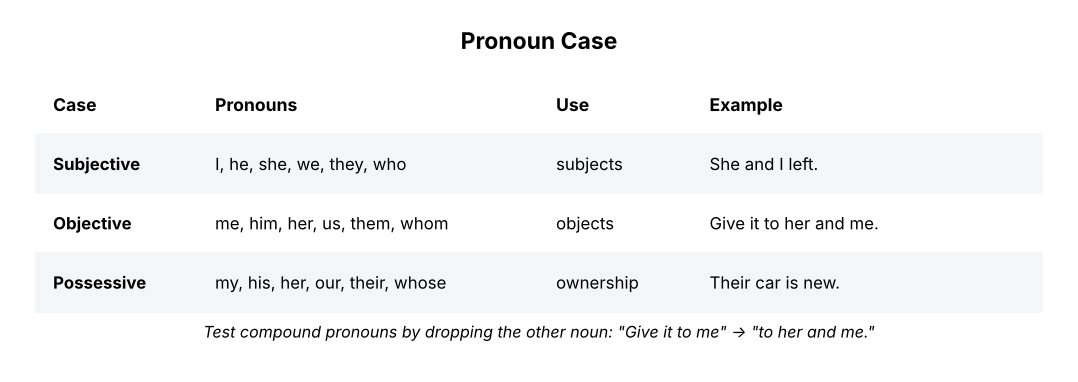
| Case | Job in the Sentence | Pronouns |
|---|---|---|
| Subjective (nominative) | Subject of a verb, or a predicate pronoun after a linking verb | I, you, he, she, it, we, they, who |
| Objective | Direct object, indirect object, or object of a preposition | me, you, him, her, it, us, them, whom |
| Possessive | Shows ownership | my, mine, your, yours, his, her, hers, its, our, ours, their, theirs, whose |
Notice that you and it look the same in the subjective and objective cases, so they never cause case errors. The trouble comes from the pronouns that change: I/me, he/him, she/her, we/us, they/them, and who/whom.
Compound Subjects and Objects
Most case errors happen when a pronoun is paired with a noun or another pronoun. The fix is the cover-up test: hide the other part of the pair and read the sentence with the pronoun alone.
- Incorrect: Maya and me finished the project. Cover “Maya and”: me finished the project sounds wrong. Correct: Maya and I finished the project.
- Incorrect: The coach gave Ben and I a ride. Cover “Ben and”: gave I a ride sounds wrong. Correct: The coach gave Ben and me a ride.
Courtesy puts the other person first: “Maya and I,” not “I and Maya.” That is a matter of style, not case.
Why does this matter? Many people overcorrect. They learn that “me and him went” is wrong and start using I everywhere, even where me belongs. The cover-up test works in both directions, so it protects you from both mistakes.
After Prepositions
A pronoun that follows a preposition is the object of that preposition, so it takes the objective case.
- Incorrect: This stays between you and I.
- Correct: This stays between you and me.
- Correct: The award went to her and them.
Pronouns with Appositive Nouns
When we or us comes right before a noun, drop the noun to test the case.
- We students want a longer lunch. (Test: We want a longer lunch.)
- The principal spoke to us students. (Test: spoke to us.)
Comparisons with Than and As
Comparisons often leave words unstated. Finish the sentence in your head to find the right case.
- Jordan is taller than I (am tall).
- She trusts you more than me. (She trusts you more than she trusts me.)
- She trusts you more than I. (She trusts you more than I trust you.)
The last two sentences mean different things. Case can change meaning, not just correctness.
After Linking Verbs
In formal writing, a pronoun that renames the subject after a form of be takes the subjective case: “It was she who called.” In casual speech, “It’s me” is widely accepted, but formal tests usually expect the subjective form. If “It was she” sounds stiff, reword: “She was the one who called.”
Who and Whom
Who is subjective, and whom is objective. Use the he/him test: answer the question or rephrase the clause with he or him.
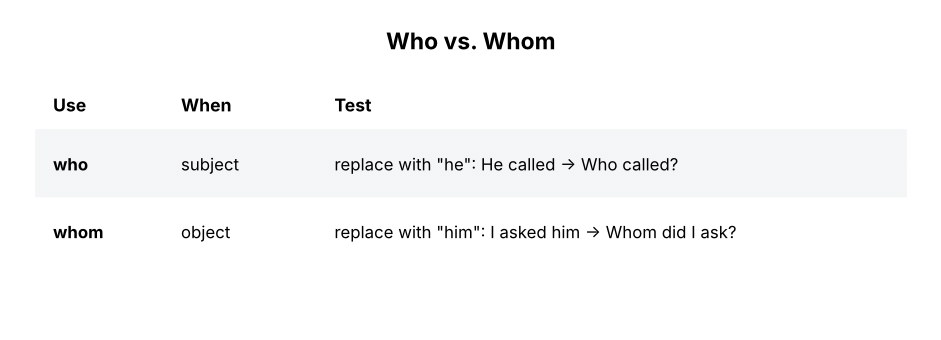
- (Who/Whom) wrote this poem? He wrote it, so who.
- (Who/Whom) did you invite? You invited him, so whom.
- Give the ticket to (whoever/whomever) arrives first. Inside the clause, he arrives first, so whoever.
The last example is tricky. Even though the clause follows the preposition to, the pronoun is the subject of arrives, and its job inside its own clause decides its case.
Possessive Case Pitfalls
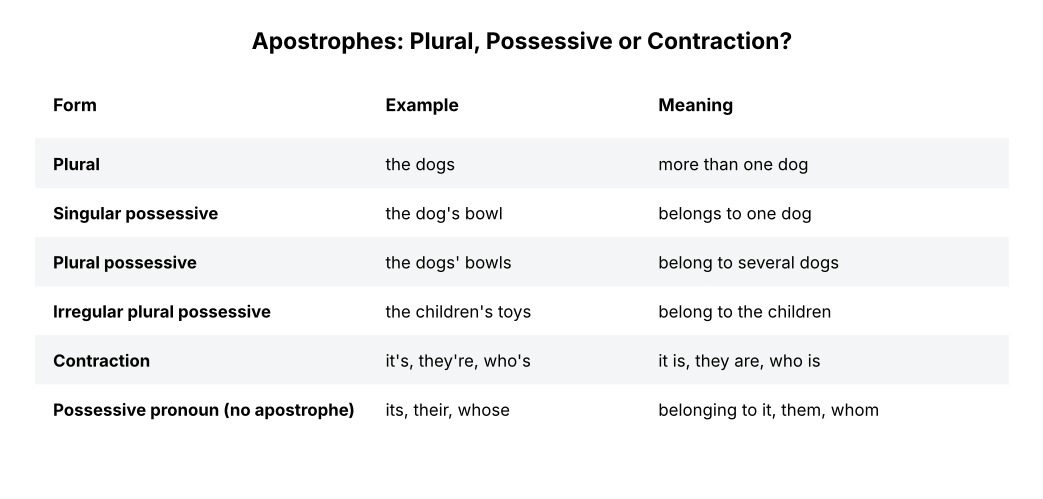
Possessive pronouns never use apostrophes. Its shows ownership, while it’s means “it is.” Whose shows ownership, while who’s means “who is.” Use a possessive before a gerund in formal writing: “We appreciated your helping us,” not “you helping us.”
Why does this matter? Pronoun case errors are small, but readers notice them. College admissions essays, job applications, and standardized tests all reward writers who choose the right form automatically.
Test-Taking Strategies
Mnemonic Devices and Memory Shortcuts
“Whom and him both end in M.” If him fits, use whom; if he fits, use who. For compounds, remember “cover the partner, test the pronoun.”
Cross-Topic Connections
- The pronoun list begins with Topic 1.5: Personal Pronouns.
- Forms like myself are covered in Topic 1.6: Reflexive and Intensive Pronouns.
- Finding the subject of a clause draws on Topic 4.1: Subjects.
- Possessive nouns and pronouns are compared in Topic 7.4: Apostrophes and Possessives.
Common Question Formats
- Choose the correct pronoun to complete a sentence.
- Identify the underlined pronoun that contains an error.
- Revise a sentence with a compound subject or object.
- Choose between who and whom in a question or clause.
Frequent Student Mistakes
- Writing “between you and I” instead of “between you and me.”
- Using myself as a substitute for I or me.
- Adding an apostrophe to possessive pronouns like its and theirs.
Test-Day Shortcuts
When an answer choice contains a pronoun pair, cover the other noun first. If two choices differ only by who and whom, plug in he and him before reading anything else.
Time Management Tips
Pronoun case items on English unit tests and standardized tests such as the SAT and ACT take 20 to 30 seconds once you know the tests. Spend extra time only on whoever and whomever clauses.