
“The window was broken.” By whom? The sentence does not say. Compare it with “Jake broke the window,” which leaves no doubt. The difference is voice. In active voice, the subject performs the action. In passive voice, the subject receives it, and the doer may disappear entirely. Knowing how to spot and switch between the two makes your writing clearer and helps you see when other writers are hiding responsibility.
This article covers Topic 2.7: Active and Passive Voice in Unit 2, Parts of Speech: Verbs. The topic asks you to identify active and passive constructions, convert between them, and decide which voice serves a sentence best.
By the end, you should be able to:
- Distinguish active voice from passive voice.
- Recognize the form of a passive verb phrase.
- Convert sentences from passive to active voice and back.
- Explain when passive voice is a reasonable choice.
What Voice Means
Voice describes the relationship between the subject and the action of the verb.
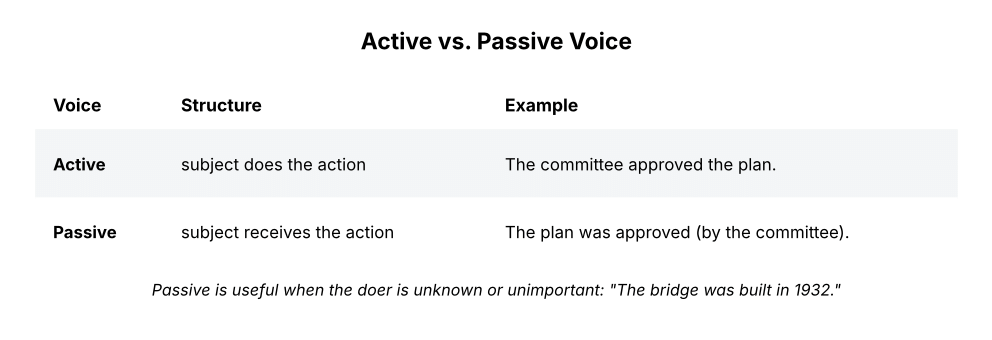
| Voice | Subject’s Role | Example |
|---|---|---|
| Active | Performs the action | The chef prepared the meal. |
| Passive | Receives the action | The meal was prepared by the chef. |
Both sentences describe the same event. In the active version, the doer (the chef) is the subject. In the passive version, the receiver (the meal) becomes the subject, and the doer moves into a phrase starting with by, or vanishes.
Recognizing the Passive
A passive verb always has two parts: a form of be plus a past participle.
- is written, are taken, was eaten, were found
- has been chosen, will be announced, is being repaired
Be careful: not every sentence with was is passive. “She was tired” uses a linking verb with an adjective. “She was running” is past progressive and active. A sentence is passive only when the subject receives the action of a past participle.
The zombie test: if you can add “by zombies” after the verb and the sentence still makes grammatical sense, it is probably passive. “The cake was eaten (by zombies)” works. “The students ate the cake (by zombies)” does not, so it is active.
Converting Between Voices
Passive to active:
- Find the doer, usually in the by phrase.
- Make the doer the subject.
- Change the verb to an active form in the same tense.
- Make the old subject the direct object.
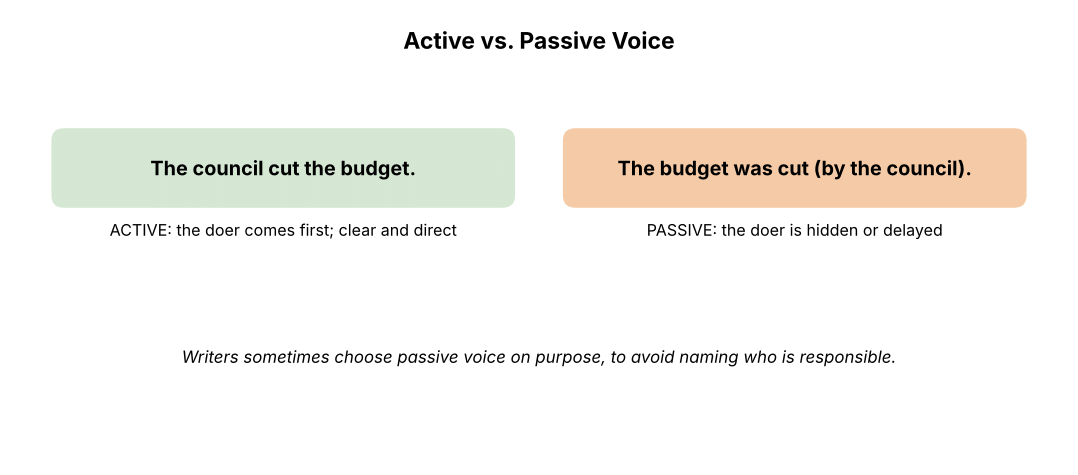
Passive: The bridge was designed by a team of engineers.
Active: A team of engineers designed the bridge.
If no doer is named, you must supply one. “Mistakes were made” might become “The committee made mistakes.”
Active to passive: Only verbs with a direct object can become passive. “The dog chased the ball” can become “The ball was chased by the dog,” but “The dog slept” has no object and cannot be made passive.
Why Active Voice Is Usually Better
Active sentences are usually shorter, more direct, and easier to follow. Compare:
- Passive: A decision was reached by the council after the evidence had been reviewed by its members. (16 words)
- Active: The council members reviewed the evidence and reached a decision. (10 words)
Why does this matter? Passive voice can hide who is responsible. Phrases like “mistakes were made” or “the data was lost” leave out the person who acted. Careful readers notice when a writer uses passive voice to avoid blame.
When Passive Voice Makes Sense
Passive voice is not a grammar error. It is a reasonable choice when:
- The doer is unknown: “My bike was stolen last night.”
- The doer is unimportant or obvious: “The suspect was arrested.” (The police did it.)
- The receiver is the focus: “The Mona Lisa was painted by Leonardo da Vinci” keeps attention on the painting.
- Scientific writing: Lab reports often say “The solution was heated to 80°C” because the procedure matters more than who performed it.
Keeping Voice Consistent
Avoid switching voice within a sentence without reason.
- Awkward: Maria wrote the essay, and then it was revised by her.
- Better: Maria wrote the essay and then revised it.
Editors and standardized tests often reward the version that keeps the same subject doing the action throughout the sentence.
Test-Taking Strategies
Mnemonic Devices and Memory Shortcuts
“Be plus past participle equals passive.” Use the zombie test: if “by zombies” fits after the verb, the sentence is passive.
Cross-Topic Connections
- Passive verbs rely on be, explained in Topic 2.3: Auxiliary Verbs.
- Only verbs with objects can turn passive; review them in Topic 2.1: Action Verbs.
- Finding the doer starts with Topic 4.1: Subjects.
- Past participles also form Topic 2.5: Perfect Verb Tenses.
Common Question Formats
- Identify whether a sentence is active or passive.
- Rewrite a passive sentence in active voice.
- Choose the clearest, most concise revision.
- Explain why a writer chose passive voice in a passage.
Frequent Student Mistakes
- Calling every sentence with was or were passive.
- Changing the tense while converting voice.
- Assuming passive voice is always grammatically wrong.
Test-Day Shortcuts
When answer choices say the same thing, the shortest active version is often correct on editing questions, as long as it keeps the original meaning and tense.
Time Management Tips
Voice items on English unit tests and standardized tests such as the SAT and ACT take about 30 seconds. Revision questions comparing four versions may take a minute.