
“Grandma baked.” That is a complete sentence, but it leaves you hungry for details. Baked what? For whom? “Grandma baked us a pie” answers both questions. The word pie receives the action, and the word us tells who benefits. These two words are a direct object and an indirect object, and finding them is a key step in understanding how English sentences are built.
This article covers Topic 4.3: Direct and Indirect Objects in Unit 4, Sentence Parts. The topic asks you to identify direct and indirect objects, tell them apart from other sentence parts, and use the correct pronoun case for objects.
By the end, you should be able to:
- Find the direct object by asking “what?” or “whom?” after an action verb.
- Find the indirect object by asking “to whom?” or “for whom?”
- Distinguish objects from subject complements and objects of prepositions.
- Choose objective-case pronouns for objects.
Direct Objects
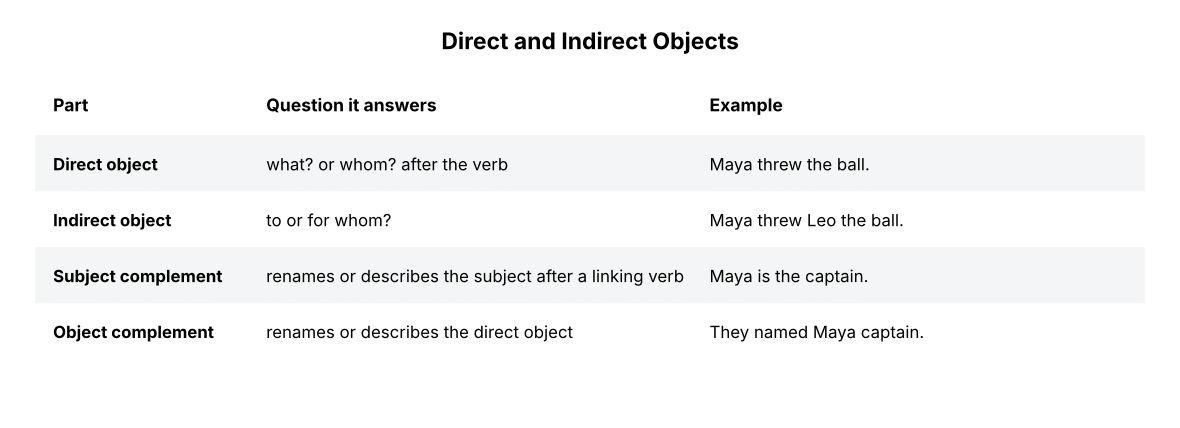
A direct object is a noun or pronoun that receives the action of an action verb. To find it, locate the verb and ask “what?” or “whom?”
- The pitcher threw the ball. (Threw what? ball)
- Lena called her sister. (Called whom? sister)
- We visited Boston and Philadelphia. (Visited what? a compound direct object)
Only transitive verbs take direct objects. Intransitive verbs, such as sleep, arrive, and laugh, do not. Many verbs can be either: “She runs every morning” has no object, but “She runs the student council” does.
Indirect Objects
An indirect object tells to whom or for whom the action is done. It always comes between the verb and the direct object, and a sentence cannot have an indirect object unless it also has a direct object.
- Mr. Patel gave the class a quiz. (Gave a quiz to whom? class)
- Dad bought me new shoes. (Bought shoes for whom? me)
- She told her friends the news.
Common verbs that take indirect objects include give, send, show, tell, bring, buy, teach, offer, and write.
A Step-by-Step Method
| Step | Question | Example: “Ava handed the coach her form.” |
|---|---|---|
| 1. Find the verb | What is the action? | handed |
| 2. Find the subject | Who or what did it? | Ava |
| 3. Find the direct object | Handed what? | form |
| 4. Find the indirect object | Handed it to whom? | coach |
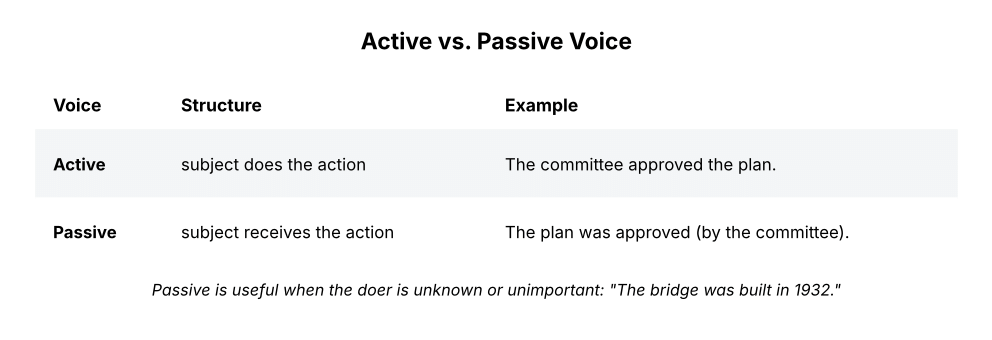
Why does this matter? Many grammar errors, from pronoun case to passive voice, depend on knowing which word is the object. Once you can label sentence parts quickly, editing questions become much easier to solve.
The Preposition Test
An indirect object can usually be rewritten as a prepositional phrase with to or for.
- Mr. Patel gave the class a quiz. = Mr. Patel gave a quiz to the class.
- Dad bought me new shoes. = Dad bought new shoes for me.
Once the preposition appears, the word is no longer an indirect object. It becomes the object of a preposition. An indirect object never has a preposition in front of it.
Objects Versus Subject Complements
After a linking verb such as is, seems, or became, the noun that follows renames the subject. It is a predicate nominative (a subject complement), not a direct object.
- Marcus became captain. (captain = Marcus; predicate nominative)
- Marcus hit the ball. (ball is not Marcus; direct object)
Ask whether the noun is the same person or thing as the subject. If it is, you have a complement. If it receives an action, you have an object.
Objects and Pronoun Case
Direct and indirect objects take objective-case pronouns: me, him, her, us, them, and whom.
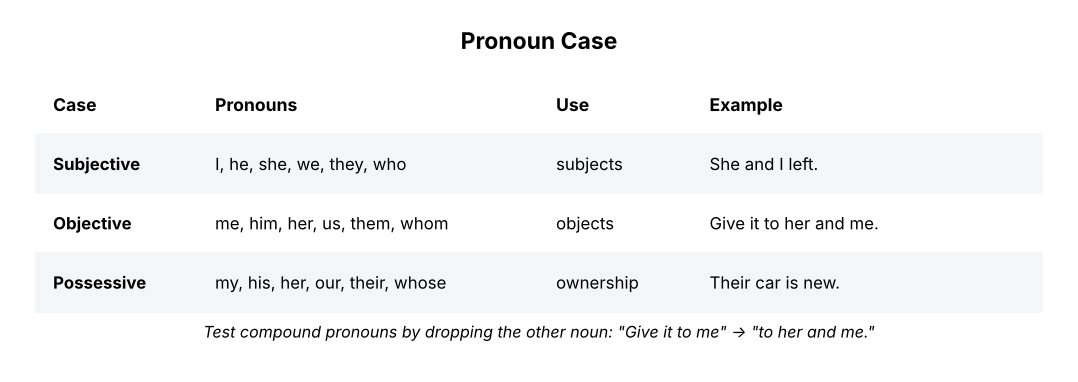
- Incorrect: The teacher gave Sam and I extra credit.
- Correct: The teacher gave Sam and me extra credit.
Cover “Sam and” to check: “gave me extra credit” is clearly right.
Why does this matter? Objects also determine whether a sentence can be turned into the passive voice. “The class was given a quiz” works only because gave had objects to move into the subject position.
Object Complements
Some verbs, such as name, make, call, and elect, take an object complement that follows the direct object and describes or renames it. In “The class elected Rosa president,” Rosa is the direct object and president is the object complement. You cannot add to or for before Rosa, which is how you know it is not an indirect object.
Test-Taking Strategies
Mnemonic Devices and Memory Shortcuts
“Direct asks what; indirect asks to whom.” Remember the order: V-I-D, verb, indirect object, direct object, as in “gave her the book.”
Cross-Topic Connections
- Objects follow the verb in Topic 4.2: Predicates.
- Only action verbs take objects; see Topic 2.1: Action Verbs.
- Complements after linking verbs are in Topic 2.2: Linking Verbs.
- Choosing me or I is explained in Topic 1.8: Pronoun Case.
Common Question Formats
- Identify the direct or indirect object in a sentence.
- Label each underlined word as subject, object, or complement.
- Choose the correct pronoun for an object position.
- Rewrite a sentence using a prepositional phrase instead of an indirect object.
Frequent Student Mistakes
- Calling the object of a preposition an indirect object.
- Labeling a predicate nominative as a direct object.
- Using subjective pronouns such as I or he as objects.
Test-Day Shortcuts
Cross out every prepositional phrase first. The object you are looking for is never inside one, so the remaining nouns after the verb are your candidates.
Time Management Tips
Labeling items on English unit tests and standardized tests such as the SAT and ACT take 20 to 30 seconds. Save extra time for sentences with object complements.