
“The storm knocked out the power. We lit candles.” Those two short sentences are clear, but they feel choppy. “The storm knocked out the power, so we lit candles” connects the ideas and shows that one caused the other. That combined sentence is a compound sentence, one of the simplest and most useful tools for writing with variety and logic.
This article covers Topic 5.2: Compound Sentences in Unit 5, Sentence Structure. The topic asks you to recognize compound sentences, build them with coordinating conjunctions or semicolons, and punctuate them correctly.
By the end, you should be able to:
- Define a compound sentence and identify its independent clauses.
- Join clauses with a comma and a coordinating conjunction.
- Join clauses with a semicolon or a semicolon and a transitional word.
- Tell a compound sentence apart from a simple sentence with a compound verb.
What Makes a Sentence Compound
A compound sentence contains two or more independent clauses and no dependent clauses. Each independent clause has its own subject and verb and could stand alone as a sentence.
- Maya plays the cello, and her brother plays the drums.
- I wanted to go, but I had homework.
Method 1: Comma Plus Coordinating Conjunction
The most common way to join independent clauses is with a comma followed by one of the seven coordinating conjunctions, remembered as FANBOYS.
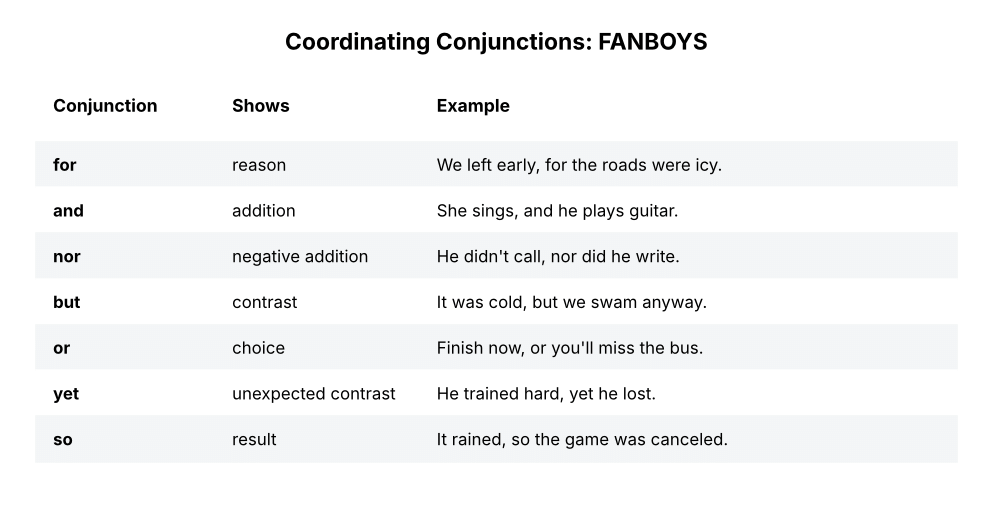
| Conjunction | Relationship | Example |
|---|---|---|
| for | Reason | She smiled, for the test was over. |
| and | Addition | The bell rang, and students filed out. |
| nor | Negative addition | He did not call, nor did he text. |
| but | Contrast | The trail was steep, but the view was worth it. |
| or | Choice | We can leave now, or we can wait for Dad. |
| yet | Unexpected contrast | The team was tired, yet it kept running. |
| so | Result | It started raining, so the game was delayed. |
The comma goes before the conjunction, not after it. Notice that after nor, the subject and helping verb switch places: “nor did he text.”
Method 2: The Semicolon
A semicolon can join two closely related independent clauses without a conjunction.
- The library closes at six; the café stays open until nine.
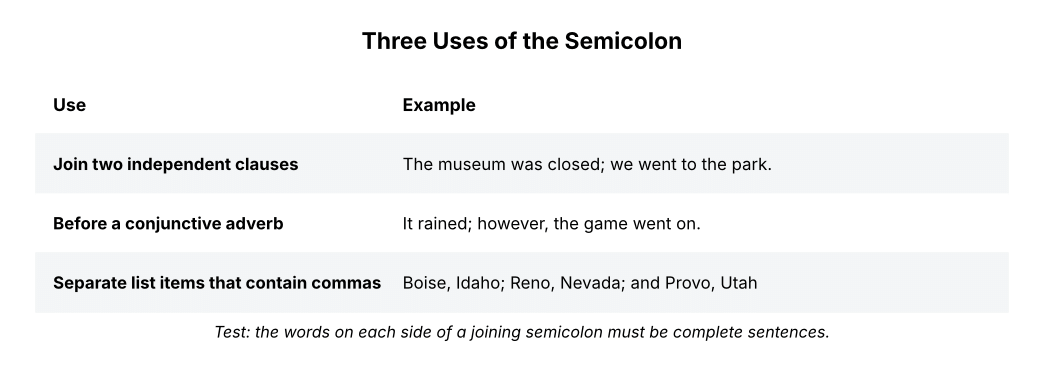
A semicolon can also come before a conjunctive adverb or transitional phrase, such as however, therefore, meanwhile, moreover, otherwise, or as a result. Put a comma after the transition.
- The forecast called for sun; however, it rained all afternoon.
Why does this matter? Words like however are not coordinating conjunctions. “The forecast called for sun, however, it rained” is a comma splice. Knowing which connecting words can follow a comma, and which need a semicolon, prevents one of the most common errors on editing tests.
Compound Sentence or Compound Verb?
A simple sentence can have a compound verb, two verbs sharing one subject. That is not a compound sentence, and it usually needs no comma.
- Simple sentence, compound verb: Jordan washed the dishes and swept the floor.
- Compound sentence: Jordan washed the dishes, and Kim swept the floor.
Test it: look at the words after the conjunction. If they include their own subject, you have two independent clauses and need the comma. If they begin with a verb, there is only one clause.
Choosing the Right Conjunction
The conjunction must match the logical relationship between ideas. “I studied for hours, but I passed the test” sounds odd because studying and passing are not in contrast. “I studied for hours, so I passed the test” shows cause and effect.
Why does this matter? Standardized tests frequently present four connecting words and ask which one best fits. The grammar of each choice may be correct; only one shows the right logic. Read both clauses and name the relationship before looking at the answers.
Using Compound Sentences Well
Compound sentences give equal weight to both ideas. If one idea is more important, or if one depends on the other, a complex sentence with a subordinating conjunction may work better. Too many and sentences in a row can sound like a list, so vary your structure.
Test-Taking Strategies
Mnemonic Devices and Memory Shortcuts
FANBOYS: for, and, nor, but, or, yet, so. “Comma before FANBOYS when both sides can stand alone.”
Cross-Topic Connections
- The seven joining words are explained in Topic 3.4: Coordinating Conjunctions.
- Each half of a compound sentence is explained in Topic 4.5: Independent Clauses.
- Compare with one-clause structures in Topic 5.1: Simple Sentences.
- Comma rules are collected in Topic 7.1: Commas.
Common Question Formats
- Identify whether a sentence is simple or compound.
- Choose the correct punctuation to join two clauses.
- Select the conjunction that best shows the relationship between ideas.
- Combine two short sentences into one.
Frequent Student Mistakes
- Placing a comma after the conjunction instead of before it.
- Adding a comma before a compound verb.
- Joining clauses with a comma and however.
Test-Day Shortcuts
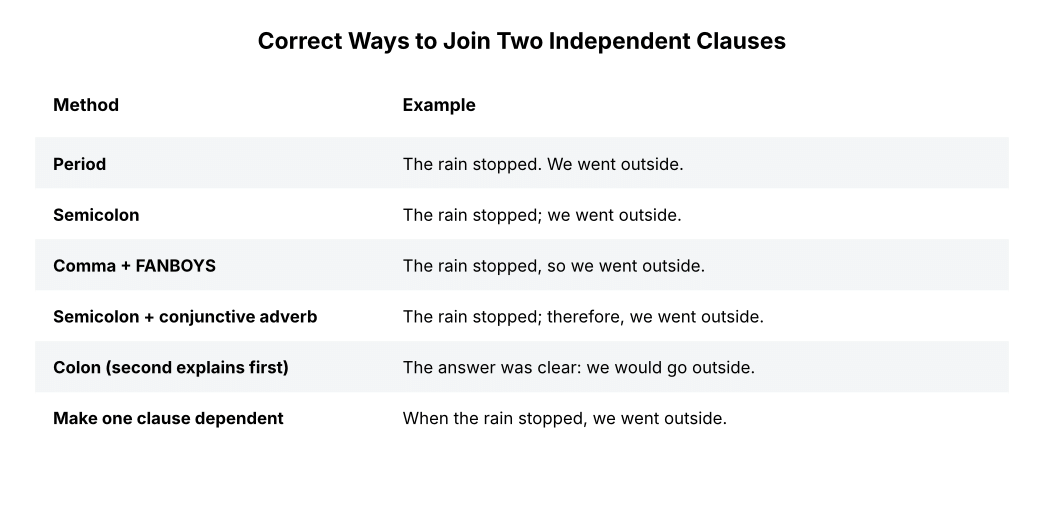
Cover each side of the punctuation mark. If both sides are complete sentences, the only correct joins are a period, a semicolon, or a comma plus FANBOYS.
Time Management Tips
Sentence-joining items on English unit tests and standardized tests such as the SAT and ACT take 20 to 40 seconds. Logic questions about conjunctions may need a quick reread of the previous sentence.