
“Although the forecast promised sunshine, the picnic was rained out.” This sentence does more than list two facts. It shows that one idea, the forecast, sets up a surprise in the other. Sentences like this rank ideas, putting the main point in one clause and background in another. They are called complex sentences, and when they are combined with compound sentences they become compound-complex sentences.
This article covers Topic 5.3: Complex and Compound-Complex Sentences in Unit 5, Sentence Structure. The topic asks you to identify these sentence types, build them with subordinating conjunctions and relative pronouns, and punctuate them correctly.
By the end, you should be able to:
- Define complex and compound-complex sentences.
- Identify independent and dependent clauses within a sentence.
- Punctuate introductory and closing dependent clauses correctly.
- Classify any sentence as simple, compound, complex, or compound-complex.
Clauses Review
A clause is a group of words with a subject and a verb. An independent clause can stand alone. A dependent (subordinate) clause cannot, because it begins with a word that makes it incomplete, such as because, when, although, if, who, which, or that.
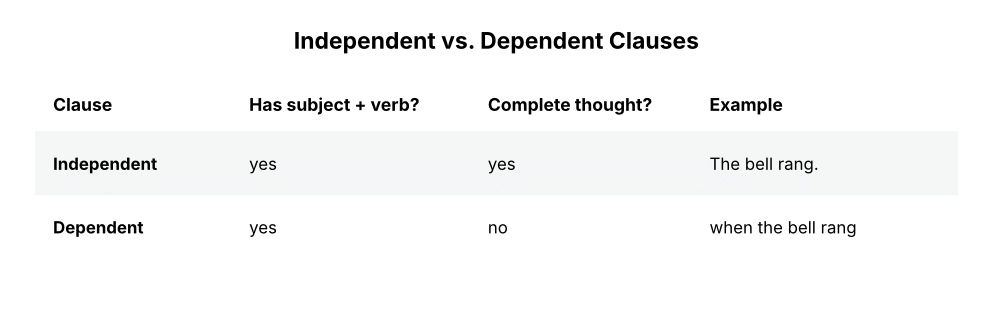
- Independent: we stayed inside
- Dependent: because it was snowing
The Four Sentence Types
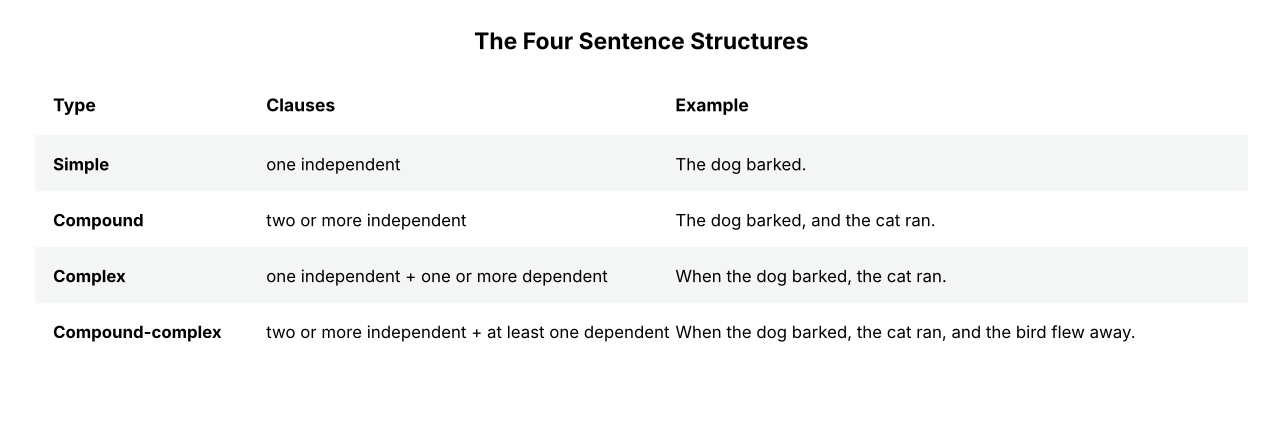
| Type | Independent Clauses | Dependent Clauses | Example |
|---|---|---|---|
| Simple | 1 | 0 | We stayed inside. |
| Compound | 2 or more | 0 | It snowed, so we stayed inside. |
| Complex | 1 | 1 or more | Because it snowed, we stayed inside. |
| Compound-complex | 2 or more | 1 or more | Because it snowed, we stayed inside, and Mom made cocoa. |
Complex Sentences
A complex sentence has one independent clause and at least one dependent clause. Dependent clauses come in three types:
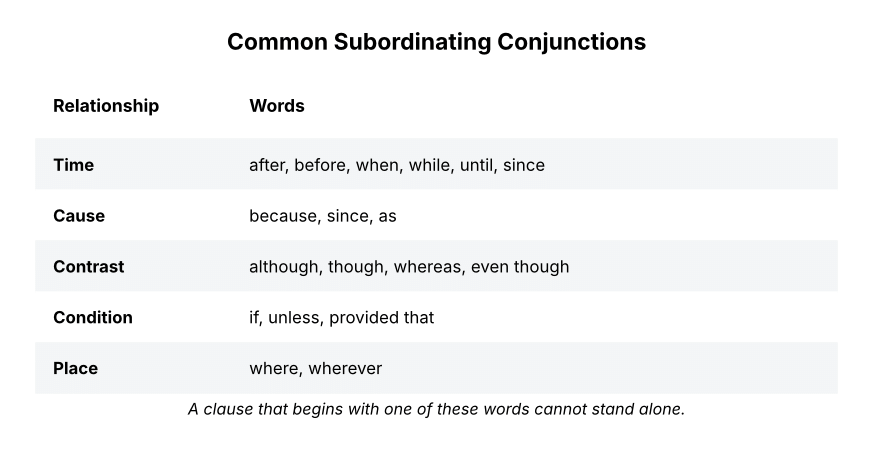
- Adverb clauses begin with subordinating conjunctions and tell when, why, how, or under what condition: “When the bell rings, put your pencils down.”
- Adjective (relative) clauses begin with who, whom, whose, which, or that and describe a noun: “The student who won the contest is my cousin.”
- Noun clauses act as a subject or object: “I know that you tried your best.”
Worked example: Classify “The book that I borrowed was due yesterday.”
- Independent clause: The book was due yesterday.
- Dependent clause: that I borrowed (describes book).
- One independent plus one dependent equals complex.
Punctuating Complex Sentences
- Introductory adverb clause: use a comma. “If you finish early, check your work.”
- Adverb clause at the end: usually no comma. “Check your work if you finish early.” A comma is often used before contrast words like although and whereas.
- Essential relative clause (needed to identify the noun): no commas. “Students who arrive late must sign in.”
- Nonessential relative clause (extra information): commas. “My sister, who arrived late, signed in.”
Why does this matter? Commas around a relative clause change meaning. “Students who arrive late must sign in” applies only to late students. “Students, who arrive late, must sign in” suggests that all students arrive late. Tests frequently check this distinction.
Compound-Complex Sentences
A compound-complex sentence combines both structures: at least two independent clauses and at least one dependent clause.
Worked example: “After the game ended, the players shook hands, and the fans cheered.”
- Dependent clause: After the game ended.
- Independent clause 1: the players shook hands.
- Independent clause 2: the fans cheered.
- Two independent plus one dependent equals compound-complex.
Punctuate each part by its own rule: a comma after the introductory clause and a comma before the coordinating conjunction.
Why Writers Use Complex Structures
Complex sentences show relationships such as cause, contrast, time, and condition. They let a writer emphasize the main idea by placing it in the independent clause.
- “Although she was nervous, she gave a strong speech” emphasizes the speech.
- “Although she gave a strong speech, she was nervous” emphasizes the nerves.
Why does this matter? Strong writing mixes sentence types. A paragraph of only simple sentences feels choppy, and a paragraph of only compound-complex sentences is hard to follow. Variety keeps readers engaged and makes logical connections clear.
Test-Taking Strategies
Mnemonic Devices and Memory Shortcuts
Count clauses: “One I is simple, two I is compound, I plus D is complex, two I plus D is compound-complex.” For subordinating conjunctions, remember AAAWWUBBIS: as, although, after, while, when, unless, because, before, if, since.
Cross-Topic Connections
- Clauses that cannot stand alone are in Topic 4.6: Dependent Clauses.
- Words that begin adverb clauses are in Topic 3.5: Subordinating Conjunctions.
- Clauses that describe nouns are in Topic 4.7: Adjective and Relative Clauses.
- The compound half builds on Topic 5.2: Compound Sentences.
Common Question Formats
- Classify a sentence by type.
- Identify the dependent clause in a sentence.
- Choose correct comma placement around a clause.
- Combine sentences using a subordinating conjunction.
Frequent Student Mistakes
- Counting a phrase as a clause even though it lacks a subject and verb.
- Calling a sentence compound because it contains and between two verbs.
- Putting commas around essential relative clauses.
Test-Day Shortcuts
Underline every verb and find its subject. Each subject-verb pair is a clause. Then check which clauses start with a subordinating word.
Time Management Tips
Classification items on English unit tests and standardized tests such as the SAT and ACT take 30 to 45 seconds. Long compound-complex sentences may need a minute.