
Quotation marks seem simple: put them around words someone said. Then the questions start. Does the period go inside or outside? What if the quotation is a question but your sentence is not? Should a song title get quotation marks or italics? These small decisions show up in every research essay and on most grammar tests, and a few clear rules answer nearly all of them.
This article covers Topic 7.5: Quotation Marks in Unit 7, Punctuation and Mechanics. The topic asks you to punctuate direct quotations, place other punctuation correctly around quotation marks, and use quotation marks for titles of short works.
By the end, you should be able to:
- Distinguish direct and indirect quotations.
- Place periods, commas, question marks, and exclamation points correctly with quotation marks.
- Punctuate dialogue tags and split quotations.
- Choose quotation marks or italics for titles.
Direct and Indirect Quotations
A direct quotation repeats someone’s exact words and needs quotation marks. An indirect quotation reports what someone said without using the exact words and needs none.
- Direct: Ms. Chen said, “The essay is due Friday.”
- Indirect: Ms. Chen said that the essay is due Friday.
The word that often signals an indirect quotation.
Punctuation Placement Rules (American English)
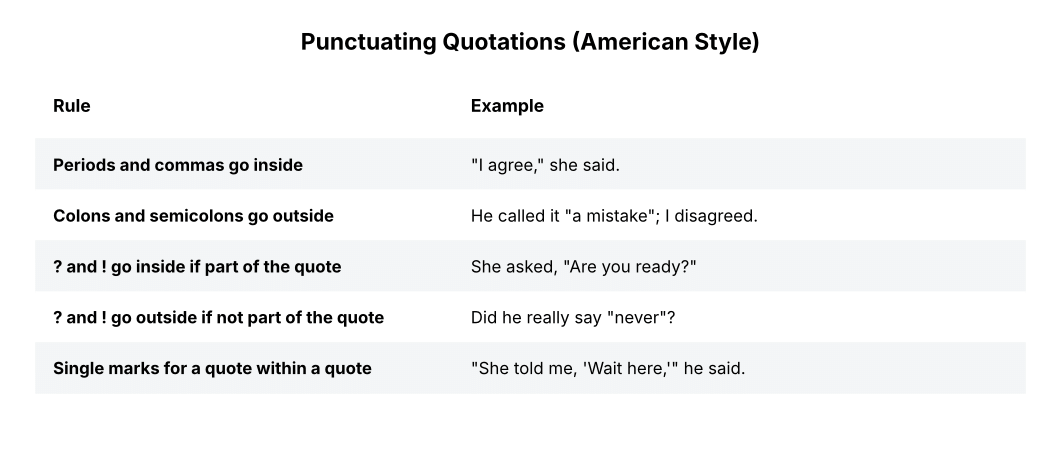
| Mark | Rule | Example |
|---|---|---|
| Period and comma | Always inside | “I’m ready,” she said. He replied, “Let’s go.” |
| Colon and semicolon | Always outside | She called it “a disaster”; I disagreed. |
| Question mark and exclamation point | Inside if they belong to the quotation; outside if they belong to the whole sentence | He asked, “Are you coming?” Did she really say “no”? |
British English often places periods and commas outside when they are not part of the quoted material. On American tests, follow the American rule.
Why does this matter? The question mark rule changes meaning. In “He asked, ‘Are you coming?’” the speaker asked the question. In “Did she really say ‘no’?” the writer is asking. Placement shows whose question it is.
Dialogue Tags
A dialogue tag identifies the speaker, such as she said or he asked.
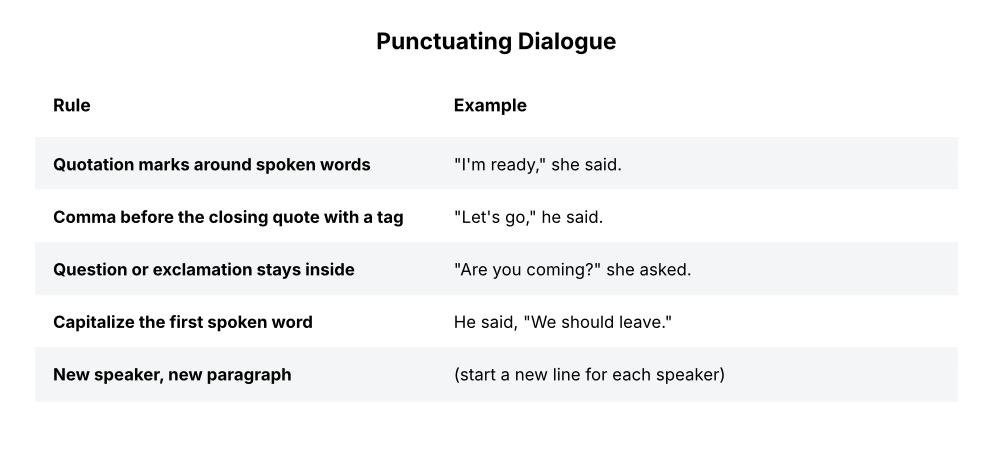
- Tag first: comma after the tag, capital letter to start the quote. Jamal said, “We won.”
- Tag last: comma inside the closing mark, lowercase tag. “We won,” Jamal said.
- Split quotation, one sentence: “We won,” Jamal said, “by one point.”
- Split quotation, two sentences: “We won,” Jamal said. “It was close.”
In a split quotation, the second part is capitalized only if it starts a new sentence.
In stories, start a new paragraph each time the speaker changes. This helps readers follow a conversation without a tag on every line.
Quotations Within Quotations
Use single quotation marks for a quotation inside another quotation.
- Maya said, “My coach always tells us, ‘Finish strong.’”
Shortening and Changing Quotations
When you leave words out of the middle of a quotation, replace them with an ellipsis, three spaced periods. When you add or change a word so the quotation fits your sentence, put the new word in square brackets. For example, “She [the narrator] never looks back” adds a clarifying word. Never change a quotation in a way that alters the author’s meaning.
Titles
Use quotation marks for titles of short works or parts of larger works. Use italics for long works or whole collections.
| Quotation Marks (short) | Italics (long) |
|---|---|
| Short stories, poems, songs, articles, essays, chapters, TV episodes | Novels, books of poetry, albums, newspapers, magazines, films, TV series |
| “The Raven” | The Complete Poems of Edgar Allan Poe |
Integrating Quotations in Essays
When a quotation flows into your own sentence, you often need no comma at all.
- Lincoln called for “a new birth of freedom” in his address.
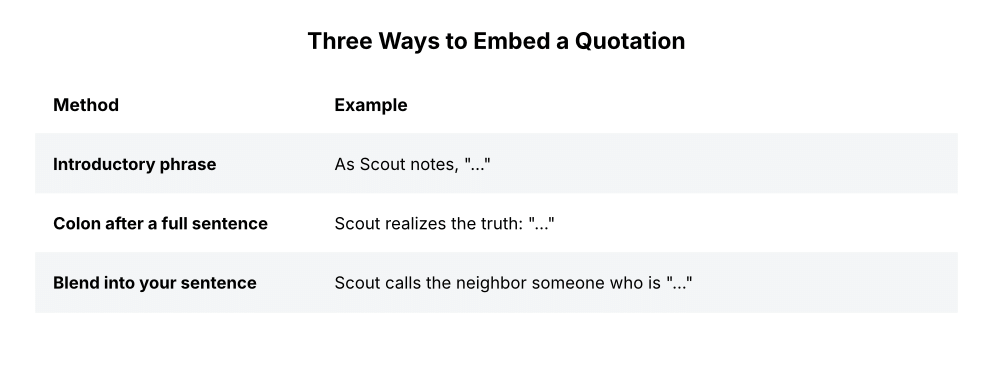
Use a comma when a dialogue tag or verb such as said introduces the quotation. Use a colon when a complete sentence introduces it.
Why does this matter? Smoothly integrated quotations are a mark of strong academic writing. Teachers reward essays that blend evidence into the writer’s own sentences instead of dropping quotations in with no introduction.
Other Uses
Quotation marks can also show that a word is being discussed as a word or used in an unusual or ironic sense: The word “literally” is often misused. Use this sparingly, since too many quotation marks can make writing sound sarcastic.
Test-Taking Strategies
Mnemonic Devices and Memory Shortcuts
“Periods and commas are always inside the house; colons and semicolons wait outside.” For titles, “short goes in quotes, long goes in italics.”
Cross-Topic Connections
- Commas with dialogue tags connect to Topic 7.1: Commas.
- Apostrophes and single quotation marks are compared in Topic 7.4: Apostrophes and Possessives.
- Colons that introduce quotations are in Topic 7.3: Semicolons and Colons.
- Quoting evidence well is practiced in Reading Skills Topic 1.6: Using Textual Evidence to Support Claims.
Common Question Formats
- Choose the correctly punctuated quotation.
- Decide whether a question mark belongs inside or outside.
- Punctuate a split quotation.
- Choose quotation marks or italics for a title.
Frequent Student Mistakes
- Placing periods outside the closing quotation mark.
- Using quotation marks for indirect quotations.
- Capitalizing the second half of a split sentence.
Test-Day Shortcuts
For question marks, ask who is asking. If the speaker is asking, the mark goes inside; if the writer is asking, it goes outside.
Time Management Tips
Quotation items on English unit tests and standardized tests such as the SAT and ACT take 20 to 30 seconds. Check the placement of every mark around the quotation.