
Many writers avoid semicolons and colons because they are not sure how to use them. That is a missed opportunity. A semicolon can link two closely related ideas more smoothly than a period, and a colon can set up a list, an explanation, or a dramatic reveal. Each mark follows a small set of rules, and once you learn them, you can use both with confidence.
This article covers Topic 7.3: Semicolons and Colons in Unit 7, Punctuation and Mechanics. The topic asks you to use semicolons to join independent clauses and separate complex list items, and to use colons to introduce lists, explanations, and quotations.
By the end, you should be able to:
- Use a semicolon to join two related independent clauses.
- Use a semicolon with conjunctive adverbs and in complex lists.
- Use a colon after a complete independent clause to introduce a list, explanation, or quotation.
- Avoid the most common semicolon and colon errors.
Semicolon Rule 1: Joining Independent Clauses
A semicolon joins two independent clauses that are closely related. It works like a period but signals that the ideas belong together.
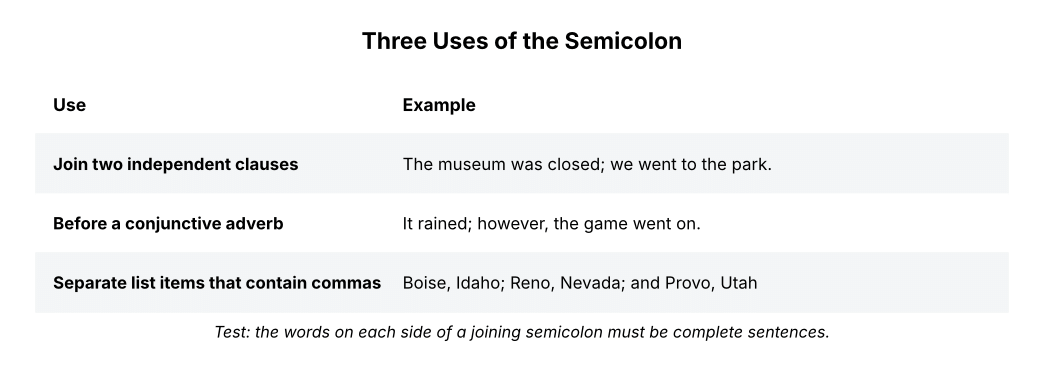
- The bakery opens at six; the line starts forming at five.
- Rosa loves mystery novels; her brother prefers science fiction.
Both sides of a semicolon must be able to stand alone as sentences. Do not use a semicolon with a coordinating conjunction such as and or but in a simple compound sentence; use a comma there instead.
Semicolon Rule 2: Before Conjunctive Adverbs
When a conjunctive adverb or transitional phrase connects two independent clauses, put a semicolon before it and a comma after it.
- The roads were icy; therefore, school was canceled.
- I studied for hours; however, the test covered different chapters.
Common conjunctive adverbs include however, therefore, moreover, consequently, nevertheless, meanwhile, otherwise, and instead.
Semicolon Rule 3: Complex Lists
When list items already contain commas, use semicolons to separate the items so readers can tell where each one ends.
- The tour stops in Austin, Texas; Denver, Colorado; and Portland, Oregon.
Without semicolons, the reader could not easily tell whether “Texas” is a separate stop.
Why does this matter? A semicolon lets you show that two ideas are connected without forcing a specific relationship like because or but. It also prevents comma splices, one of the most common errors on standardized tests.
Colon Rules
A colon points forward. It tells the reader, “Here comes what I promised.” The most important rule: a colon must follow a complete independent clause.
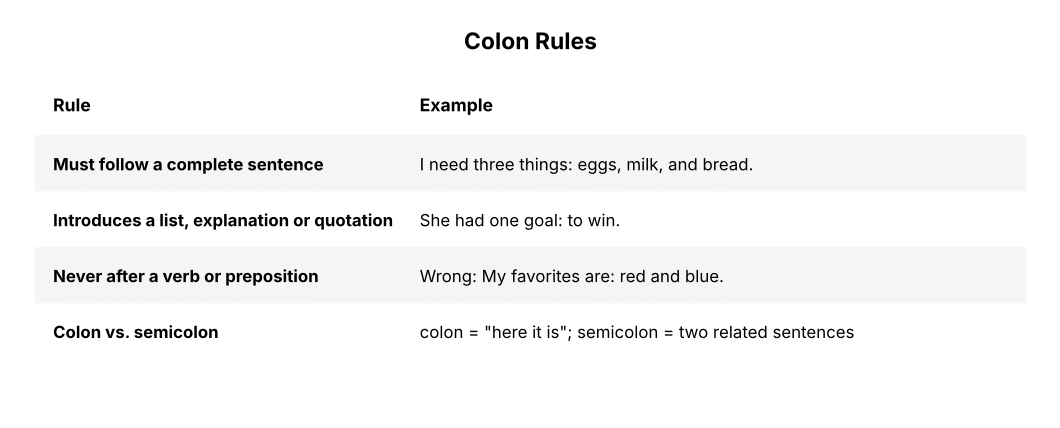
| Use | Example |
|---|---|
| Introduce a list | Bring three items: a pencil, a calculator, and an eraser. |
| Introduce an explanation | The reason was simple: nobody had read the instructions. |
| Introduce a quotation | Franklin gave clear advice: “Well done is better than well said.” |
| Emphasize a final word | She had only one goal: victory. |
| Conventional uses | Times (6:30 p.m.), letter greetings (Dear Dr. Lee:), and ratios (3:1) |
The Most Common Colon Error
Do not put a colon directly after a verb or preposition, because the words before it are not a complete sentence.
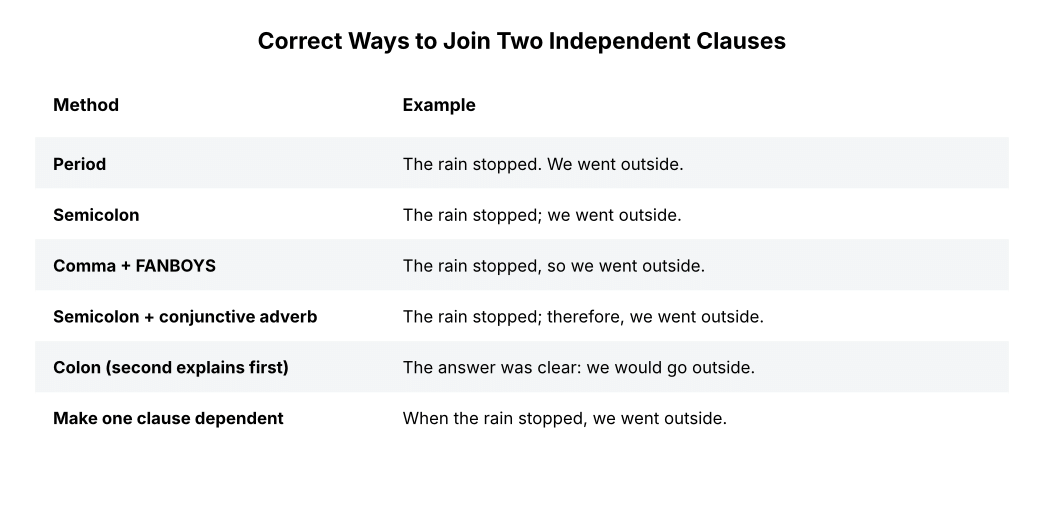
- Incorrect: My favorite sports are: soccer, tennis, and swimming.
- Correct: My favorite sports are soccer, tennis, and swimming.
- Correct: I have three favorite sports: soccer, tennis, and swimming.
- Incorrect: The kit includes: bandages and tape.
- Incorrect: We traveled to: Ohio and Michigan.
Worked example: Choose the correct punctuation: “The coach gave us one piece of advice ___ never give up.”
- “The coach gave us one piece of advice” is a complete independent clause.
- “never give up” explains what the advice was.
- A colon fits: “The coach gave us one piece of advice: never give up.”
Capitalizing After a Colon
In American English, the word after a colon is usually lowercase unless it is a proper noun, the start of a quotation, or, in some styles, the start of a complete sentence. Follow the style your teacher or test uses.
Why does this matter? Standardized tests regularly offer a colon, semicolon, comma, and period as answer choices. The test is really asking you to check what comes before and after the mark. Semicolons need complete clauses on both sides; colons need one before.
Test-Taking Strategies
Mnemonic Devices and Memory Shortcuts
“Semicolon: sentence on both sides. Colon: complete sentence before, anything after.” Think of the colon as a drumroll that announces what comes next.
Cross-Topic Connections
- Semicolons offer one fix for Topic 5.5: Run-On Sentences and Comma Splices.
- Joining clauses is also covered in Topic 5.2: Compound Sentences.
- Series commas are reviewed in Topic 7.1: Commas.
- Recognizing a complete clause starts with Topic 4.5: Independent Clauses.
Common Question Formats
- Choose the correct punctuation mark between two parts of a sentence.
- Identify an unnecessary colon.
- Punctuate a list whose items contain commas.
- Correct a sentence using however or therefore.
Frequent Student Mistakes
- Placing a colon after are, include, or such as.
- Using a semicolon before a dependent clause.
- Forgetting the comma after a conjunctive adverb.
Test-Day Shortcuts
Cover everything after the mark. If what remains is not a complete sentence, eliminate both the colon and the semicolon.
Time Management Tips
Punctuation items on English unit tests and standardized tests such as the SAT and ACT take 20 to 30 seconds. Check the words before the mark first to save time.