
“I love soccer I practice every day.” Read that aloud and you will probably pause after soccer, even though nothing on the page tells you to. The sentence is a run-on: two complete thoughts crammed together with no punctuation. Add a comma alone, “I love soccer, I practice every day,” and you have a comma splice. Both errors are among the most heavily tested on English exams.
This article covers Topic 5.5: Run-On Sentences and Comma Splices in Unit 5, Sentence Structure. The topic asks you to identify fused sentences and comma splices and correct them in several ways.
By the end, you should be able to:
- Define a run-on (fused) sentence and a comma splice.
- Find the point where two independent clauses meet.
- Fix run-ons and comma splices using five methods.
- Choose the fix that best shows the relationship between ideas.
Two Kinds of Errors
Both errors join two independent clauses incorrectly.
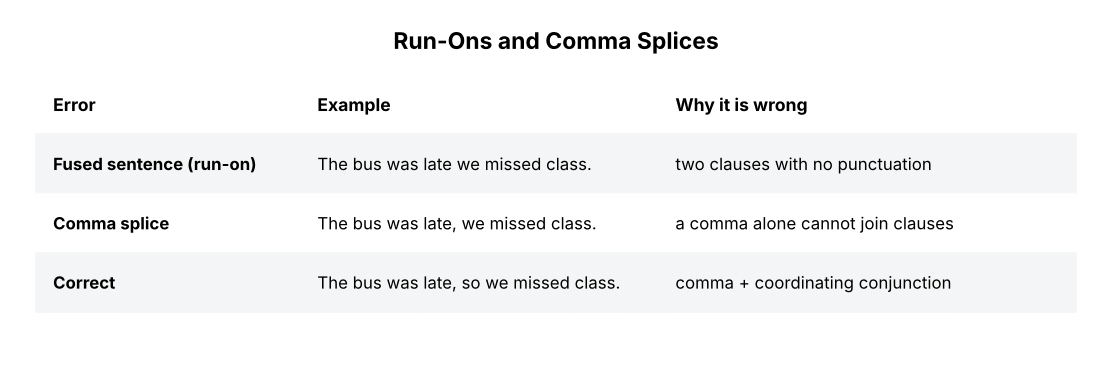
| Error | What Happens | Example |
|---|---|---|
| Fused sentence (run-on) | Two clauses with no punctuation | The game ended late we missed the bus. |
| Comma splice | Two clauses joined only by a comma | The game ended late, we missed the bus. |
Many teachers use “run-on” for both errors. Either way, a comma by itself is not strong enough to hold two sentences together.
Note that a run-on is not the same as a long sentence. A sentence of 50 words can be perfectly correct, and a sentence of 8 words can be a run-on. Length has nothing to do with it; structure does.
Finding the Break
To spot a run-on, look for a second subject and verb that begin a new complete thought. Pronouns are a big clue. In “Maria finished her essay she turned it in,” the word she starts a new independent clause.
Transition words like however, then, therefore, and also are another clue. Writers often put just a comma before them, creating a splice: “It was raining, however, we played anyway.”
Five Ways to Fix Them
Starting from “The game ended late we missed the bus”:
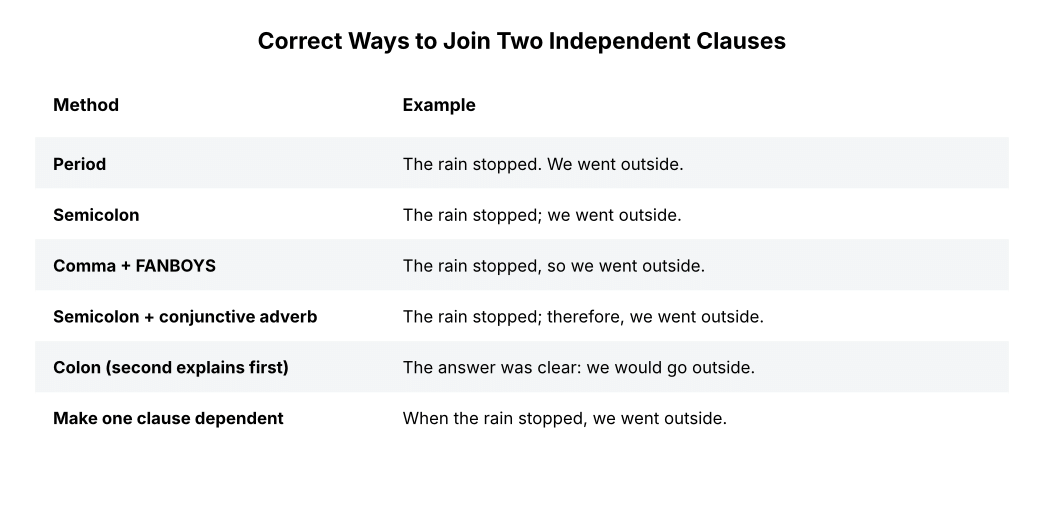
- Period: The game ended late. We missed the bus.
- Comma plus FANBOYS: The game ended late, so we missed the bus.
- Semicolon: The game ended late; we missed the bus.
- Semicolon plus transition: The game ended late; as a result, we missed the bus.
- Subordination: Because the game ended late, we missed the bus.
All five are grammatically correct. They differ in emphasis and in how clearly they show the cause-and-effect link.
Why does this matter? On multiple-choice editing questions, several answers may fix the error. The best answer is the one that is correct and shows the right logical relationship. “The game ended late, but we missed the bus” is punctuated correctly but makes no sense.
Using a Colon
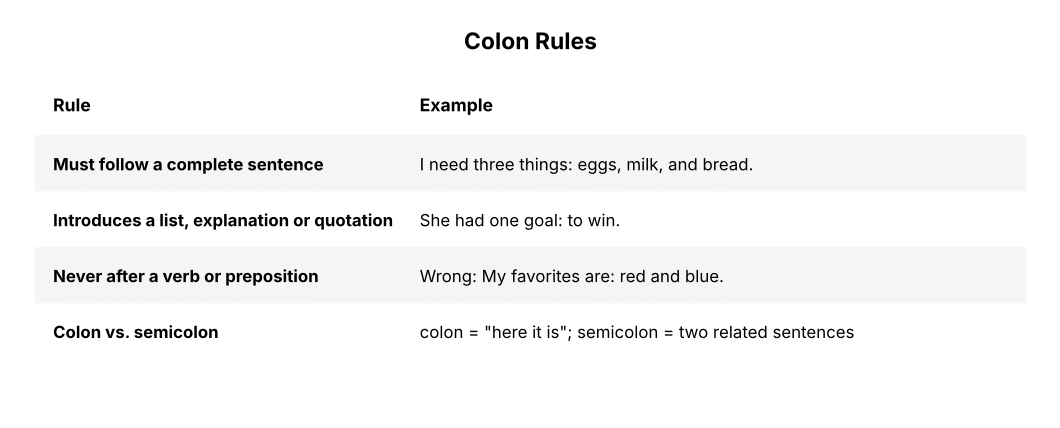
A colon can also join two independent clauses when the second explains or illustrates the first: “The answer was obvious: we had to start over.” Use it only when the second clause clearly follows from the first.
Worked Example
Identify and correct the error: My brother loves astronomy, he has a telescope in his room.
- Clause 1: My brother loves astronomy (complete).
- Clause 2: he has a telescope in his room (complete).
- Joined only by a comma, so this is a comma splice.
- Fix: My brother loves astronomy, and he has a telescope in his room. Or: My brother loves astronomy; he has a telescope in his room.
When a Comma Is Enough
A comma can separate a dependent clause from an independent clause: “When the game ended, we ran for the bus.” That is not a splice, because only one clause is independent. Before calling something a splice, check that both sides could stand alone.
Why does this matter? Students who over-correct start removing commas that belong, such as the one after an introductory clause. Learning to test each side protects you from both mistakes.
Test-Taking Strategies
Mnemonic Devices and Memory Shortcuts
“A comma is a pause, not a wall.” Two sentences need a wall: a period, a semicolon, or a comma with FANBOYS.
Cross-Topic Connections
- Recognizing complete clauses starts with Topic 4.5: Independent Clauses.
- The comma-plus-conjunction fix is in Topic 5.2: Compound Sentences.
- The opposite error is covered in Topic 5.4: Sentence Fragments.
- Other comma uses are listed in Topic 7.1: Commas.
Common Question Formats
- Identify a sentence as correct, a fused sentence, or a comma splice.
- Choose the punctuation that correctly joins two clauses.
- Pick the revision that fixes the error and keeps the meaning.
- Find the one answer choice that is not acceptable.
Frequent Student Mistakes
- Putting only a comma before however or therefore.
- Assuming long sentences are automatically run-ons.
- Choosing a conjunction that fixes the grammar but breaks the logic.
Test-Day Shortcuts
A period and a semicolon are interchangeable between two independent clauses. If two answer choices differ only by that, both are correct, so the right answer must be something else.
Time Management Tips
Run-on items on English unit tests and standardized tests such as the SAT and ACT take 20 to 40 seconds. “Not acceptable” questions take longer, so test each option.