
“I came, I saw, I conquered.” Julius Caesar’s famous report has lasted more than 2,000 years partly because of its balance. Each part uses the same pattern: a subject and a past-tense verb. Now imagine “I came, I was seeing things, and conquering happened.” The meaning is similar, but the rhythm collapses. Matching grammatical forms in a series is called parallel structure, and it makes writing clearer and more memorable.
This article covers Topic 5.6: Parallel Structure in Unit 5, Sentence Structure. The topic asks you to recognize and correct faulty parallelism in lists, paired ideas, and comparisons.
By the end, you should be able to:
- Define parallel structure.
- Correct faulty parallelism in a series of three or more items.
- Keep paired ideas parallel with correlative conjunctions.
- Keep comparisons parallel.
What Parallel Structure Means
Parallel structure (or parallelism) means using the same grammatical form for items that play the same role in a sentence. Nouns match nouns, verbs match verbs, phrases match phrases, and clauses match clauses.
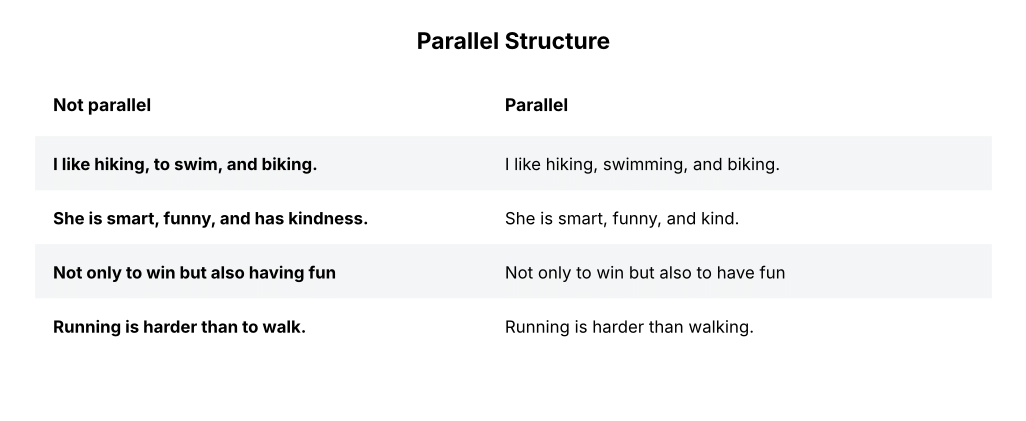
| Not Parallel | Parallel |
|---|---|
| She likes hiking, to swim, and biking. | She likes hiking, swimming, and biking. |
| The job requires patience, creativity, and being on time. | The job requires patience, creativity, and punctuality. |
| He told us to read the chapter and that we should take notes. | He told us to read the chapter and to take notes. |
Parallelism in a Series
When you list three or more items, each one should have the same form. A useful check is to read the sentence with each item alone after the shared opening.
Worked example: “The coach told us to stretch, hydrate, and that we should rest.”
- The shared opening is “told us to.”
- Test: “told us to stretch” works. “told us to hydrate” works. “told us to that we should rest” does not.
- Fix: “The coach told us to stretch, hydrate, and rest.”
Small words such as to, the, and by can appear once before the whole series or before every item, but not before only some of them. “To read, to write, and to speak” and “to read, write, and speak” are both fine. “To read, write, and to speak” is not.
Why does this matter? Parallel structure helps readers see that items belong together. It also gives writing a rhythm that makes speeches and essays easier to remember, which is why so many famous quotations use it.
Paired Ideas with Correlative Conjunctions
Correlative conjunctions come in pairs: either/or, neither/nor, both/and, not only/but also, and whether/or. The words after each half of the pair must match in form.
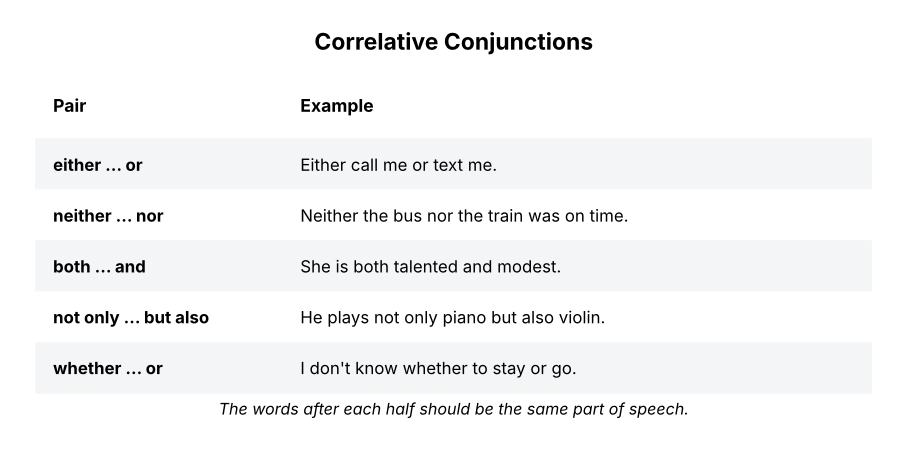
- Not parallel: She is not only a talented singer but also plays the piano.
- Parallel: She not only sings beautifully but also plays the piano.
- Parallel: She is not only a talented singer but also a skilled pianist.
Check where the first conjunction sits. Whatever grammatical form follows it should also follow the second.
Parallelism in Comparisons
Items compared with than or as should also match.
- Not parallel: Swimming is better exercise than to jog.
- Parallel: Swimming is better exercise than jogging.
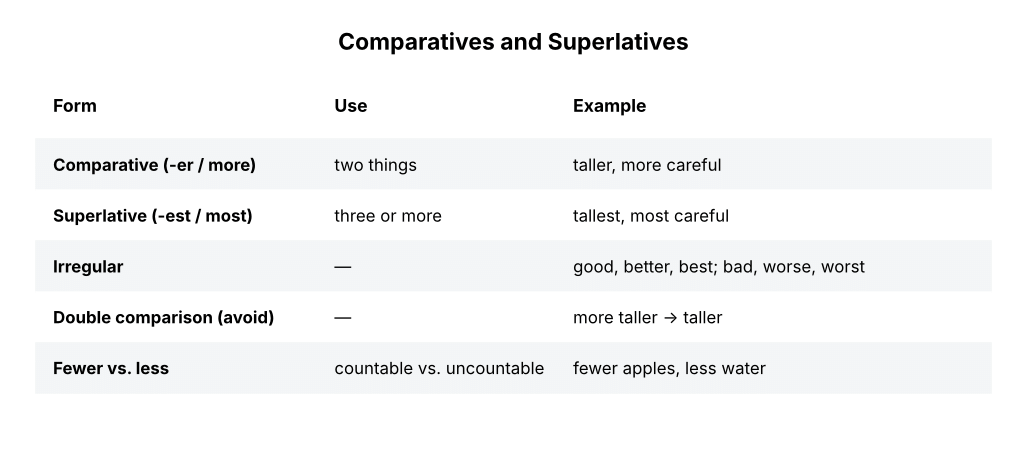
Comparisons must also compare like things. “The population of Texas is larger than California” compares a population to a state. Write “larger than that of California” or “larger than California’s.”
Parallel Clauses
When a sentence pairs two clauses, keep their structure and voice consistent.
- Not parallel: The teacher explained the lesson, and the questions were answered by her.
- Parallel: The teacher explained the lesson and answered the questions.
Parallelism in Famous Writing
Writers and speakers use parallelism for power. Abraham Lincoln’s Gettysburg Address ends with “government of the people, by the people, for the people.” The repeated pattern of preposition plus “the people” makes the line easy to remember. Parallel structure is a grammar rule and a rhetorical device at the same time.
Why does this matter? Faulty parallelism is one of the most common errors tested on the SAT and ACT. It often hides at the end of a long list, where test writers change the form of only the final item.
Test-Taking Strategies
Mnemonic Devices and Memory Shortcuts
“Match the first item.” The form of the first item in a list or pair sets the pattern for all the rest. For correlatives, “what follows the first half must follow the second.”
Cross-Topic Connections
- Paired conjunctions are explained in Topic 3.6: Correlative Conjunctions.
- Series punctuation is in Topic 7.1: Commas.
- Comparison forms are in Topic 3.2: Comparatives and Superlatives.
- Keeping voice consistent connects to Topic 2.7: Active and Passive Voice.
Common Question Formats
- Identify the item in a list that breaks the pattern.
- Choose the revision that makes a sentence parallel.
- Correct a sentence using not only/but also.
- Fix an illogical comparison.
Frequent Student Mistakes
- Mixing -ing forms and to forms in one list.
- Placing not only before a verb and but also before a noun.
- Comparing a thing to a person, such as “my grade” to “Jamal.”
Test-Day Shortcuts
When the underlined portion is the last item in a list, look at the first item and choose the answer that matches its form.
Time Management Tips
Parallelism items on English unit tests and standardized tests such as the SAT and ACT take 20 to 40 seconds. Long lists may need a quick scan of each item.