
“Covered in chocolate sauce, my little brother ate the ice cream.” Was your brother covered in sauce, or was the ice cream? The sentence says the brother, even though the writer almost certainly meant the dessert. Errors like this are called misplaced and dangling modifiers. They can be funny, but they also confuse readers, and they appear on nearly every major English test.
This article covers Topic 5.7: Misplaced and Dangling Modifiers in Unit 5, Sentence Structure. The topic asks you to identify modifiers that describe the wrong word or no word at all and to revise sentences so every modifier is clear.
By the end, you should be able to:
- Define a modifier and explain why placement matters.
- Identify and fix misplaced modifiers.
- Identify and fix dangling modifiers.
- Place limiting words such as only and almost correctly.
What Is a Modifier?
A modifier is a word, phrase, or clause that describes another part of a sentence. Adjectives, adverbs, prepositional phrases, participial phrases, and relative clauses are all modifiers. The basic rule is simple: put a modifier as close as possible to the word it describes.
Misplaced Modifiers
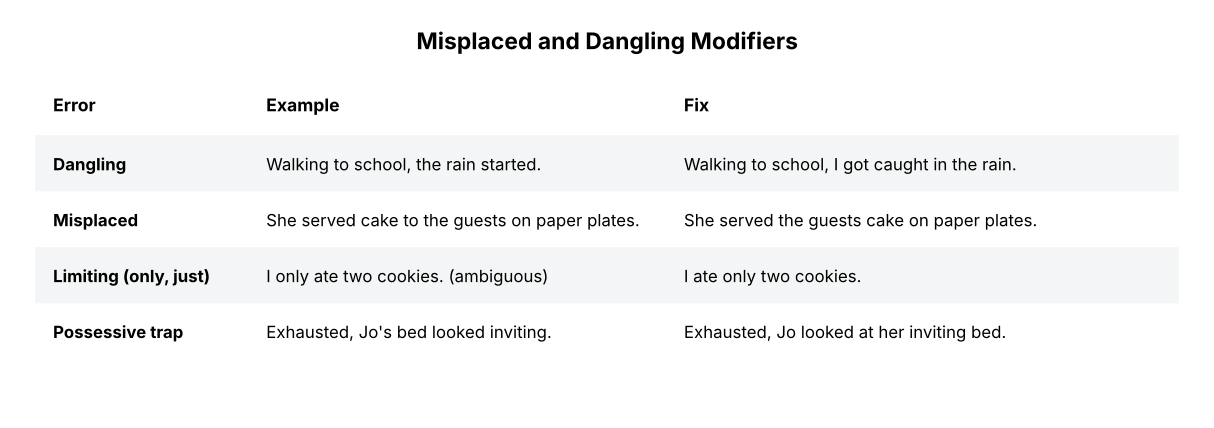
A misplaced modifier describes a word that is in the sentence, but it sits next to the wrong word.
| Misplaced | Revised |
|---|---|
| She served sandwiches to the children on paper plates. | She served the children sandwiches on paper plates. |
| I saw a deer driving to school. | Driving to school, I saw a deer. |
| The museum displayed a vase from ancient Greece that was cracked. | The museum displayed a cracked vase from ancient Greece. |
In each case, the fix is to move the modifier next to the word it describes.
Limiting Modifiers
Words like only, just, almost, nearly, even, and barely change meaning depending on where they go. Each describes the word right after it.
- Only Maria ate the cookies. (No one else ate them.)
- Maria only ate the cookies. (She did nothing else with them.)
- Maria ate only the cookies. (She ate nothing else.)
“I almost ate the whole pizza” means you did not eat any of it, while “I ate almost the whole pizza” means you ate most of it.
Why does this matter? A misplaced only can change the facts of a sentence. In instructions, contracts, and test questions, that difference matters. Careful placement shows exactly what you mean.
Dangling Modifiers
A dangling modifier describes a word that is not in the sentence at all. Dangling modifiers usually appear as introductory phrases.
- Dangling: Walking into the room, the lights were turned on.
Who was walking? The lights cannot walk, and no person is named. The rule is that an introductory modifier describes the subject that comes right after the comma.
Two ways to fix a dangler:
- Name the doer as the subject of the main clause: “Walking into the room, Kai turned on the lights.”
- Turn the phrase into a clause with its own subject: “When Kai walked into the room, the lights were turned on.”
Worked example: Fix “After finishing the test, the room was quiet.”
- Ask who finished the test. No person appears in the sentence.
- Option 1: “After finishing the test, the students sat quietly.”
- Option 2: “After the students finished the test, the room was quiet.”
The Comma Test
For any sentence that starts with a descriptive phrase, look at the first noun or pronoun after the comma. Ask, “Is this the one doing the action in the phrase?” If not, the modifier dangles or is misplaced.
- “Barking loudly, the mail carrier was chased by the dog.” The mail carrier was not barking. Fix: “Barking loudly, the dog chased the mail carrier.”
Why does this matter? Standardized tests love introductory modifiers. Often all four answer choices have the same opening phrase, and only one puts the correct noun right after the comma. Using the comma test lets you eliminate wrong choices in seconds.
Squinting Modifiers
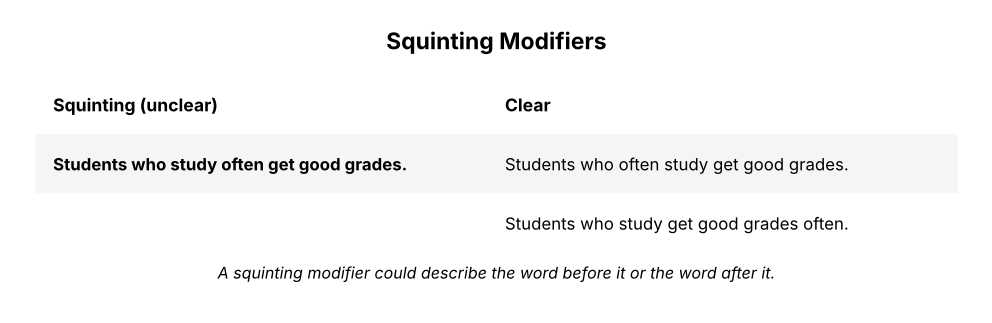
A squinting modifier sits between two words and could describe either. “Students who study often earn high grades” might mean they study often or often earn high grades. Move the modifier to remove the doubt: “Students who often study earn high grades.”
Test-Taking Strategies
Mnemonic Devices and Memory Shortcuts
“Modifiers sit next to what they modify.” For danglers, remember “the doer follows the comma.”
Cross-Topic Connections
- Many modifiers are adjectives and adverbs, as in Topic 3.1: Adjectives and Adverbs.
- Participial phrases are explained in Topic 4.4: Phrases.
- Clause modifiers are in Topic 4.7: Adjective and Relative Clauses.
- Commas after introductory phrases are covered in Topic 7.2: Punctuating Phrases.
Common Question Formats
- Identify the misplaced or dangling modifier in a sentence.
- Choose the revision that places the modifier correctly.
- Complete a sentence that begins with an introductory phrase.
- Explain how moving only changes meaning.
Frequent Student Mistakes
- Fixing a dangler by moving the phrase instead of adding the missing doer.
- Ignoring the placement of only and almost.
- Assuming any sentence that sounds natural is correct.
Test-Day Shortcuts
When a sentence opens with a descriptive phrase and the rest is underlined, ask who is doing the action. Choose the answer that names that person or thing right after the comma.
Time Management Tips
Modifier items on English unit tests and standardized tests such as the SAT and ACT take 20 to 40 seconds. Use the comma test before reading every choice in full.