
Spell-check will happily approve “Their going to except the award,” even though two words in that sentence are wrong. The words their and except are real, correctly spelled English words; they just do not mean what the writer intended. Commonly confused words like these slip past software and into essays every day, and English tests check for them often.
This article covers Topic 6.3: Commonly Confused Words in Unit 6, Agreement and Usage. The topic asks you to distinguish homophones and near-homophones and to choose the word that fits a sentence’s meaning.
By the end, you should be able to:
- Distinguish the most common homophone sets.
- Use contraction tests to choose between pairs like its and it’s.
- Choose correctly between near-homophones such as affect and effect.
- Avoid common usage errors such as could of.
Contractions Versus Possessives
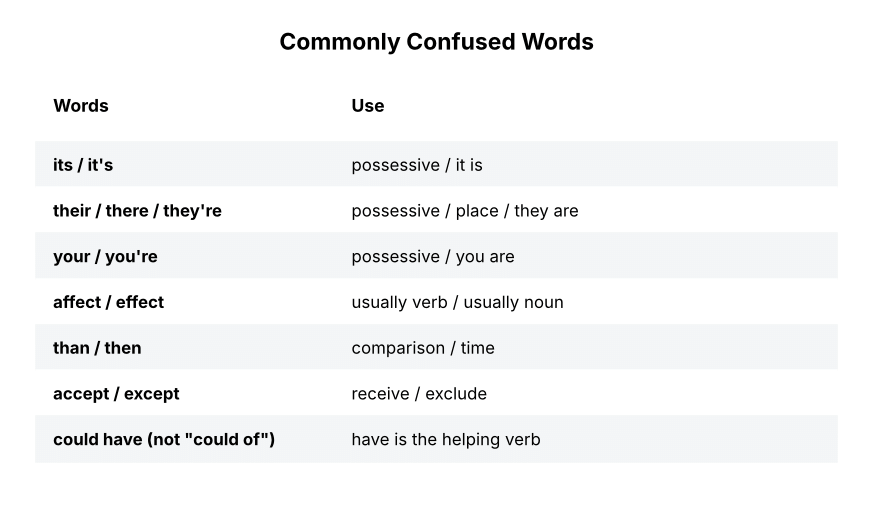
Many confused pairs involve a contraction and a possessive pronoun. Possessive pronouns never use apostrophes.
| Contraction | Meaning | Possessive | Example |
|---|---|---|---|
| it’s | it is / it has | its | It’s clear the dog hurt its paw. |
| they’re | they are | their | They’re proud of their work. |
| you’re | you are | your | You’re leaving your jacket. |
| who’s | who is / who has | whose | Who’s sure whose phone this is? |
The expansion test: replace the word with its two-word version. If “it is” or “they are” makes sense, use the contraction. If not, use the possessive.
Do not forget there, which refers to a place or begins a sentence: “There are three books over there.”
Common Homophones and Near-Homophones
| Pair | Meaning | Example |
|---|---|---|
| to / too / two | direction or infinitive / also or excessively / the number 2 | The two of us went to the show too. |
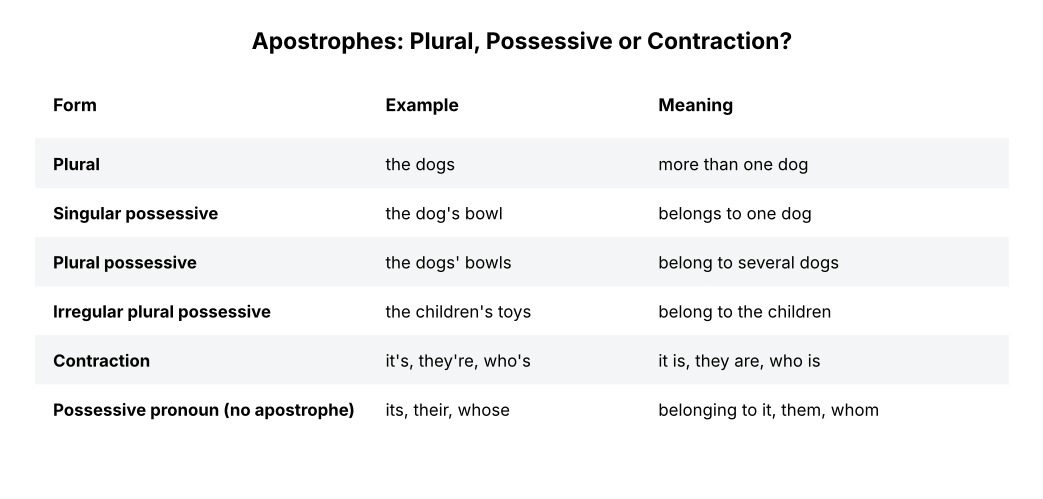
| than / then | comparison / time | Finish lunch, then rest. She is taller than her brother. |
| accept / except | to receive / excluding | I accept every offer except that one. |
| lose / loose | to misplace or fail to win / not tight | If the screw is loose, you may lose it. |
| principal / principle | head of a school or main / a rule or belief | The principal explained the principle of fairness. |
| complement / compliment | to complete / to praise | Her scarf complements her coat; I complimented it. |
| weather / whether | climate conditions / if | We will go whether or not the weather clears. |
Affect and Effect
Usually, affect is a verb meaning “to influence,” and effect is a noun meaning “a result.”
- The cold affected the runners. The cold had an effect on the runners.
Less commonly, effect is a verb meaning “to bring about” (“to effect change”), and affect is a noun used in psychology to mean a displayed emotion. Most tests focus on the common uses.
Why does this matter? These errors cannot be caught by spell-check, so they reveal how carefully a writer has proofread. A single your for you’re in a college or job application can undercut an otherwise strong impression.
Usage Errors That Sound Right
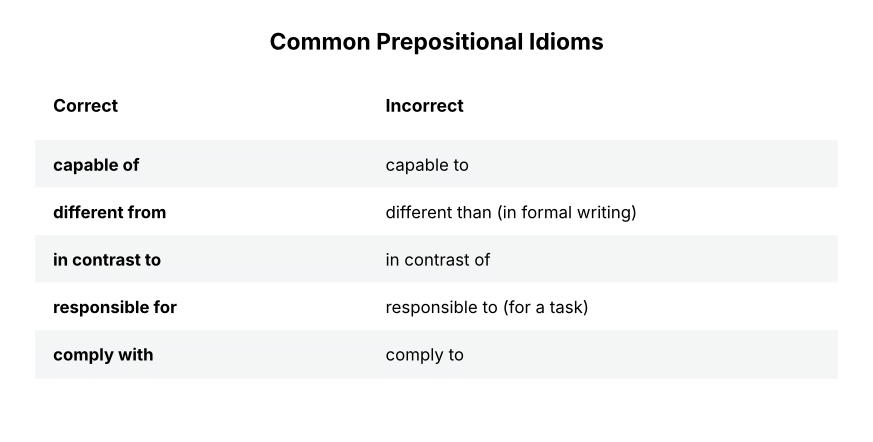
- Could of / should of / would of are always wrong. The correct forms are could have, should have, and would have. The error comes from how “could’ve” sounds aloud.
- Fewer / less: use fewer for things you can count (fewer apples) and less for amounts (less water).
- Good / well: good is an adjective; well is usually an adverb. “She sings well,” not “She sings good.”
- Lie / lay: lie means to recline and takes no object; lay means to place something. “I lie down; I lay the book down.”
Worked Example
Correct the errors: Its to late to except there invitation.
- Its: test “It is to late.” The contraction fits, so use It’s.
- to late: means “excessively late,” so use too.
- except: means “receive,” so use accept.
- there: shows ownership, so use their.
- Corrected: It’s too late to accept their invitation.
Test-Taking Strategies
Mnemonic Devices and Memory Shortcuts
“Affect is an action; effect is an end result.” “The principal is your pal.” “Then is about when.” “Loose has an extra o, like a loose belt with extra room.”
Cross-Topic Connections
- Possessive pronouns are compared in Topic 7.4: Apostrophes and Possessives.
- Good and well are explained in Topic 3.1: Adjectives and Adverbs.
- Than in comparisons is covered in Topic 3.2: Comparatives and Superlatives.
- Who’s and whose connect to Topic 1.8: Pronoun Case.
Common Question Formats
- Choose the correct word to complete a sentence.
- Find the usage error in a sentence or passage.
- Correct multiple homophone errors in one sentence.
- Explain the difference between two similar words.
Frequent Student Mistakes
- Adding an apostrophe to possessive its.
- Writing could of instead of could have.
- Using then in comparisons.
Test-Day Shortcuts
When answer choices differ only by an apostrophe, expand the contraction. If the expanded version does not make sense, choose the version without the apostrophe.
Time Management Tips
Word choice items on English unit tests and standardized tests such as the SAT and ACT take 10 to 20 seconds. Use the saved time on longer revision questions.